
The Art-iest Science
Few figures in history embody the blend of art and science that modern web development lives in quite like Leonardo da Vinci. His notebooks were a running repository of ideas, sketches, and questions—some mundane, many brilliant—captured without much filtering. For those of us building on the web, the lesson is clear: an idea only has value once it leaves your head.
The practice of writing things down, of sketching a thought out of the air and onto paper, has a creative freedom most digital tools don't offer. It allows you to be playful, audacious, or outright wrong. Not everything you produce needs to be a final draft. Outlet and exploration count for far more than perfection in the early stages. That unpolished, sometimes chaotic process is what led da Vinci from shopping lists to flying machines.
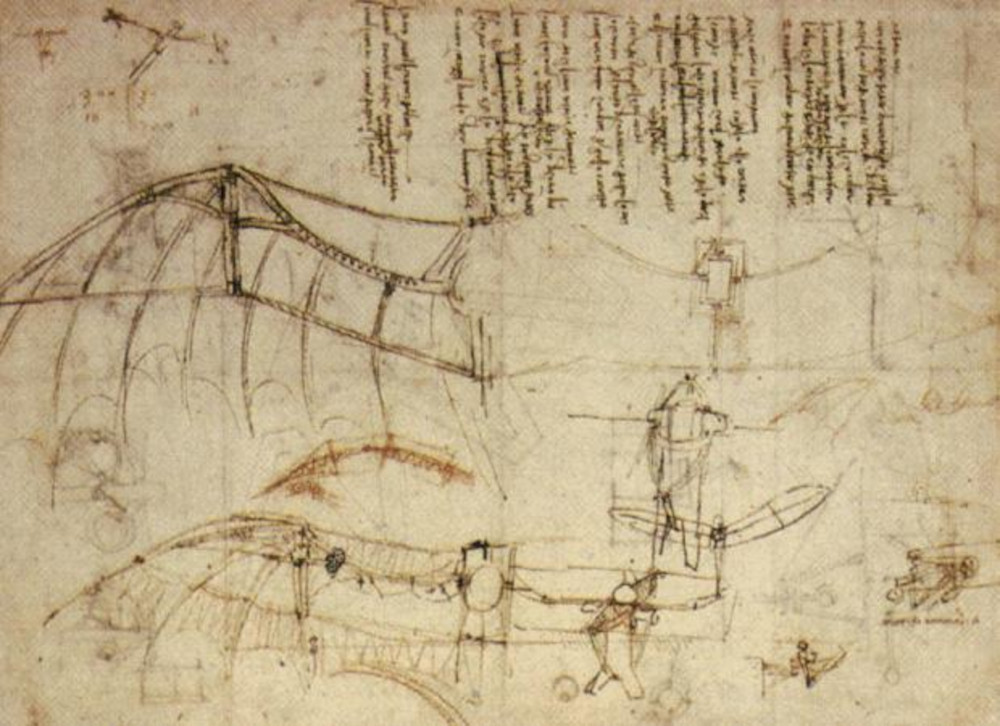
Fleshing out every thought isn't just good for the idea itself; it creates a map of your reasoning. It's easy to treat code like "sand sculptures"—functional and beautiful for a moment, then washed away—but the thinking behind that evolution has real value. Documenting your pull requests, leaving detailed descriptions, and keeping a paper trail of your decisions offers a priceless roadmap for your future self and successors long after you've moved on.
Shape Up Your Code
As the Vitruvian Man demonstrates, da Vinci studied geometry and proportion obsessively, applying these rules to both his paintings and his architecture. He knew that the frameworks underneath a work do not have to be visible to be necessary. Eyeballing a scene wasn't okay. He drew complex grids and diagrams for every adaptation to ensure accuracy and to ground his work in solid mathematical reality.
Web development could use the same rigor. Pages need invisible guidelines to feel organized, whether you're looking at layout grids, responsive breakpoints, or typographic scales. The difference between a site that feels fine and one that feels perfect is almost never about the colors or font choices alone. It’s about the proportion, ratio, and relationship every element shares with the next.

Paying obsessive attention to these structural details is what transforms a bland collection of modules into a cohesive interface. It makes the user experience feel more deliberate, and, ideally, more effortless and intuitive. The study of shape and the strategic use of mathematical structure bring a logic to aesthetics that your users will feel, even if they have no idea why.
Mirror, Mirror
In his private notebooks, da Vinci famously wrote in reverse—using "mirror script," likely so he could write faster and avoid smearing ink simply because he was left-handed. He wrote normally, left to right, only when he expected others to read the work. It wasn't an eccentricity for its own sake; it was a workflow that suited his specific physical needs, so he embraced it without apology.
You don't need to adopt his unusual methods, but you can learn from his attitude toward them. Part of being effective is respecting your own working style. If that means customizing your text editor, switching your keyboard layout, or mapping out design ideas in a physical sketchbook before writing actual CSS, you have the right to do that. There's no end of useful tools and approaches, but there's no one-size-fits-all way to create. What matters is that you work in a way that allows your most natural, fluid thinking to happen.

The norms of an industry aren't mandatory. Creating space for your own methods is likely to make your work feel less like a chore and more like a craft. When you feel less constrained by convention, more unexpected solutions start to surface.
Choose Your Culture
Where you work makes a difference, and da Vinci was particular about it. He sought out cities and rulers with cultures that appreciated his talents. Florence encouraged artists and gave him and contemporaries like Michelangelo room to explore. Milan gave him a platform for his theatricality and inventive stagecraft.
Not all of his patrons were so perfect. He spent time employed by the de' Medici family, yes, but he also spent years working for Cesare Borgia, whose ruthless methods are thought to have inspired Machiavelli's The Prince. Even if it gave him access to new professional arenas like applied cartography, da Vinci preferred to limit his time in such brutal company. At some point, returning to a list of clients who valued your craft over your submission is a necessary move.
In an industry as project-based as tech, you have a bit more power over your environment than you might assume. Always look for teams and companies that provide room to breathe, where you aren't just keeping the lights on for behavior you don't agree with. Find a working culture that values your strange methods and flamboyance, or at least one that doesn't make you feel like a production-fixed cog. If your current situation lacks that, treat your time as a temporary, educational season, and keep your resume sharp for a return to more human company.
Honestly, it's the only way to keep any enthusiasm for solving problems every day.
Great Work Is Never Really Finished
Leonardo da Vinci was, by many accounts, a spectacular procrastinator. He spent years on individual paintings, and some works, like the Mona Lisa, remained in his possession until his death, forever subject to adjustment. The masterpieces we remember are the products of countless experiments, tangents, and iterative refinements that often unfolded over decades.
Consider Leonardo’s Horse, an equestrian monument commissioned in 1482 by the Duke of Milan. For years, da Vinci researched horse anatomy and devised new bronze-casting techniques. The project was never completed in his lifetime, but when his extensive notes resurfaced in the 20th century, the work was renewed. In 1999—517 years after the original commission—the monument was finally unveiled in Milan.
This history offers a lesson for web design: steady, incremental progress often matters more than a flash of inspiration. As Steven Pressfield wrote in The War of Art, “The Muse favors working stiffs.”
For designers and developers, the notion of a truly “finished” product is increasingly quaint. Dependencies require updating, new devices demand accommodation, and user expectations evolve. Rather than a drawback, this is a feature of working on the web. Unlike an architect’s building or a painter’s canvas, the web is infinitely revisable. You can build something, tear it down conceptually, and rebuild it better—not to discard the effort but to evolve it.
Don’t get too attached to what your work looks like today. It is valuable, but it is ultimately a stepping stone. There will always be further refinements to pursue. As da Vinci reportedly said:
“Art is never finished, only abandoned.”
Learning Without Borders
Leonardo defies easy categorization. Painter, sculptor, architect, inventor, scientist—his expertise in one domain informed and elevated his work in others. His anatomical studies made his figures more realistic; his observations of light made his paintings more lifelike. This cross-disciplinary fluency arose in part because he avoided the classical syllabus, preferring to explore subjects on his own terms. His knowledge was fluid and holistic rather than siloed.
Web professionals live in a similarly interconnected ecosystem. The best output emerges when disparate disciplines—design, engineering, psychology, literature, and beyond—are allowed to cross-pollinate.
“Technology alone is not enough—it’s technology married with liberal arts, married with the humanities, that yields us the results that make our heart sing.”
— Steve Jobs
So, experiment with unfamiliar languages, frameworks, and libraries. Read articles in categories outside your comfort zone. Follow the rabbit holes. The web, like art, can never be completed, only left behind for the next iteration.