

Why API Design Principles Matter
Slack launched its platform over five years ago, and since then, more than 885,000 active developers have built apps for the 12 million-plus users who work in Slack daily. With that kind of adoption, the platform team has had to think carefully about how it designs APIs—because once a behavioral contract is released, changing it later is extremely difficult. Developers invest significant time and resources into building on an API, so a poorly designed one can quickly become a liability for both the developer and the company behind it.
Slack hasn't always gotten it right. But by recognizing mistakes, identifying improvement opportunities, and sometimes deliberately staying consistent with past choices that wouldn't be made today, the team has worked to improve the developer experience holistically. An API style guide won't prevent every bad decision, but it helps teams make decisions openly, honestly, and with clarity.
Design Principles for Better APIs
Slack has settled on six principles to guide its API design process. These are the standards against which every new method and feature is evaluated:
Do One Thing and Do It Well
APIs that try to solve too many problems at once become complex and hard to understand. Picking a specific use case keeps an API simple—and simple APIs are easier to scale, more performant, and safer. New features are easy to add, but removing them is hard.
Slack's rtm.start method became a cautionary tale in this regard. Originally designed to return a WebSocket URL along with a broad payload of team, channel, and member data, it grew unwieldy as Slack workspaces scaled. Most developers only needed the WebSocket connection, so Slack introduced rtm.connect, a method that does one thing only: return a session URL without any additional payload. The lesson: while a handful of developers may use all the data a method returns, most want a focused outcome. When in doubt, enforce finite object counts in any collection or paginate them—organic growth makes it harder to introduce sane limits later.
Make It Fast and Easy to Get Started
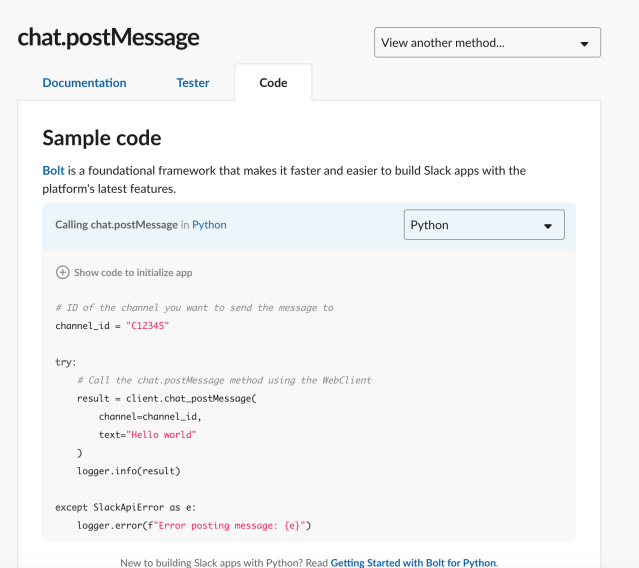
Developers should be able to complete a "Hello world" exercise quickly, and Slack uses "Time to First Hello World" as a metric to evaluate how easy this is. The platform team aims for entry-level developers to learn about the platform, create an app, and send their first API call within about 15 minutes—though the target will vary by platform and audience.
Getting started guides, tutorials, sample code, and interactive documentation are essential. Slack's documentation includes an API tester for trying out endpoints in a browser, and the SDK collection includes code snippets in multiple languages that plug directly into applications. But getting past "Hello world" matters, too. Slack considers it important for developers to get their app in front of another user or reach a point of interactivity beyond broadcasting a message. While designing documentation, teams should ask themselves what goals developers need to accomplish on the platform.
Strive for Intuitive Consistency
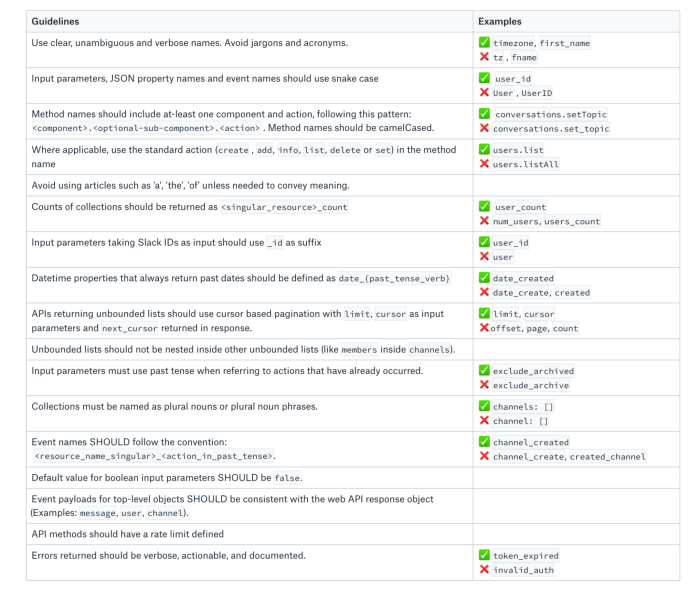
APIs should be intuititively consistent across endpoint names, input parameters, and output responses. Developers should be able to guess parts of an API without reading documentation. Slack identifies three levels of consistency to maintain:
- Consistency with industry standards: adhere to accepted best practices
- Consistency with your product: use field names based on concepts from the product itself, avoiding abbreviations and jargon
- Consistency with your other API methods: naming should be uniform across all methods
Writing down API design guidelines is one of the best ways to achieve consistency, especially when there's no single correct answer. Pick a side and stick with it. Slack maintains comprehensive guidelines that codify its practices and patterns.
Return Meaningful Errors
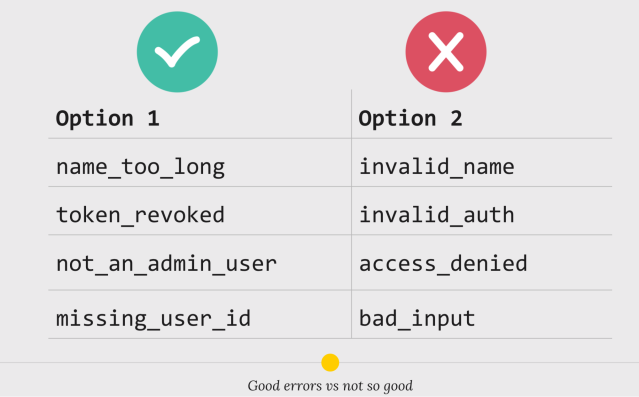
Error handling is often an afterthought during API design, but incorrect or unclear errors frustrate developers and hurt adoption. Good errors are easy to understand, unambiguous, and actionable, without leaking implementation details. In addition to error codes, longer-form error descriptions—including human-readable explanations and links to more information—should be available either in documentation or as part of the API response.
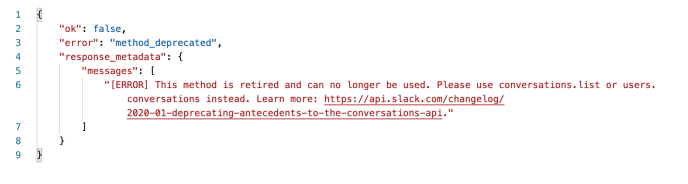
SDKs shouldn't swallow or obscure error messages. Developers need access to anything useful in a debugging session, like HTTP headers and raw request bodies. An SDK can interpret errors to make them more useful, but developers should also be able to pinpoint an error using raw API documentation.
Design for Scale and Performance
Bad design limits performance. Large datasets should be paginated rather than returned in a single call; big collections shouldn't be nested inside other big collections, since pagination becomes too complicated; and rate limits protect infrastructure from misbehaving developers or runaway code loops.
Slack's retired channels.list method returned channels along with all members in each channel—nesting a collection within another. That design assumed teams would be limited to a few hundred users. As workspaces grew to tens of thousands of members, the API structure became too expensive to support. Slack split it into conversations.list and conversations.members, improving performance and developer experience simultaneously.
The pattern of the mistake is the same across many API issues: "good enough" for the API's own creators usually isn't good enough for everyone else. API designers can't predict how developers will use their product, but they still need to anticipate possibilities their own assumptions obscure.
Avoid Breaking Changes
A breaking change stops existing apps from functioning as they did before. Slack's philosophy is that what worked yesterday should work tomorrow. When breaking changes are unavoidable—in rare, exceptional cases—the notice period and migration support depend on the number of affected users and the degree of difficulty for developers to adapt. Developers shouldn't be asked to handle breaking changes every few months.
No communications plan is complete, however, without addressing unanticipated breaking changes. Teams should have an apologetic response plan for a change that can't be rolled back, even if it wasn't supposed to happen in the first place.
From spec to release: Slack’s internal review pipeline
Principles alone don’t keep an API consistent—process does. Slack’s workflow for building public APIs forces teams to think through design before code exists and to collect input from both internal and external stakeholders along the way.
Start with a spec
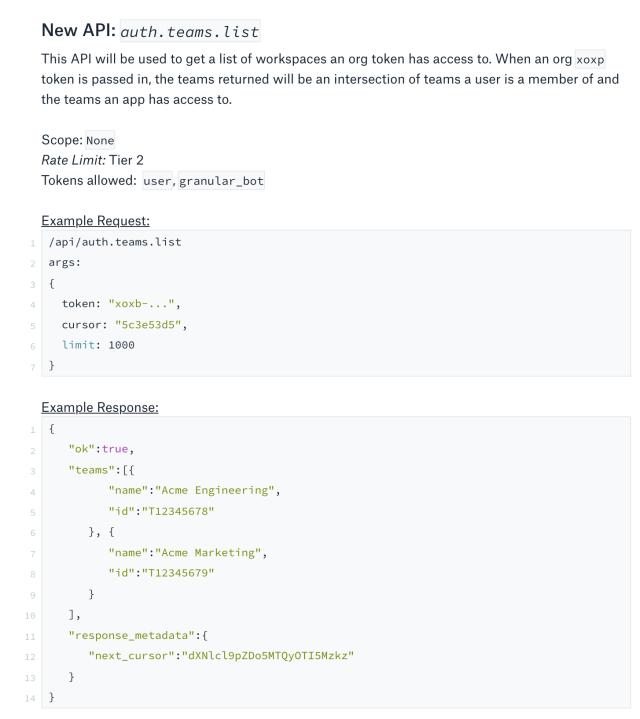
Once a team has defined the problem and use cases for an API, the first artifact they produce is a spec. This document captures method names, purpose, example requests and responses, and possible errors. It serves as a shared draft that keeps the whole team aligned on what the API exposes and why.
Teams that want to go further can write JSON schemas or use public formats like OpenAPI or AsyncAPI. This lets you prototype the API before implementation, and publishing schemas can help developers build tooling ahead of time. The trade-off is real, though: keeping specs current is a ongoing maintenance burden Slack itself acknowledges it could handle better.
Review before you code
Finding design flaws after implementation is expensive. That’s why Slack engineers share their API specs in an internal channel dedicated to API decisions. The audience is deliberately cross-functional—people from developer relations, engineering, product management, developer support, partner engineering, and security all weigh in on the proposal. For changes that need more depth, Slack holds regular API office hours where the group examines consistency with existing APIs, alignment with design guidelines, naming, usability, security, and performance.
Bring partners in early
Internal review isn’t the only checkpoint. Slack shares the draft spec with the partners who are the ideal developers for the API. Their feedback validates that the API actually solves the intended problem and reveals which aspects need improvement. Doing this before any code is written makes iteration cheap and the final design noticeably better.
After that comes beta testing. Selected partners get early access to integrate the API into their products and give detailed feedback. That final round of input lets Slack fix issues and refine the design before the public release.
Principles bend, spirit doesn’t
A team that has written design guidelines and reviews APIs against them will quickly internalize those rules. And just as quickly, they’ll hit cases that don’t fit the predicted patterns.
Some of those cases require compromises against your own advice—sometimes to serve internal engineering needs, sometimes in pursuit of consistency that still disappoints. But occasionally a genuinely novel API comes along that doesn’t match any template you’ve planned for. In those moments, following the spirit of your guidelines instead of the letter can unblock cross-functional partners and move the platform forward. There’s always time to codify the precise rules after the design works.
What to take away
Designing intuitive, consistent, and easy-to-use APIs is genuinely difficult. Slack’s approach comes down to three habits: invest in design work before implementation, be deliberate about every design choice, and seek feedback from many perspectives—both inside and outside the company.