
The Hidden Friction in Real-Time Interfaces
Streaming UIs seem simple on paper—content arrives, the UI updates, the user reads. In practice, keeping those interfaces stable and comfortable is a constant battle against three distinct forces.
The first is scroll. Most streaming interfaces pin the viewport to the bottom, which works fine for passive viewing. The moment a user scrolls up to re-read something, the interface yanks them back down. The page made a decision about where attention should be, overriding the user's intent.
The second is layout shift. Streaming containers constantly grow, pushing everything below them downward. A button you aimed for is no longer there. A line you were reading moved. Nothing is broken, but nothing stays still long enough to interact with comfortably.
The third is render frequency. Browsers paint roughly 60 times per second, but streams can deliver data much faster. Updating the DOM for frames the user will never see quietly adds up until performance starts to slip.
These issues manifest across very different interfaces. In an AI chat response, the message grows token by token. In a live log viewer, new lines append continuously. In a real-time metrics dashboard, numbers and charts refresh in place. Each presents the same underlying instability in different clothing.
Common Failure Patterns
In the chat interface, the most noticeable problem is that auto-scrolling never lets go. Even when you scroll upward to review streamed content, the UI pulls you back down to the latest update. This takes you out of context and prevents you from digesting content at your own pace.
The log viewer shows the same dynamic from a different angle. With a "tail" toggle enabled, the UI follows new content and prevents upward scrolling entirely. To explore the content, you have to stop the stream or disable the tail—the interface doesn't trust you to manage your own position.
These aren't bugs in the traditional sense, but accessibility issues that affect all users. They emerge from UX decisions made implicitly rather than deliberately, and they can be fixed with careful planning.
Predictable Auto-Scroll
The goal is straightforward: auto-scroll when the user is at the bottom, stop when they scroll up, and resume when they return to the bottom. Tracking this requires a small flag set whenever the user manually changes the scroll position.
A threshold of around 60px is critical. Without it, a tiny layout change—like a single new line—could briefly create a gap, breaking auto-scroll even though the user never actually scrolled. Auto-scroll should only trigger when the user's scroll position is essentially equal to the stream's total scroll height.
One detail is easy to miss: the scroll flag must be reset when a new stream begins. A single scroll during one message can otherwise silently disable auto-scroll for the entire next one.
Write Into Live Nodes, Not Rebuilt DOM
In the chat example, a subtle artifact appears beyond the scroll struggle: cursor flicker. The rendering code wipes innerHTML and recreates every element on every tick. The cursor is destroyed and re-added dozens of times per second. At normal speed it's hard to see; slow the stream to around 30ms and the persistent flicker becomes obvious.
The destructive rebuild pattern, running on every incoming character, works but is expensive. Every update wipes the DOM and rebuilds it, forcing layout recalculation each time. That constant reconstruction is what causes the layout to shift even when no actual content above the fold has changed.
A cheaper approach: create a single paragraph with an empty text node up front, then write directly into that live node. For each regular character, extend the text node by one character—the browser updates the text without recalculating layout for everything else. For a newline, create a fresh paragraph and move the current reference forward. Layout recalculates once for that new paragraph, and nothing else. This pattern eliminates the flicker because the cursor node is never removed and re-added.
Batch Updates to Be Frame-Sensitive
Even with efficient node updates, writing to the DOM on every incoming character is wasteful, especially at high stream speeds. The fix is to hold incoming text in a buffer instead of rendering it immediately, then flush everything once per frame.
The mechanics are simple. Keep a character buffer and a flag indicating whether a flush is already scheduled. When a character arrives, add it to the buffer. If no frame is scheduled yet, queue one. The flag prevents every character from scheduling its own frame, which would produce dozens of redundant flushes per second.
When the frame fires, it drains the buffer in a single pass. All characters that arrived since the last paint are rendered together right before the browser draws them. Then the buffer is cleared, the flag is reset, and auto-scroll runs exactly once. This separation decouples two things previously tied together: the rate at which data arrives and the rate at which the UI updates. The visual result appears identical, but the browser does far less work, which becomes noticeable at faster stream speeds.
After applying this buffering pattern, an important behavior emerges: when the gap between the scroll position and the bottom grows, the interface assumes the user scrolled up and stops auto-scrolling. Small gaps keep the stream following content; larger ones stop it. The threshold absorbs jitter from new lines slightly changing the container height.
Beyond the Basics
Together, these changes—respecting scroll intent, writing into live nodes, and batched per-frame rendering—transform a streaming interface from something that reacts blindly to every update into something the user can read, control, and tolerate. The work is incremental, but the collective effect is substantial.
These adjustments address the visible friction, but they are only part of the story. A complete solution must also account for edge conditions: what happens when a stream is canceled mid-flow? How should the interface respect reduced-motion preferences? Does the shifting content remain navigable via keyboard and compatible with screen readers? Those states require their own deliberate design.
Stopping a Stream Without Leaving the UI in Limbo
Most streaming interfaces offer a way to halt output, but the common implementation only cancels the timer. That leaves a cursor blinking, buttons stuck, and a message frozen mid-sentence with no hint that it didn’t finish. Clean stop handling requires four steps: cancel the render loop, flush any pending buffer, remove the cursor, and mark the response as incomplete.
First, cancel the timer and flip the isStreaming flag so no further ticks execute. Then clear the requestAnimationFrame (RAF) buffer to prevent queued characters from being written after the stop signal.
function stopStream() {
  clearTimeout(streamTimer);
  isStreaming = false;
  pending     = '';
  rafQueued   = false;
}
Clearing the pending property is essential because characters may remain buffered from the last stream that haven't been flushed. If left intact, the next RAF callback will drain that buffer and write stale characters into the DOM after the stream is officially done.
Next, remove the cursor by calling markStopped on the bubble element.
if (cursorEl && cursorEl.parentNode) cursorEl.remove();
  markStopped(aiBubble);

  stopBtn.style.display  = 'none';
  retryBtn.style.display = '';
  playBtn.style.display  = '';
  setStatus('Stopped', 'stopped');
  chat.removeEventListener('scroll', onScroll);
}
The cursorEl.parentNode check guards against calling on an already-detached node. stopStream gets invoked internally when a new message interrupts an active stream, at which point the cursor may not exist. Removing a detached node throws an error, so verify first.
The markStopped method appends a label at the bubble's bottom, informing the user the output was truncated.
function markStopped(bubble) {
  if (!bubble) return;
  bubble.classList.add('stopped');

  const label = document.createElement('span');
  label.className = 'stopped-label';
  label.textContent = 'response stopped';
  bubble.appendChild(label);
}
The null check on bubble covers the edge case where a stop request arrives before the AI message element initializes — possible if the user clicks stop during the delay before the bubble renders.
Rebuilding State for Retry and Interruptions
When a stream halts due to a network failure or other error, the user deserves a direct path to retry without reloading the page, scrolling back up, and retyping the original question. This requires retaining the prompt when the stream begins:
let lastQuestion = '';

function startStream(question, answer) {
  lastQuestion = question;
  // rest of setup...
}
On retry, reset all state and start over cleanly.
function retryStream() {
  if (currentMsgEl && currentMsgEl.parentNode) {
    currentMsgEl.remove();
  }

  charIndex    = 0;
  userScrolled = false;
  pending      = '';
  rafQueued    = false;
  isStreaming  = true;

  retryBtn.style.display = 'none';
  stopBtn.style.display  = '';
  setStatus('Streaming...', 'streaming');

  chat.addEventListener('scroll', onScroll, { passive: true });

  setTimeout(() => {
    initAIMsg();
    tick(lastAnswer);
  }, 200);
}
Complete reset is mandatory — every piece of state must return to its initial value as if launching a fresh stream. Remove the entire message row (currentMsgEl) rather than just the bubble; leaving the wrapper and avatar behind breaks the layout structure.
Interrupting With a New Message
Sending a new message while another stream is active creates two write loops operating concurrently, mixing characters from different responses. Always stop the current stream before initiating a new one:
function startStream(question, answer) {
  if (isStreaming) {
    clearTimeout(streamTimer);
    isStreaming = false;
    pending     = '';
    rafQueued   = false;
    if (cursorEl && cursorEl.parentNode) cursorEl.remove();
    chat.removeEventListener('scroll', onScroll);
  }

  // now reset and start fresh
  charIndex    = 0;
  userScrolled = false;
  isStreaming  = true;
  lastQuestion = question;
  // ...
}
Inline cleanup is used here instead of calling stopStream, since that function also appends the “response stopped” label and resets buttons. The integrated demo wires up all three behaviors so users can start a stream, interrupt it, see the cursor vanish, view the label, and access a closeable retry option.

Supporting Assisted and Keyboard Navigation
Screen readers do not announce content that appears dynamically unless explicitly told to. A streaming interface where text accumulates naturally produces silence for assistive tech users. The aria-live attribute instructs the browser to watch a container and broadcast updates as they are injected.
<div
  id="chat"
  role="log"
  aria-live="polite"
  aria-atomic="false"
  aria-label="Chat messages"
></div>
role="log"declares the container as a running transcript, prompting assistive tools to handle changes as a live stream. Explicit declaration ensures consistent behavior across tools.aria-atomic="false"limits announcements to only newly added content. Without it, some screen readers repeat the entire message with every update.aria-live="polite"queues announcements so they do not interrupt current speech. Useassertivesparingly for critical items like errors.
The “Response Stopped” label already gains an announcement because it lands inside a polite live region — no extra ARIA is required on that element.
The Retry button needs context beyond the word “Retry.” Attach an aria-label including the original question:
retryBtn.setAttribute(
  'aria-label',
  `Retry: ${lastQuestion.slice(0, 60)}`
);
Set that label programmatically when the button appears, not during page load:
retryBtn.style.display = 'inline-block';
retryBtn.setAttribute(
  'aria-label',
  `Retry: ${lastQuestion.slice(0, 60)}`
);
After stopping, invoke retryBtn.focus() so keyboard users can immediately continue without tabbing around to find the next action. Validate this with real assistive tools such as NVDA or VoiceOver — DevTools exposes the accessibility tree but not how the content sounds.
Keyboard Reach and Visual Focus
All controls must remain keyboard-reachable while the stream is live. The Stop button is the critical one — for keyboard-only users, Tab + Enter may be the only escape hatch. Hiding controls with display: none safely removes them from the tab order, but opacity: 0 or visibility: hidden still leaves them focusable, trapping users on invisible elements.
Apply :focus-visible to show focus rings for keyboard interaction while avoiding the ring for mouse clicks.
btn:focus-visible {
  outline: 2px solid #1d9e75;
  outline-offset: 2px;
}
Mark the animated cursor with aria-hidden="true" — it exists purely for visual feedback and would otherwise be read by screen readers as irrelevant text.
Reducing Motion for Sensitive Users
Typewriter effects produce constant motion. For users with vestibular disorders, this can be mentally and physically taxing. The prefers-reduced-motion media query informs detection based on OS-level preferences. The cleanest approach for streaming: skip animation entirely and render the full response at once. Content is identical; only the movement is removed.
const reducedMotion = window.matchMedia(
  '(prefers-reduced-motion: reduce)'
).matches;
if (reducedMotion) {
  initAIMsg();
  for (const char of text) appendChar(char);
  if (cursorEl && cursorEl.parentNode) cursorEl.remove();
  done();
  return;
}
tick(text); // normal animation
CSS must also disable the cursor blink — even a blinking element qualifies as flashing content per WCAG guidelines.
@media (prefers-reduced-motion: reduce) {
  .cursor { animation: none; opacity: 1; }
}
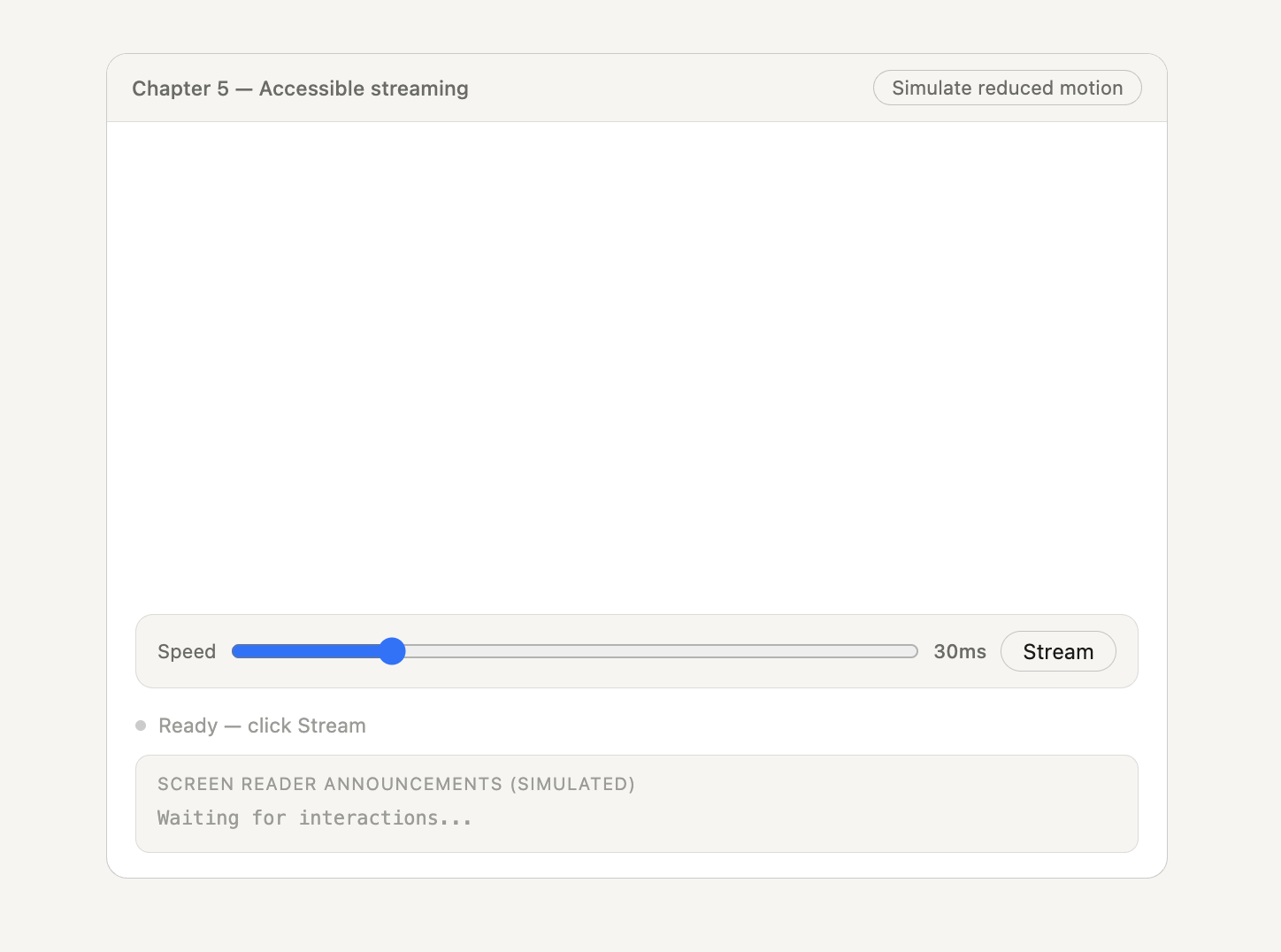
The full demo combines every pattern discussed above, including a reduced-motion toggle to preview the instant-render mode:
Essential Patterns for Dependable Streaming Interfaces
Transporting data over a stream is no longer the challenge. The fragility now lives in the interface surrounding it. As content arrives continuously, interactions with scroll position, layout stability, render scheduling, and user controls all become points of failure if poorly handled.
The patterns that hold up are:
- Refraining from forcing scroll position,
- Updating only the elements whose content actually changed,
- Batching writes within a single animation frame,
- Implementing deliberate stop and retry flows,
- Designing for accessibility from the start.
Not every streaming UI demands every one of these techniques. But when streams are involved, these are the places where failures typically surface first.
Further Reading
- Using Server-Sent Events — the underlying transport layer for opening connections, handling events, and planning reconnects.
- Streams API — for cases where
fetchneeds more granular control than SSE offers. - Chrome DevTools Performance panel — for visualizing layout recalculations and paint costs during streaming updates.
- How Large DOM Sizes Affect Interactivity, And What You Can Do About It, Jeremy Wagner — on controlling DOM scope in long-lived streaming sessions.