How Microsoft and Figma Reshape the Collaboration Landscape
Jon Friedman, Microsoft’s corporate vice president of design and research, sat down for a conversation on the heels of Figma’s integration with Microsoft Teams. The discussion sheds light on how two design-heavy organizations approach the growing overlap between workflow tools and creative platforms, and where collaboration technology is headed next.
From File Sharing to Multipurpose Hubs
Friedman reflects on the evolution of collaboration tools, noting that the early days of cloud-based document sharing were centered on file storage and status updates. Today, the focus has shifted toward shared spaces where participants control content and context simultaneously. This shift has made design a critical component of any organizational workflow.
Design systems, built components and shared libraries reduce redundancy across an organization and enable faster, more consistent output. According to Friedman, investing in reusable components and scalable design languages improves an organization's agility and helps products compete in a crowded market.
Research also plays a foundational role. Friedman notes that understanding user behavior and validating early hypotheses gives teams license to iterate and pivot before committing to build. In his view, research-driven teams deliver stronger, defensible products and maintain more productive cross-functional alignment.
Why Integrations Matter for the Next Generation of Design
Friedman emphasizes that integrations are becoming the new workbench—not optional add-ons to a design stack, but central connectors for effective communication.
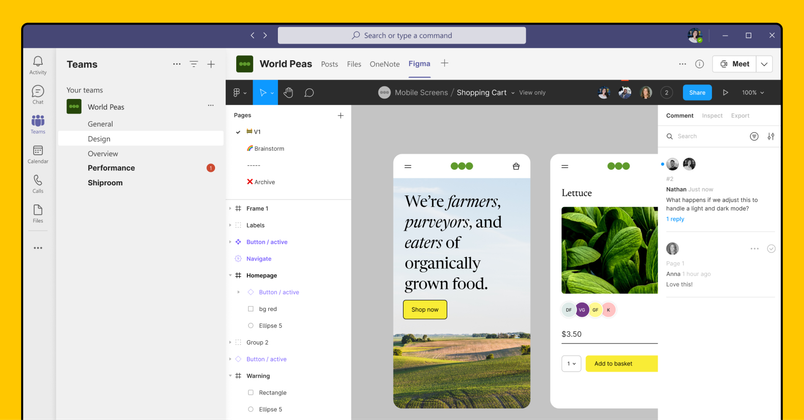
With Figma’s integration into Microsoft Teams, designers and their colleagues no longer need to toggle between separate contexts to reach prototypes, share feedback or align on next steps. Integration bridges two realities: the tool where visual decisions happen and the hub where business conversations occur.
One key consideration for bringing tools like these together is understanding where decisions are made, who holds context, and how artifact ownership and permissions interplay across platforms. Friedman praises Figma for considering these factors carefully in its collaboration features, making it natural for teams to give design presence in everyday conversations.
Friedman notes that curation is essential to collaboration: bringing useful context to a shared space is more powerful than dumping endless files there. This is especially true for enterprise teams, where complexity and scale demand focus rather than more noise.
The Future of Remote and Hybrid Collaboration
Friedman expects collaboration technology to become more inclusive, incorporating asynchronous work and richer presence mechanisms. New generations of cloud-powered platforms are enabling users to co-edit, share media, and make decisions without needing the same inputs as everyone else or occupying the same timezone.
He believes the future will involve cross-tool workflows that rely less on rigid space boundaries and more on context hopping between complementary platforms. In this future, seeing the same design artifact synchronously, with both conversation and content on the same canvas, will simplify shared understanding dramatically.
Key Takeaways for Product Teams
Friedman distills important lessons from Microsoft’s integration journey for product teams considering system collaborations:
- Evaluate comprehensive user journeys and understand where collaboration breaks down ahead of time.
- Align incentives across partners to design purposeful features that solve shared challenges.
- Consider both synchronous and asynchronous workflows from the beginning to maximize inclusion.
- Lean into research loops to confirm direction and uncover pain points early.
- Approach privacy, security and permissioning as foundational architecture rather than compliance padding.
Friedman’s message is consistent with Figma’s own: despite tool fragmentation, design technology is taking on a central role in an increasingly collaborative workplace—and integration is shaping how and where our next big ideas travel. Tools that provide seamless interoperability could be what help teams deliver extraordinary products at enterprise scale.
The opinions expressed here are solely those of the author and do not necessarily reflect those of Tech Report.
Design systems, hybrid work, and the multiplayer nature of creation
Microsoft’s Jon Friedman has spent years thinking about how teams actually create together. As Corporate Vice President of Design & Research, he’s watched collaboration move from siloed handoffs to shared ecosystems where design, engineering, and product tools sit side by side. With Figma now fully integrated into Microsoft Teams, he sees that evolution entering a new phase — one where the boundaries between tools, and between people, matter less every day.
Remote work’s long runway
Friedman doesn’t claim to have predicted the pandemic, but he says the shift to hybrid work didn’t come out of nowhere. Long before COVID-19, Microsoft was already grappling with a simple observation: great talent exists far beyond any single office location. That realization, paired with a growing question about why someone in New York shouldn’t be promoted just because they aren’t in Redmond, pushed the company to think seriously about how remote work could succeed.
Those early, mostly academic efforts became practical overnight when the pandemic hit. “We were able to put a lot of these lessons into practice,” Friedman says.
What virtual tools get right — and what they miss
Friedman sees a paradox in today’s collaboration landscape. Tools like Figma and Teams are often more effective than in-person meetings because they flatten hierarchy and give everyone an equal voice. But that doesn’t mean the physical world has lost its purpose.
“The big question for us next is: what is in-person for?” he says. Virtual work captures scheduled interactions well, but it still can’t fully replace the richness of unplanned human connection. He recalls meeting a newer employee for coffee for the first time mid-pandemic. "I saw what they actually looked like," he says. Those subtle cues — mannerisms, style, presence — are signals our brains are wired to read, and they build bonds that tools alone can’t replicate.
The case for design systems over pixel-perfect pride
Getting a company to adopt a design system is often a cultural battle, not a technical one. Friedman remembers pitching the idea to his design team with some hesitation, worried he was telling a room of creatives they couldn’t design every pixel anymore. Instead, the room erupted with excitement.
The real pitch wasn’t about restrictions. It was about freedom: stop reinventing the wheel, and focus energy on what genuinely matters. A strong design system or a good set of tools lets creators build on what’s already good. When design conversations happen in tandem with chat and video, whether in real time or asynchronously, the result is better than anything a solo contributor could produce in isolation.
Microsoft’s own use of Figma as a core tool, alongside Teams, has helped push the company toward what Friedman calls "building together" as a default mode.
Scaling design across a sprawling portfolio
Design systems only work at Microsoft’s scale if they’re built to adapt. Friedman describes a hub-and-spoke model, where central teams set direction but local teams hold real power and accountability. Neither half works without the other.
But spokes can’t just consume the system — they have to be able to influence it. When a local team invents a better approach, the process for cascading that change across an entire portfolio has to be easy. That’s a tall order for a company whose products range from decades old to brand new, spanning every platform imaginable.
Microsoft’s current answer is design tokens integrated into its Fluent controls. Tokens connect Figma designs directly to multiple code bases, making change fluid and fast. The promise, Friedman says, is that design is no longer the bottleneck. Teams outside the central design group can play on equal footing and push changes across a wide swath of products without bureaucratic friction.
Shared language starts with shared artifacts
Tools won’t solve every collaboration problem. Friedman has long advised designers to bring even a rough drawing into conversations, because it forces discussion into a concrete focus. Words alone leave too much to individual interpretation.
He frames this as a form of active listening. Put something imperfect in front of people, and you invite reactions that might surprise you. Sometimes the most interesting ideas come from someone misunderstanding what you meant and heading off in an unexpected direction. If tools, culture, and process don’t actively encourage that kind of exchange, Friedman worries we lose the very thing that drives human creativity forward.
Design is inherently multiplayer
Friedman draws a firm line between art and design. Art can be a solo expression, but design never is. "There is no world where anyone really designed something on their own," he says.
Every design process follows the same rhythm: diverge alone, converge together. These convergence points — critiques, reviews, user tests — are always multidisciplinary. Whatever you’re building, you’re building on the work and input of others at every stage.
Tools that enable conscious creation
Figma and Teams serve different purposes, but together they mirror the natural ebb and flow of design work. One moment you’re deep in a flow state, creating in isolation; the next you’re sharing that work, getting asynchronous feedback, and reconvening to talk it through. Friedman believes that pairing is uniquely powerful because it gives teams the serendipity of creation in a collaborative environment.
For him, the ultimate point isn’t the tools themselves. It’s what they enable. "We have to help people design better and help empower people first," he says. Designers shouldn’t fear that accessible systems and shared tools make them obsolete — they make design more accessible to everyone.
Figma for the whole design loop
Figma moves design work from a handoff into a living collaboration. Instead of exporting static files, teams work in a shared canvas where feedback, iteration, and delivery happen in one place. Commenting works directly on the design, so stakeholders mark up screens without leaving the document, and developers inspect specs with precise measurements and CSS values without interrupting the flow.
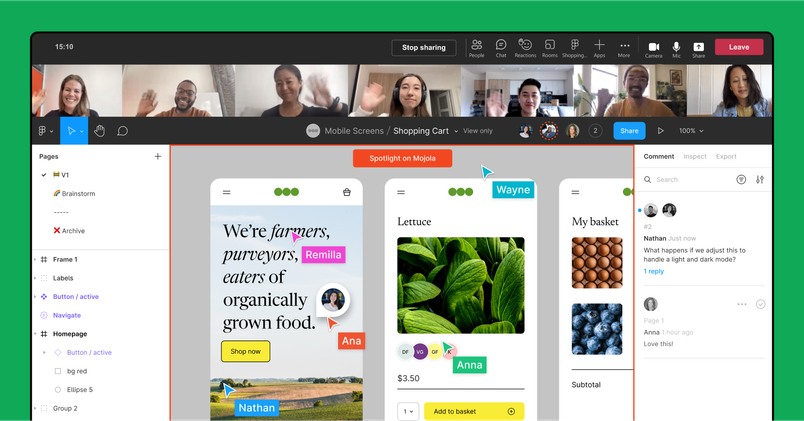
The platform is built for concurrent work. Multiple people can edit the same file at the same time, and multiplayer cursors show exactly where each collaborator is active. Branching and versioning let teams explore options or work in parallel without overwriting each other. When a change ships to the main file, updates propagate automatically to every linked context.
From wireframe to shipped product
- Shared libraries keep components, variables, and styles consistent, so teams never chase stale design tokens.
- Design-to-code handoff embeds specifications where developers already work, reducing the back-and-forth of manual handoff.
- Live comments and mentions turn review cycles into conversations with clear owners and next actions.