AI Cloud pushes agents from prototype to production
Vercel's Ship AI event last week introduced a new wave of SDKs, infrastructure, and open source templates aimed at making production-ready agents as straightforward to build as standard application features. The common thread across the announcements: defining intelligent workflows once and letting the underlying platform handle reuse, reliability, and scaling.
AI SDK 6 introduces reusable agent abstraction
Now in beta, AI SDK 6 moves beyond prompt-and-API wiring with a proper agent abstraction that can be defined once and deployed across any application or workflow. Alongside this, the release brings built-in human-in-the-loop review through a tool approval system. Any action that needs human sign-off can be gated by defining a tool with needsApproval: true, which pauses the agent until someone confirms.
const weather = tool({
description: 'Get the weather in a city',
inputSchema: z.object({ city: z.string() }),
needsApproval: true, // approval gate
execute: async ({ city }) => {
const weather = await fetchWeather(city);
return weather;
},
});
// Agent that can call the approved tool in a loop
export const agent = new ToolLoopAgent({
model: "openai/gpt-5",
instructions: 'You are a concise weather assistant.',
tools: { weather },
});
Type safety runs end-to-end across models and UI, and the beta is available via npm i ai@beta.
Vercel Marketplace adds agents and AI services
Production-ready agents can now be discovered, installed, and connected to projects directly through the Vercel Marketplace. Development workflow automation comes from agents such as CodeRabbit, Corridor, and Sourcery, while integrations from Autonoma, Braintrust, Browser Use, Chatbase, Descope, Kernel, Kubiks, and Mixedbread provide model access, analytics, and observability in one place.


The integrations share unified billing, native observability, and managed credentials, easing the operational overhead of building on a distributed AI toolchain.
Workflow Development Kit adds reliability-as-code
Long-running processes that require retries, background steps, and recoverable state traditionally force you to cobble together message queues, schedulers, and state storage. The Workflow Development Kit's use workflow construct encodes that durability into plain TypeScript functions, which then automatically gain retry behavior for failed steps, persisted execution progress, and per-run observability. The kit is open source and platform-agnostic, suited to AI agent loops, data pipelines, and commerce workflows that need to survive crashes and resume at the exact stopping point.


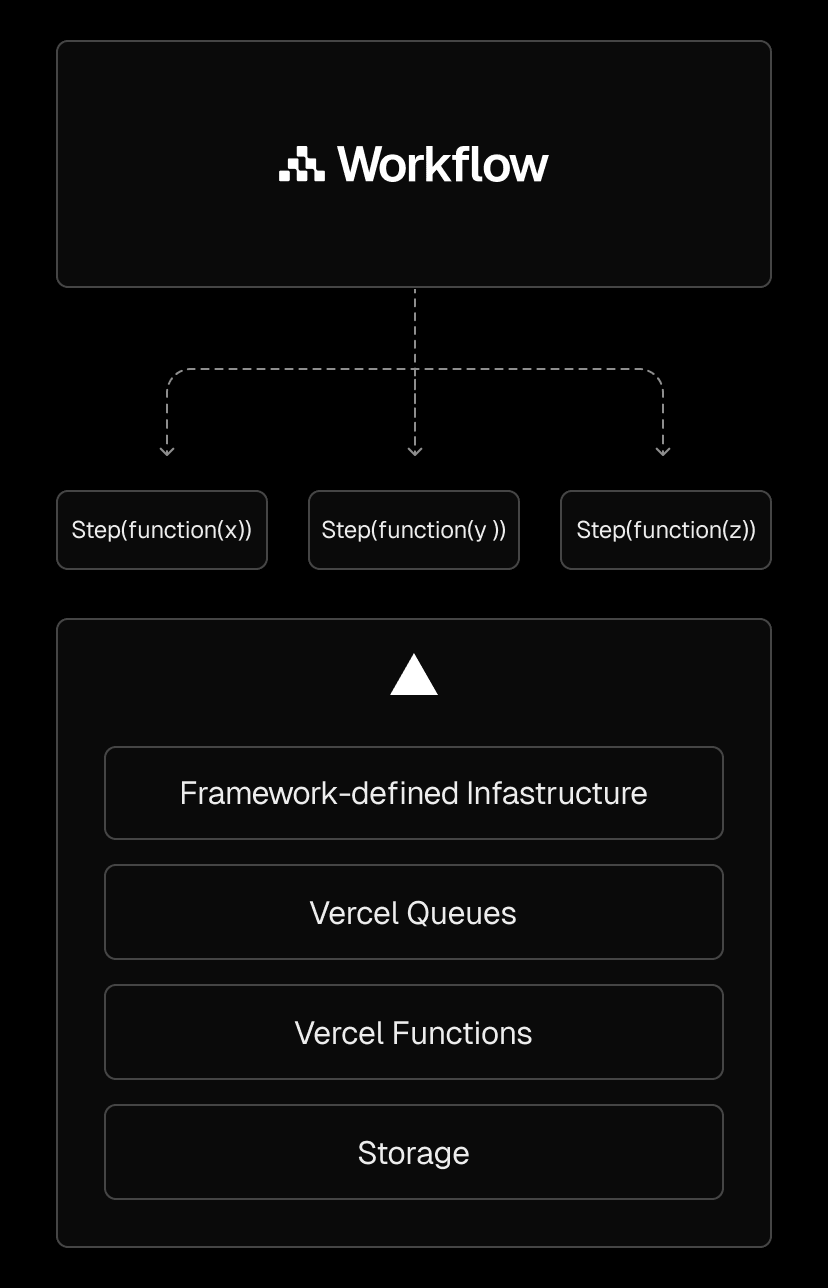
Vercel can also detect that a function is durable and respond by provision the right infrastructure dynamically in real time.
Vercel Agent enters beta
Vercel Agent operates as an intelligent teammate for shipping on the platform. It reviews code and proposes validated patches, and watches production data for anomalies. If it spots performance or error spikes, it auto-opens an AI investigation that summarizes root causes and actionable next steps. Beta users get $100 in promo credit to get started.
Python SDK hits zero-config beta
Python developers can deploy on Vercel without configuration work. The Vercel Python SDK, now in beta, runs FastAPI and Flask apps natively on the platform while giving direct access to Vercel's Blob storage, Sandboxes, and Runtime Cache. It's installed with pip install vercel.
Agent templates and the road ahead
A new initiative, An Agent on Every Desk, offers guided adoption with team experts to help identify high-value use cases, supply starter templates, and take organizations from idea to a live agent.
Two open source agent templates ship as reference architectures. The OSS lead agent automates go-to-market workflows by researching and qualifying inbound leads, built on Next.js, AI SDK, Workflow DevKit, and the Vercel Slack Adapter. The OSS Data Analyst Agent connects Slack to SQL, letting anyone pose natural-language questions and receive query-driven answers—serving as a clean model for building your own text-to-SQL implementations with the AI SDK.
The scope of Ship AI's releases is broad, but the direction is consistent: abstract the plumbing so that defining logic, deploying, and letting the platform run the details feels less like specialized AI work and more like ordinary web development.