Assembling the parts of a production agent
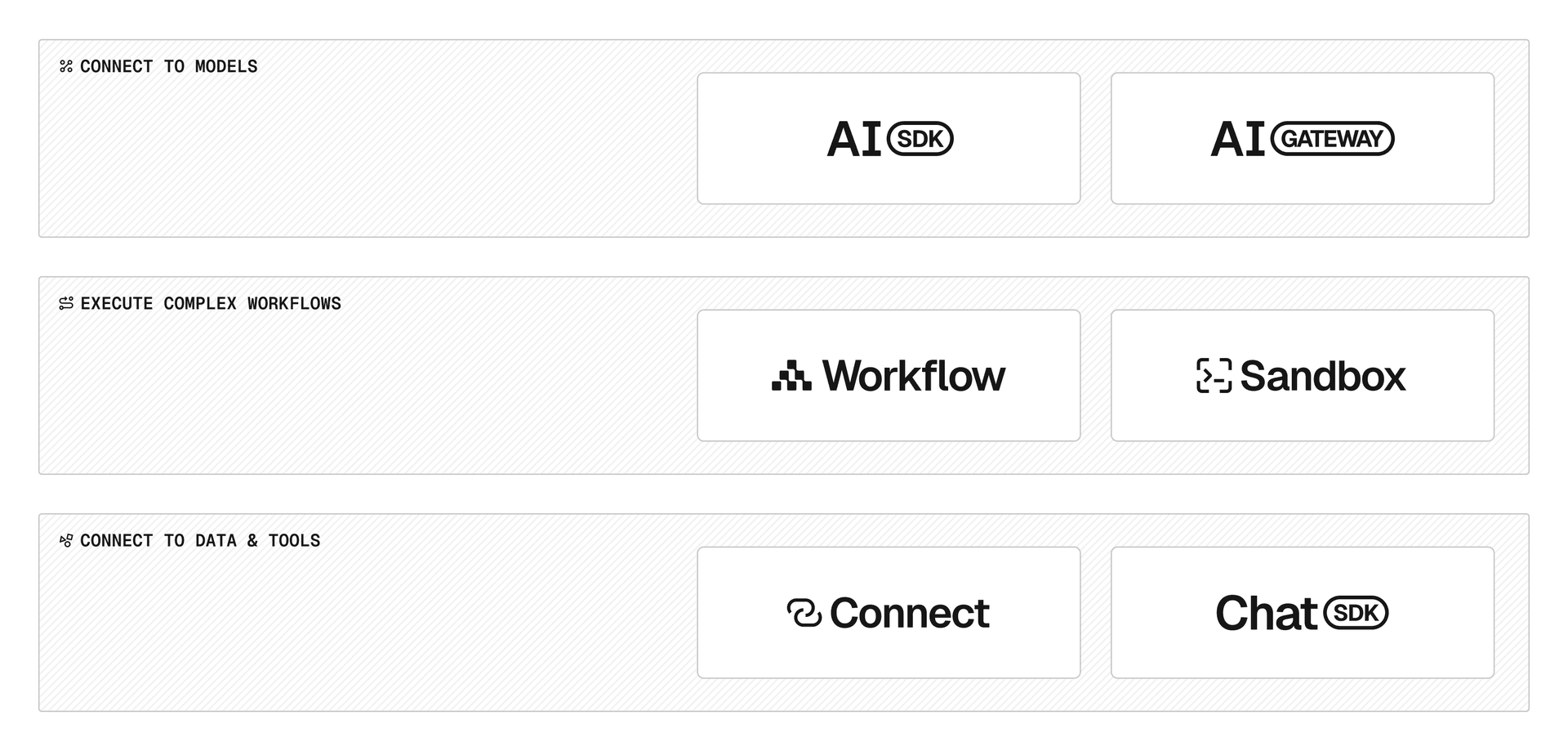
Every agent, regardless of its job, needs three things to function: access to models, a way to run durable workflows across many steps, and secure connections to the data, tools, and messaging platforms it relies on. Historically, getting those pieces meant either committing to one vendor's API, gluing together unrelated libraries, or writing the plumbing yourself.
Vercel's Agent Stack bundles those core building blocks into a set of services and SDKs — AI SDK, AI Gateway, Workflow SDK, Vercel Sandbox, Vercel Connect, and Chat SDK — designed so you can ship complete agents without assembling the infrastructure from scratch. Vercel Connect reached general availability on August 25, 2026.


One interface to any model
Agents rarely run on a single model. Each call has its own cost, latency, and capability tradeoffs, and the right choice depends on the task. That means an agent needs one way to reach any model, a method to route between them, and a path to stream results back.
AI SDK
Every model provider exposes its own API with different conventions for request shape, tool calls, structured output, and streaming. Supporting more than one provider means building and maintaining an integration for each. AI SDK provides a single, model-agnostic interface for generating text, images, speech, and video, working across platforms and frameworks.
call-model.ts
import { generateText } from 'ai';
const { text } = await generateText({
model: 'anthropic/claude-sonnet-4.6',
prompt: 'Summarize the latest deploys.',
});
console.log(text);
Switching from one model to another becomes a one-line change, not a code rewrite.
AI Gateway
Tokens are now a production dependency on par with bandwidth, and agents drawing from different models for different tasks makes provider diversity the norm. That creates a sprawl of keys, billing relationships, rate limits, and APIs that shift over time.
AI Gateway acts as a CDN for token traffic. It sits on Vercel's global edge network, exposing a single endpoint that routes calls, fails over if a provider goes down, and tracks cost and usage across all of them. You pay the provider's list price with no markup, and can remain on your own keys.
“The last thing we want is to rebuild our infrastructure every time a new model drops.”

SERHANT., a real-estate firm, runs three models through one key: market analysis goes to Claude, marketing copy to GPT, and image generation to Gemini.
Making long runs durable and contained
An agent's work often unfolds sequentially over minutes or hours. Workflow SDK makes these processes durable, while Vercel Sandbox provides an isolated VM for the code those processes run.
Workflow SDK
When a step fails deep inside a long agent run with no saved state, the whole task restarts, re-billing every model call along the way. Building durability yourself means owning retries, state persistence, and orchestration. Workflow SDK handles this by checkpointing each step, storing state, retrying failures, and pausing when a run waits on input from a human, a slow API, or a webhook. A paused run resumes from the last good step, not from zero.
“Questions like 'how do we make this durable?' or 'what if the user disconnects mid-generation?' used to eat up our design discussions. Now they're solved, so we can ship as fast as we experiment.”

FLORA, a creative platform, uses Workflow SDK to fan a single creative session out across more than fifty image models. Every step persists and retries on failure, so long sessions keep their state in full.
Vercel Sandbox
Agents become useful when they can read files, run commands, and write code — but that same freedom is a security risk when the code is unreviewed. Vercel Sandbox isolates each agent in its own microVM: a full Linux machine with a filesystem, Docker support, and a dedicated kernel, cut off from the host and every other sandbox. Credentials are injected only when code calls a service, so the agent never sees a raw secret.
run-agent-code.ts
import { Sandbox } from '@vercel/sandbox';
const sandbox = await Sandbox.create({ runtime: 'python3.13' });
await sandbox.writeFiles([
{ path: 'agent.py', content: Buffer.from(agentCode) },
]);
const result = await sandbox.runCommand('python', ['agent.py']);
console.log(await result.stdout());
Each sandbox gives agents the same isolation primitive behind Vercel's own preview deployments and millions of daily builds.
Secure connections to the outside
For an agent to be useful, it needs access to external systems and a presence where users already communicate. Both connections need tight security controls.
Vercel Connect
Opening a pull request or querying a warehouse requires granting an agent access to those platforms. Traditional access means giving it a long-lived token broad enough for any possible action — one that never expires and obscures which human authorized what. Vercel Connect takes a different route: you integrate each system once, then the agent mints a short-lived token per task, scoped only to the permissions you explicitly grant.


Every action traces from user to agent to service, keeping an audit log that ties each call to the person the agent acted for.
Vercel Connect is public beta today. It supports Slack, GitHub, Snowflake, Salesforce, Notion, and Linear out of the box, plus any OAuth or API-based service.
Chat SDK
Users live in Slack, GitHub, Linear, WhatsApp, and Discord — not in a single tab. Pushing an agent into each one yourself means building and maintaining multiple API integrations, auth flows, and message formats. Chat SDK handles the adapters for each channel from one integration, so a single agent can appear wherever your users are.
“Chat SDK is how one of our agents shows up in fifteen apps without building fifteen integrations.”

NanoClaw uses it to run one agent across a dozen channels from a single codebase. A conversation can start in Slack and migrate to GitHub or Linear with the agent's context intact.
eve, the agent framework
After building hundreds of agents on the stack, a repeated shape emerged. eve is that shape as an open-source framework — an opinionated implementation of the stack in one directory.
agent/
agent.ts # the model it runs on
instructions.md # who it is
tools/
run_sql.ts # what it can do
post_chart.ts
skills/
revenue-definitions.md # what it knows
subagents/
investigator/ # who it delegates to
channels/
slack.ts # where it lives
schedules/
monday-summary.ts # when it acts on its own
Instructions live in markdown, tools in TypeScript. Durable execution, sandboxed compute, approvals, and channel delivery are wired in underneath. eve is in public beta, so the remaining assembly is the agent itself. You can start from one of Vercel's eve templates, deploy in minutes, and debug sessions from the first run in the Vercel dashboard.