Mainstream Adoption of a New Toolchain
Git took roughly two decades to become the universal backbone of software development, and today 93% of developers use it. In 2023, GitHub’s data shows that a similar shift is underway with artificial intelligence. The gap between experimentation and production use is closing fast: open source generative AI projects broke into the top 10 projects by contributor count for the first time, and 92% of developers report using or experimenting with AI coding tools.
Three structural changes defined the year on the platform:
- Generative AI became a mainstream developer activity. Developers moved from machine learning libraries to pre-trained models and APIs, building applications on top of foundation models at a pace that outpaced every previous technology wave.
- Cloud-native operations continued to mature. Git-based infrastructure as code (IaC), containerized workflows, and declarative languages saw higher standardization and sharper growth in usage rates.
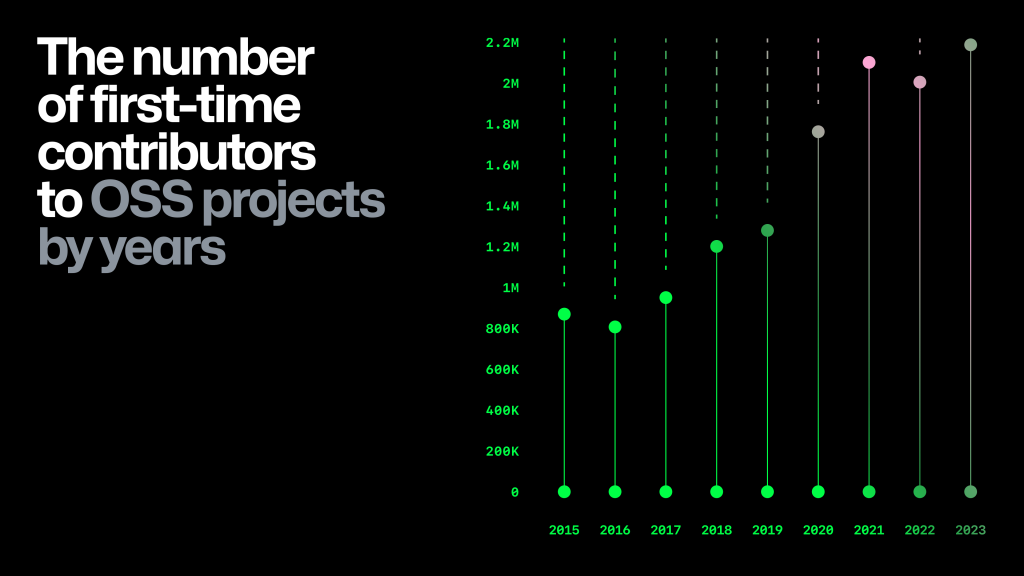
- 2023 brought the largest cohort of first-time contributors in history. Commercial projects still capture the majority of contributions, but generative AI projects also became top destinations for newcomers. Private project activity grew 38% year over year and now accounts for more than 80% of all activity on GitHub.
A Widening Global Base
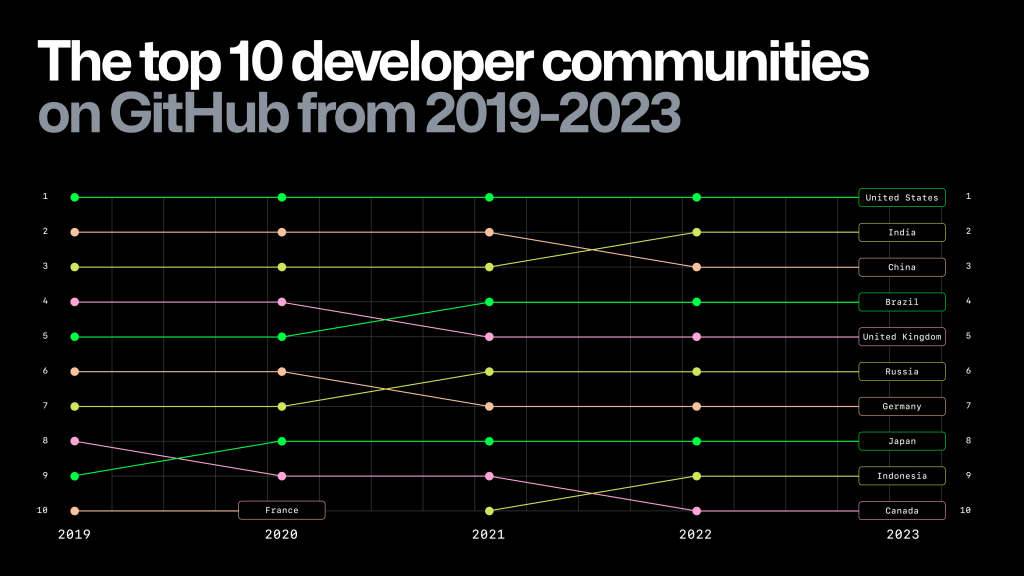
Developer populations grew worldwide across both public and private work. The United States remains the largest community with 20.2 million developers and a 21% annual growth rate, but other regions are catching up quickly. The biggest increases are concentrated in Asia Pacific, Africa, and South America, with India, Brazil, and Japan leading.

The Next Five Years
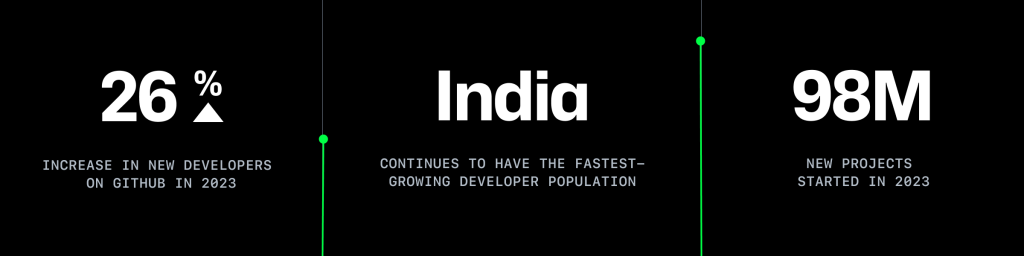
Projections based on current trends point to India overtaking the United States as the largest developer community on GitHub by 2027. India added 3.5 million developers in 2023, a 36% year-over-year increase, supported by national efforts to build digital public infrastructure with open source software.

Asia Pacific Hubs
Economic hubs in India, Japan, and Singapore drove the region's growth. Singapore posted the highest developer-to-population ratio in the world and the strongest growth in APAC, helped by university curricula that incorporate GitHub. Japan's startup investment is expected to sustain its growth.
# of developers
YoY growth
01 Singapore
>1M developers
39%
02 India
>13.2M developers
36%
03 Hong Kong (SAR)
>1.6M developers
35%
04 Vietnam
>1.5M developers
34%
05 Indonesia
>2.9M developers
31%
06 Japan
>2.8M developers
31%
07 The Philippines
>1.3M developers
31%
08 Thailand
>857K developers
25%
09 South Korea
>1.9M developers
22%
10 Australia
>1.4M developers
21%
Africa's Rising Contingent
Africa was identified as a promising source of tech talent, reinforced by policies like mandatory programming education in Kenya's schools. Nigeria grew 45% year over year, the largest increase worldwide, matching its status as a hub for open source adoption and technology investment in the region.
# of developers
YoY growth
01 Nigeria
>868K developers
45%
02 Ghana
>152K developers
41%
03 Kenya
>296K developers
41%
04 Morocco
>446K developers
35%
05 Ethiopia
>94K developers
32%
06 South Africa
>539K developers
30%
South American Gains
South American growth rates rival those in faster-growing regions elsewhere. Brazil has the region's largest developer population, increasing 30% year over year amid public and private investment. Argentina and Colombia also emerged as favored investment targets over the past several years.
# of developers
YoY growth
01 Argentina
>925K developers
33%
02 Bolivia
>105K developers
33%
03 Colombia
>872K developers
31%
04 Brazil
>4.3M developers
30%
05 Chile
>437K developers
26%
European Consolidation
European communities kept growing, but more slowly than their counterparts in the Global South. France's expansion follows explicit government efforts to attract startups, while Spain and Italy also drew more developers thanks to measures to bolster domestic technology markets.
# of developers
YoY growth
01 Spain
>1.5M developers
25%
02 Portugal
>410K developers
24%
03 Poland
>1.2M developers
24%
04 Germany
>2.9M developers
22%
05 Italy
>1.1M developers
22%
06 France
>2.3M developers
22%
07 United Kingdom
>3.4M developers
21%
Generative AI Moves From Research to Production
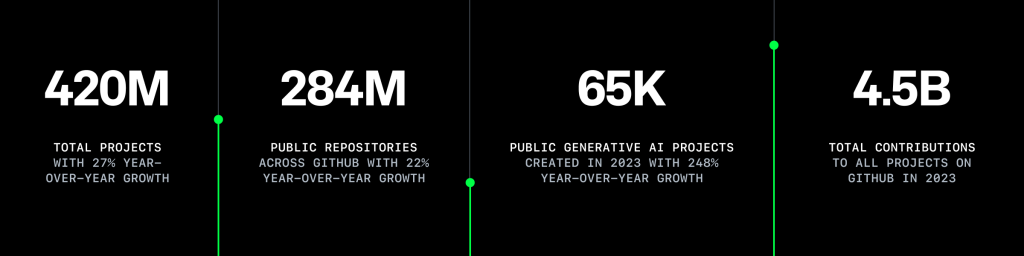
Generative AI is not new to GitHub, but its role changed dramatically in 2023. Projects that were once the domain of specialists became the foundation for mainstream application development. The numbers reflect that transition: the total count of generative AI projects grew 248% year over year, and individual contributors to them rose 148%.
Halfway through 2023, developers had already created more than twice as many generative AI projects as in all of 2022. Increasingly, those projects relied on pre-trained models rather than custom machine learning pipelines. The most popular repositories now include API-driven projects built on models like ChatGPT, alongside stalwarts like tensorflow/tensorflow and pytorch/pytorch.
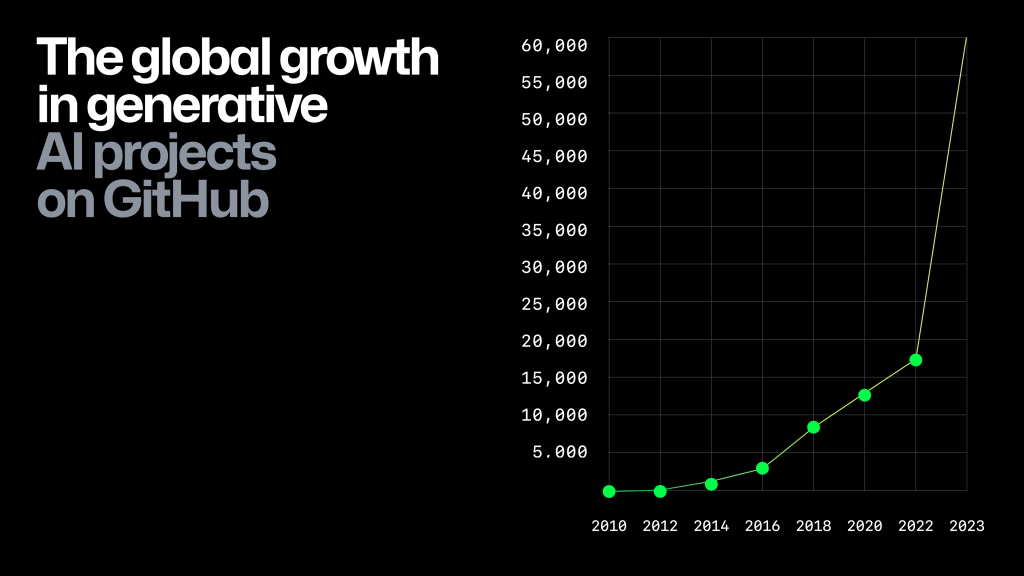
A striking detail in the top 20 open source generative AI projects: many are owned by individuals, not companies. That points to continued grassroots innovation, with small teams accelerating what the broader ecosystem then adopts.
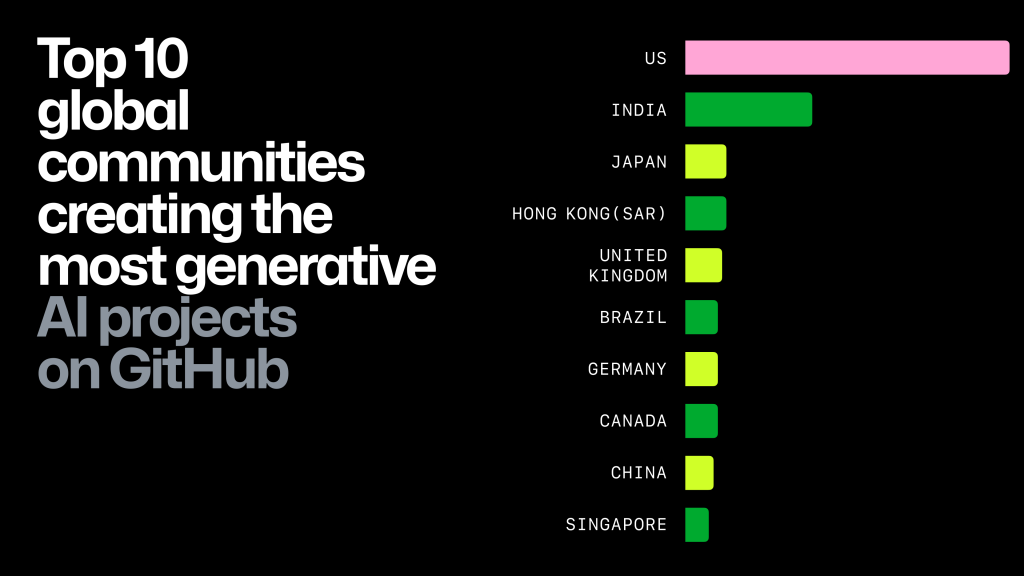
The geography of generative AI contribution is also widening. The United States, India, and Japan lead, with Hong Kong (SAR), the United Kingdom, and Brazil following. As this talent pool grows, organizations should expect a ready supply of developers who are familiar with building AI-powered products — from APIs and bots to mobile applications and plugins. The experimentation happening now is laying the human infrastructure for the next wave of production AI.
TypeScript overtakes Java as open source shifts toward ops and data
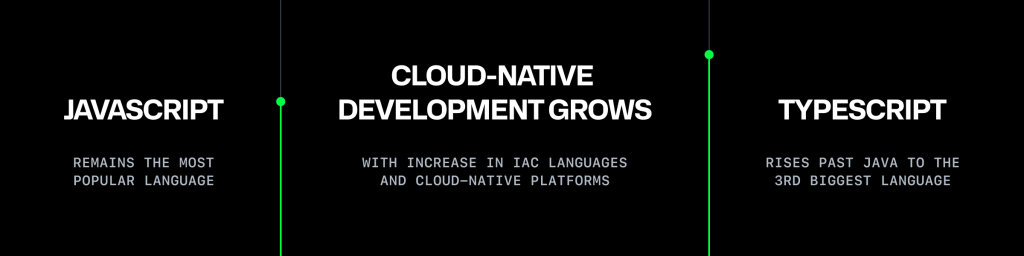
JavaScript remains the most popular language across open source projects on GitHub, with Python and Java holding steady in the top five. The notable shake-up this year: TypeScript surpassed Java for the first time to become the third most-used language, growing its user base 37% year over year. Launched in 2012, TypeScript combines a language, type checker, compiler, and language service, and pioneered gradual typing—letting developers mix static and dynamic typing within the same codebase.
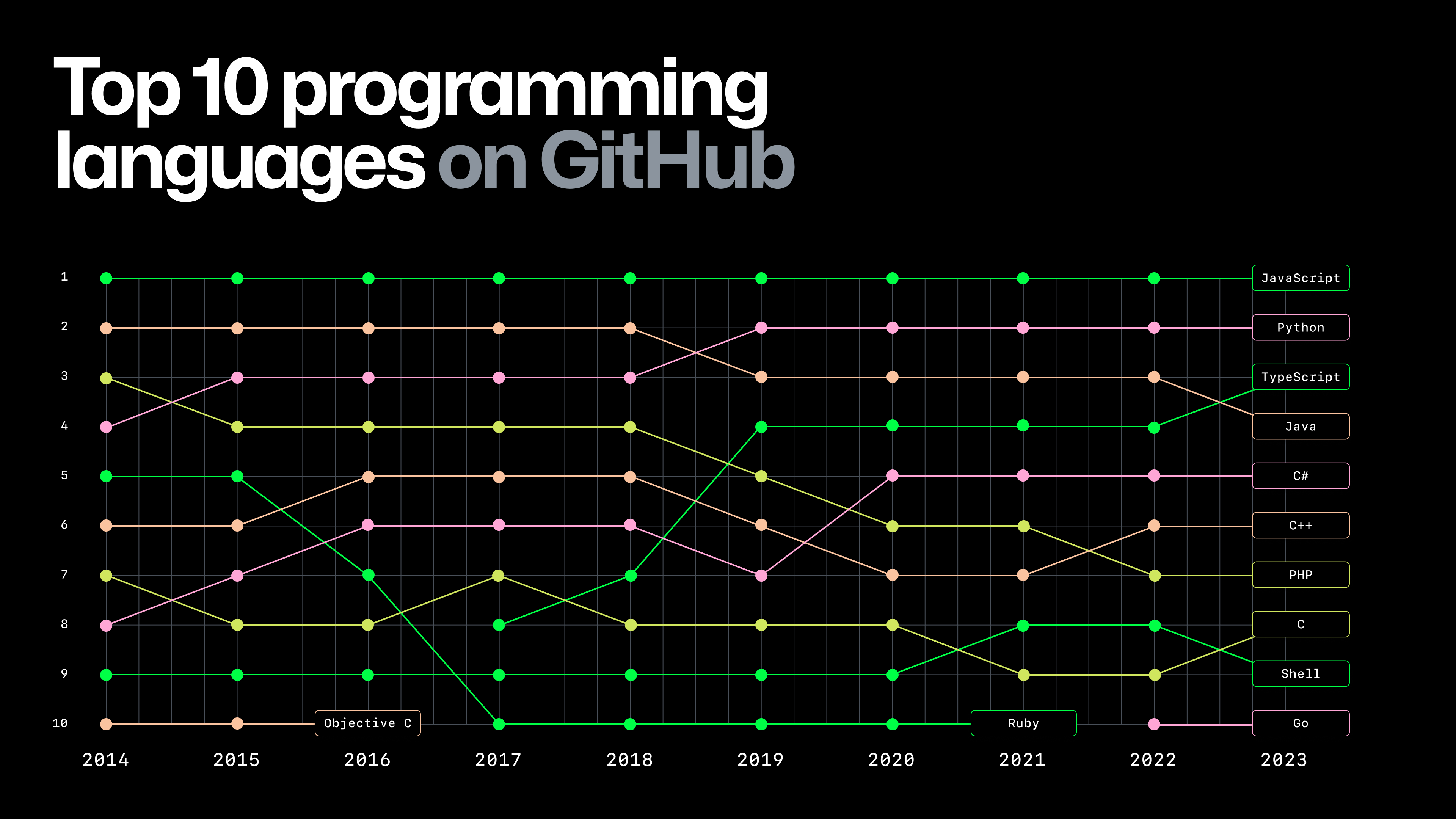
Beyond traditional software development, languages tied to infrastructure and data work are climbing the ranks. Shell and Hashicorp Configuration Language (HCL) both remain top languages, signaling that operations and infrastructure-as-code (IaC) are increasingly central to open source. HCL adoption grew 36% year over year, reflecting broader use of declarative languages to manage cloud deployments. Similarly, T-SQL and TeX saw gains in 2023, a sign that data scientists, mathematicians, and analysts are participating more in open source development.
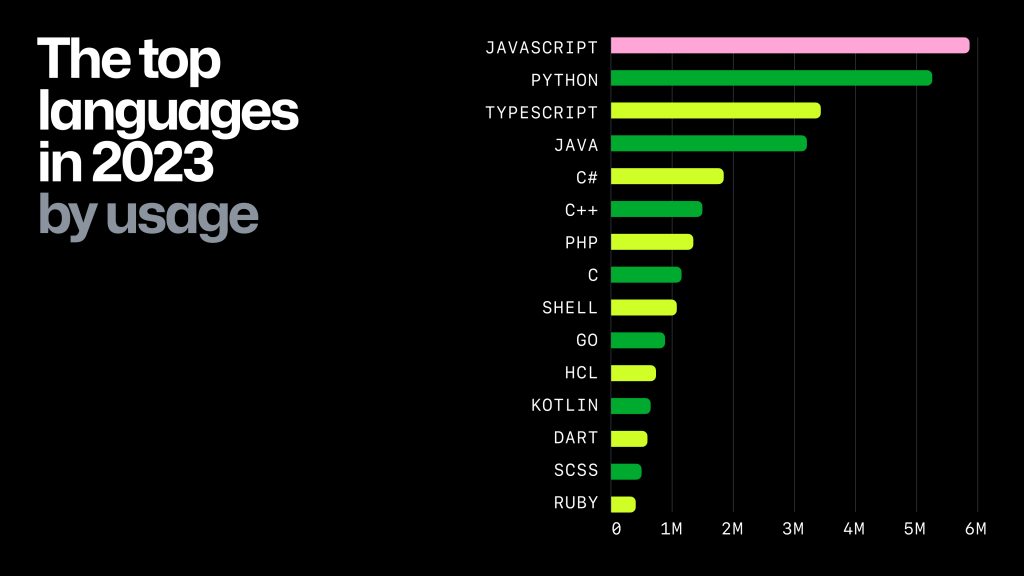
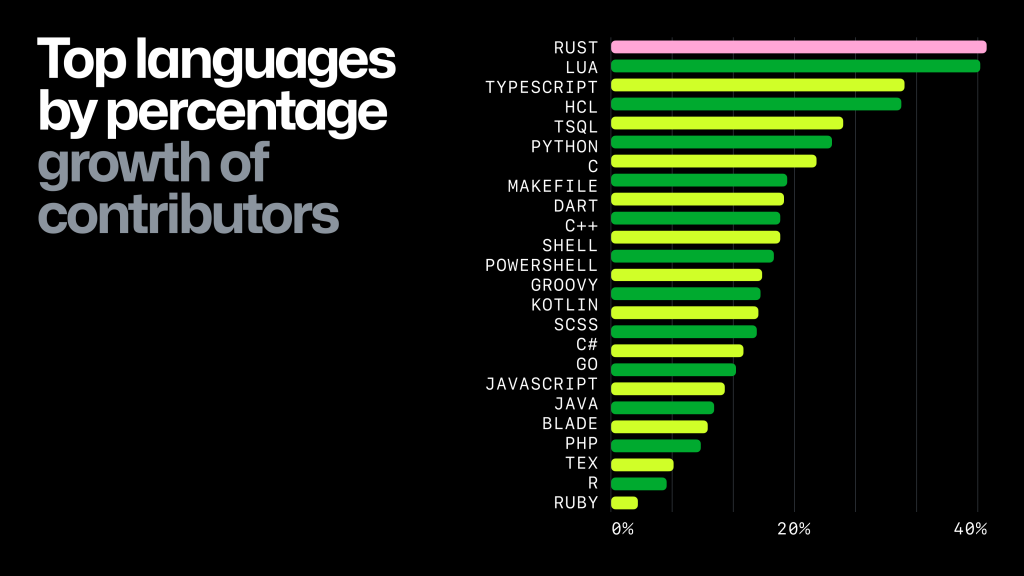
Looking only at projects created in 2023, the most popular languages largely mirror the overall rankings. The outliers are Kotlin, Rust, Go, and Lua, which show outsized growth in newer projects. Rust and Lua both prioritize memory safety and efficiency, making them attractive for systems and embedded programming. Go's momentum continues to be driven by cloud-native projects like Kubernetes and Prometheus.
Automation, private repos, and containers define developer activity
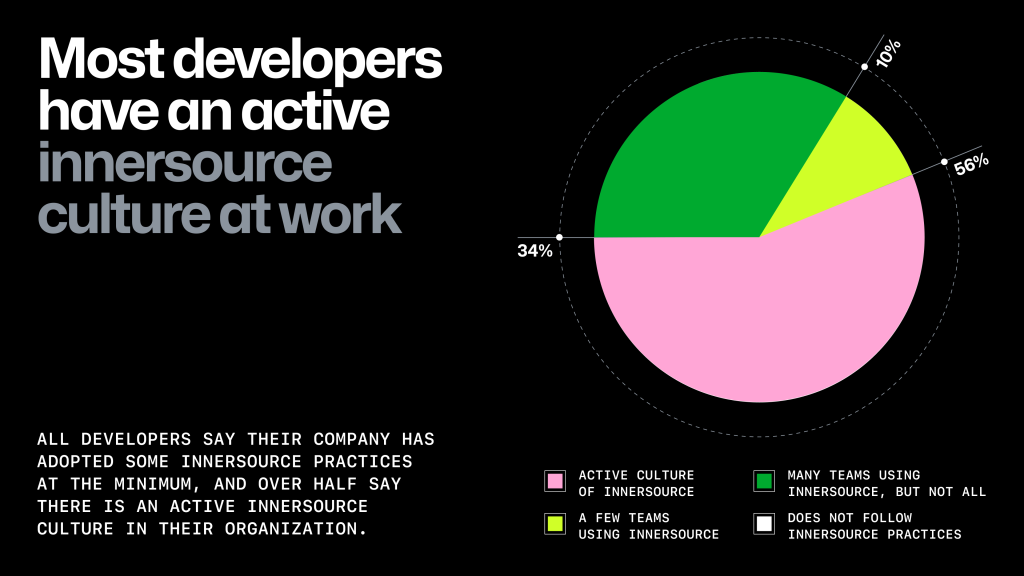
GitHub passed 100 million developers in early 2023, and global developer accounts have grown nearly 26% since last year. That activity is concentrated heavily in private work: more than 80% of all contributions go to private repositories, totaling over 4.2 billion contributions, compared to more than 310 million to public and open source projects. The scale of private activity points to the value of innersource—Git-based collaboration improving proprietary code, not just open source. In a GitHub-sponsored survey, all developers reported at least some innersource practices at their companies, and over half said their organization has an active innersource culture.
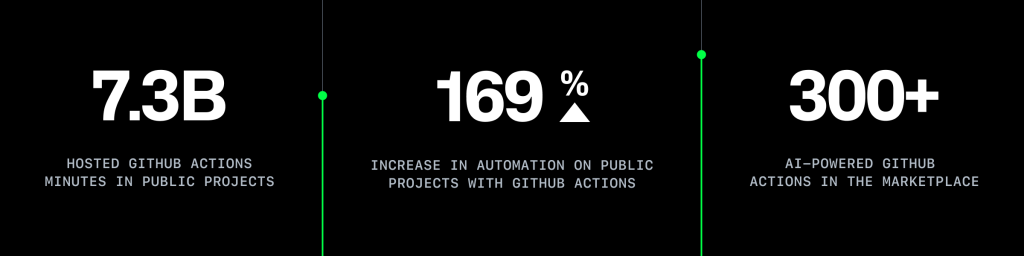
Automation is a major driver of developer activity. Over the past year, developers used 169% more GitHub Actions minutes in public projects, averaging more than 20 million minutes per day. The GitHub Marketplace also passed 20,000 Actions in 2023, reflecting growing adoption of CI/CD and community management automation.
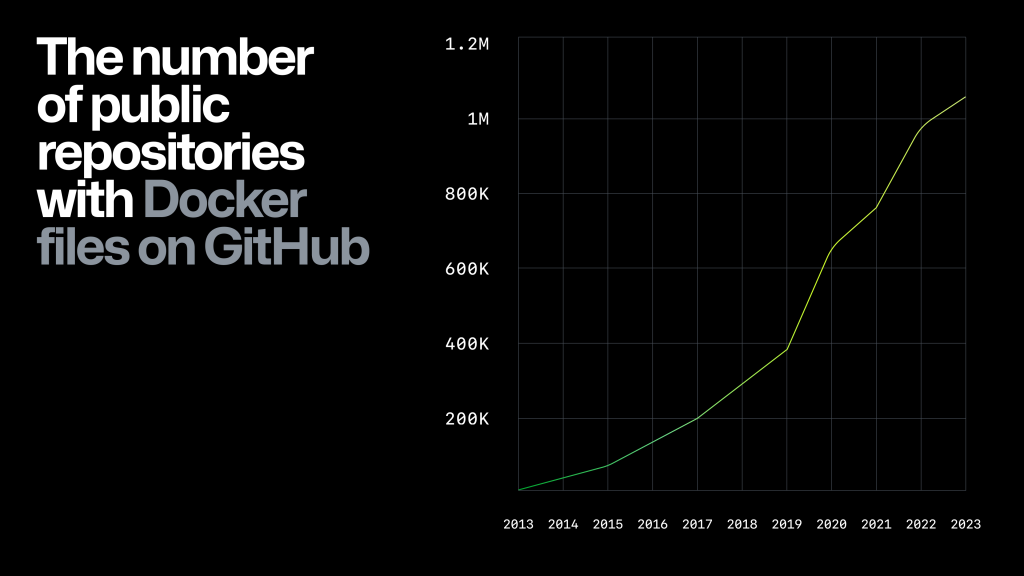
Cloud-native development continues to expand. In 2023, 4.3 million public and private repositories used Dockerfiles, with more than 1 million public repositories using them for container creation. Combined with increased Terraform and HCL adoption, developers are bringing more standardization to cloud deployments through IaC practices.
Generative AI is also making its way into developer workflows via the Marketplace, which now hosts more than 300 AI-powered Actions and 30+ GPT-powered Actions. Developers are not just experimenting with AI—they're integrating it into more parts of the development experience.
Security automation gains traction alongside responsible AI tooling
Open source security is improving as developers adopt automated tooling. In 2023, open source developers merged 60% more automated Dependabot pull requests for vulnerable packages than in 2022, indicating a stronger community commitment to fixing dependencies. More than 60% of the most popular open source projects now use protected branches, and repository rules became generally available in July 2023 to help manage those protections at scale.

There is also a growing trend in AI trust and safety tooling. Developers are creating and sharing projects related to responsible AI, fairness in AI, responsible machine learning, and ethical AI on GitHub. Institutional research is contributing as well: the Center for Security and Emerging Technology at Georgetown University is identifying top producers of trustworthy AI research and publishing its research code on GitHub.

The shape of open source in 2023
Open source activity reached new heights this year, with developers making 301 million total contributions to projects on GitHub. The activity spanned established software like Mastodon and newer generative AI projects including Stable Diffusion and LangChain. While commercially backed projects continued to attract the most contributors, 2023 marked the first time generative AI projects broke into the top 10 most popular projects on the platform.
Adoption of AI tools also moved into the maintainer community. Nearly a third of open source projects with at least one star have a maintainer who uses GitHub Copilot, an uptick that follows GitHub’s program offering Copilot for free to open source maintainers.
Who led in contributors
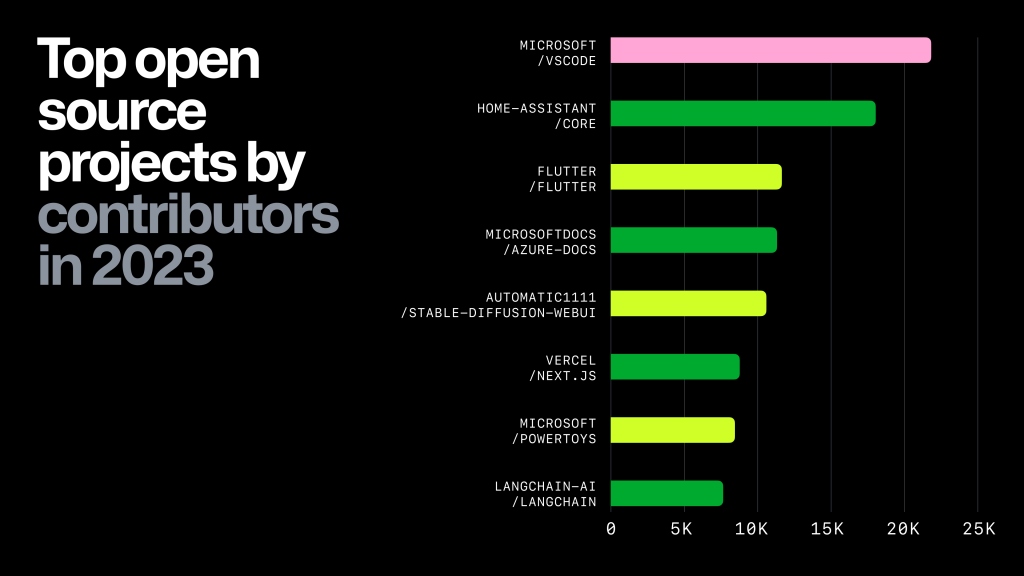
Commercial backing continued to dominate the top of the contributor leaderboard. Projects including microsoft/vscode, flutter/flutter, and vercel/next.js all repeated their top-10 appearances from the previous year. Yet generative AI projects like langchain-ai/langchain and AUTOMATIC1111/stable-diffusion-webui climbed the ranks as more developers built LLM-based applications from pre-trained models and customized AI tools for end users.
Developer interest also remained high in packaging and containerization approaches. Docker was used across 4.3 million repositories during the year, while the Linux distribution NixOS/nixpkgs stayed in the top open source projects by contributor count for the second consecutive year.
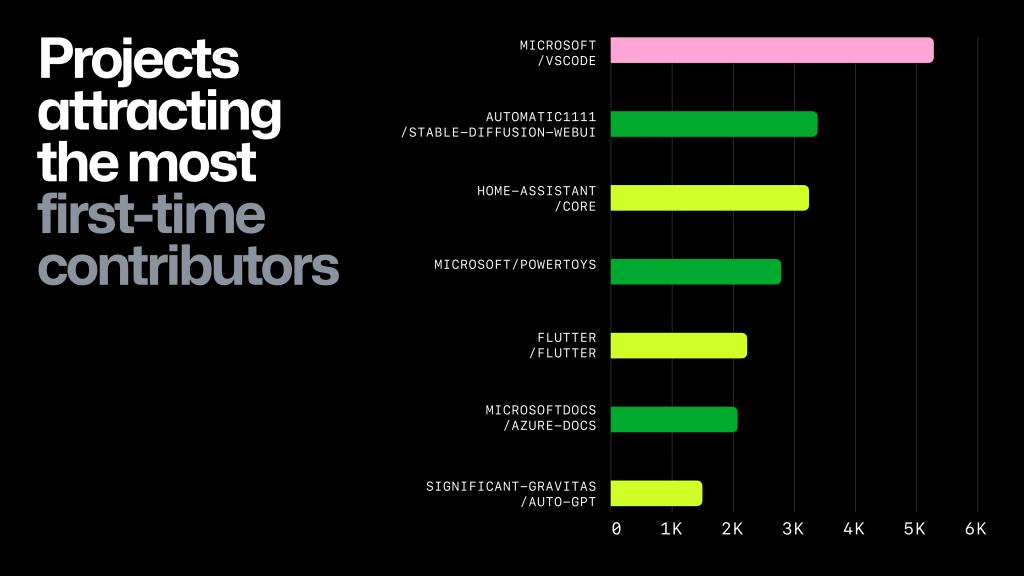
First-time contributors in 2023 continued to gravitate toward well-known, commercially backed projects from Microsoft, Google, Meta, and Vercel. At the same time, a surge of newcomers contributed to community-driven projects such as home-assistant/core, Stable Diffusion, LangChain, and Significant-Gravitas/Auto-GPT. The activity suggests that open experimentation with foundation models has made generative AI more accessible, inviting broader participation and new kinds of collaboration.

The year also brought the largest number of first-time contributors to open source on record. Onboarding happened through education programs like freeCodeCamp, First Contributions, and GitHub Education, as well as through openly sourced training materials from Google and IBM.
Takeaways from the year
The broader data from 2023 points to the mainstream arrival of AI in development workflows: 92% of developers reported using AI-based coding tools in the past year, both inside and outside of work. Three trends stand out.
- GitHub has become the development platform for generative AI. AI moved from a niche specialty into mainstream technology, and open source projects reflect that transition as developers use GitHub to experiment, build, and share knowledge.
- Cloud-native development is scaling on GitHub. Following a jump in container technology adoption starting in 2019, 2023 saw a sharp increase in Git-based infrastructure-as-code workflows, container orchestration, and other cloud-native practices. Developers are standardizing how they deploy to the cloud through these tools.
- Open source communities continue to grow alongside private development. Private repositories increased by 38% and now account for more than 81% of all activity on GitHub. Despite that shift, open source participation keeps climbing with record numbers of new contributors and faster innovation cycles in open communities.

Methodology and notes
The report draws on anonymized user and product data from GitHub covering October 1, 2022 through September 30, 2023. AI projects are identified using 683 repository topic terms, detailed in research GitHub conducted in 2023. Open source projects are evaluated with “Mona Rank,” a rank-based measure of community size and popularity.
Additional data is available publicly through the GitHub Innovation Graph, and full methodology details can be obtained by contacting [email protected].
Key terms as used in the report: “developers” refers to individual, non-spammy user accounts; “public projects” are any publicly available repositories; “open source projects” are public repositories with an open source license; “location” is based on last known network geolocation data aggregated to country or region level; and “projects” and “repositories” are used interchangeably, allowing that large projects can span multiple repositories.


