
Search visibility is now a two-system problem
Traditional SEO focused on rankings, backlinks, and driving clicks to a page. That model is breaking down as AI assistants increasingly answer questions directly—often without any click at all. ChatGPT, Google AI Overviews, and Perplexity have inserted themselves between the query and the content, becoming a new discovery layer that decides what users see and whether they bother to visit a site at all.
This doesn't mean traditional SEO is dead. It means visibility now depends on two distinct systems: the classic search index and the LLM layer. An LLM may retrieve content at runtime via RAG, or it may rely on knowledge encoded during training. Both are influenced by the same fundamental quality: how clearly and deeply a concept is explained. Keyword density, synonym swapping, and hidden text tactics carry little weight when models are interpreting meaning rather than matching strings. Poor content is ignored at best—and can muddy the signals that traditional SEO still depends on.
That's why this shift is less about abandoning old tactics and more about layering new ones on top. The authors of this guidance argue that the goal is to own a concept so well that a model can't help but surface and cite your version of it. That requires supporting both real-time retrieval and long-term training-data inclusion. You can't pick one system to optimize for.
Where the two systems diverge
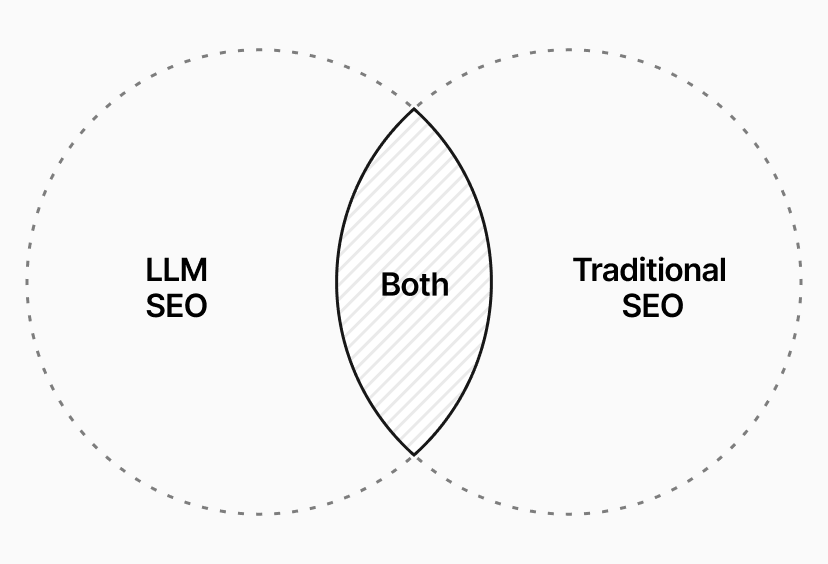
Traditional SEO rewards established signals like backlinks, domain authority, and historical ranking data. LLM-based discovery relies on semantic clarity. The two overlap on fundamentals—crawlability, site speed, clean structure—but the strategic emphasis has shifted. In practice, that means a topic like an API reference can target both patterns at once.

Traditional SEO | LLM SEO / AI SEO | Both |
Backlinks | Embedding-based relevance | Crawlable, indexable pages |
Volume-based keywords | Natural-language queries | Clear heading hierarchy (H1 → H2 → H3) |
Search engine results page rankings (SERP) | Visibility in Retrieval-Augmented Generation (RAG) indexes | Fresh, regularly updated content |
Anchor text optimization | Concept clarity and ownership | Schema markup (TechArticle, FAQPage, etc.) |
Meta descriptions | Self-contained, extractable snippets | Internal linking across related topics |
Link equity | Community mentions (GitHub, Reddit, etc) | Fast, static HTML/CSS pages |
Click-through rate (CTR) optimization | Semantic depth and originality | High-intent, decision-stage content |
The tradeoff is real: while LLMs might surface a concise code answer directly in a chat UI, that's a zero-click win for the user but a loss for a site relying on referral traffic. Some research points to AI Overviews potentially reducing clicks by 34.5% versus equivalent searches without them. Yet the user still needs the page to exist and be authoritative for the model to have pulled that answer from. Being excluded from AI results entirely is the worse outcome in nearly every scenario.

How models consume content
Retrieval systems like RAG fetch external information at request time to ground answers in current, specific context. ChatGPT, Copilot, and Meta AI lean on Bing's index; Google uses its own; Perplexity mixes several. Whatever the backend, content must be crawlable, parseable, and semantically aligned with the query's intent. Models also rely on latent knowledge from training—high-dimensional embeddings that map relationships between concepts, letting them reason about topics even when exact keywords are absent.
Two practical implications follow. Most AI crawlers fetch HTML but don't execute JavaScript, so serving static markup is non-negotiable. SSG and ISR patterns — like those used in Next.js — expose content without gating it behind client-side rendering. And because models favor the clearest, most substantive explanation rather than the one that repeats a phrase most often, depth and consistency of terminology matter more than raw volume.
Five working principles for LLM-era content
The tactic set below emphasizes winning visibility through substance, structure, and source trails. None of it is fast. These are compounding, long-term content investments rather than one-off optimizations.
Choose a concept worth owning
LLMs tend to favor the first clear explanation of a concept. If you get a term or pattern documented early with authority, your version may become the default reference. If you're late, aim to be the most definitive. Watch developer forums, changelogs, professional social networks, and community discussions for emerging questions that map to your product's strengths. Look for gaps where existing coverage is shallow.
- Monitor community channels and code repositories for unanswered questions
- Surface original data, benchmarks, and customer insights that aren't easy to replicate
- Prioritize topics your users are already voicing needs around
Publish proof, not summaries
Generic overviews get skipped. Models infer authority from density of useful signal. A strong litmus test: if a competitor could easily replicate the piece tomorrow, it probably isn't the most authoritative source on the topic.
- Go below surface level with metrics, code, tables, quotes, and diagrams
- Keep terminology precise and repeated; avoid fuzzy synonyms that weaken semantic embeddings
- Write self-contained, extractable assertions that are easy to cite verbatim
Make intent machine-legible
Even a well-indexed page can be overlooked if its structure is ambiguous to a crawler. Both HTML semantics and visual/structural clarity matter when a model is deciding what a page is about and which section to pull from.
- Use valid, logical heading hierarchies
- Apply JSON-LD and Schema.org markup
- Favor semantic HTML: definition lists, tables, and elements that describe their role
- Verify indexability in both Google and Bing — the latter powers many AI retrieval paths
- Serve HTML through SSR, SSG, or ISR rather than requiring browser-side JavaScript execution
This isn't about gaming the parser. It's about eliminating ambiguity between what a page means to a human and what it means to a machine, leaving as little room for misinterpretation as possible.
Plant citation seeds
Models learn from what the web collectively says. Community references shape the association between your brand and your product category. Real citations in public conversations translate into model behavior; paid links or coerced placements don't help here and can hurt traditional rankings.
- Be present in threads, AMAs, changelogs, and public technical discussions
- Build open-source resources that create natural reason for reference
- Link internally between related pieces to reinforce topical relationships
- Prioritize high-signal channels like Reddit, GitHub, Hacker News, and Stack Overflow
Refresh on a schedule
Models re-crawl the indexed web on a rolling basis. Content that stays accurate and current is more consistently considered for retrieval and citation because retrieval systems are biased toward newer, higher-ranking content when deciding what to include.
- Check content health at 30, 90, and 180-day intervals
- Fix 404s, confirm
lastmodfields, and keeprobots.txtand sitemaps clean - Expand material that's performing and archive pages that have fallen out of relevance — always with redirects
Measuring success without a dashboard
There's no single panel that shows whether ChatGPT internalized your blog post. Google Analytics can capture referral traffic from AI sources, but attribution from a model-generated answer is messy and often doesn't match the session path. Monitoring is an ongoing inference from scattered hints rather than a clean, measurable pipeline.

- Source citations: Check whether Perplexity, Google AI Overviews, and ChatGPT cite your domain inline for relevant queries.
- Referrer traffic: Track visits from chat.openai.com, perplexity.ai, claude.ai, and bard.google.com in your analytics to identify high-intent users moving from answer to action.
- Mentions and links: Watch community references; repeated phrasing or citations across forums and blogs can indicate influence in training data.
- Index coverage: Perplexity-style retrieval begins with discoverability. Track indexing in Google Search Console and Bing Webmaster Tools and maintain performant Core Web Vitals scores.
Traffic from AI referrers often reflects people who have already asked, already seen an answer, and are now taking a follow-up step. High-intent visits from a smaller pool deserve attention even when overall volumes lag traditional search sessions.
Adapting without abandoning SEO's foundations
Traditions still matter: speed, fresh content, correct metadata, and structured pages remain required groundwork. The distinction in the emerging strategy is understanding where that foundation serves you. Classic SEO feeds the ranking index, while the LLM-era plays feed the models that produce direct answers.
The larger shift as summarized here is from "rank this result," where the model decides what you see. Success belongs to the teams that stake a clear claim on concepts, back claims with original evidence, and maintain presentation across systems. Whether the efforts are branded LLM SEO, GEO, or any of their close variants, they converge on behaving like a trustworthy set of answers sources—for machines and, ultimately, the people asking them questions.


