The new Dropbox experience, three years in the making, began rolling out to customers this week. Reaching that launch required a change in how the company builds software: web capabilities had to reach desktop, shared code had to serve both apps, and a backlog of accessibility and testing work had to be cleared against a November deadline. AI-assisted development, with engineers reviewing the output, carried much of that effort.
The product itself answers questions about a project folder with sources users can open, and it proposes plans—for organizing a folder, renaming files by content, or combining documents into a PDF—that can be reviewed and edited before approval. Dropbox reads and acts only on content the user already has permission to access, supported file changes can be undone, and results stay in Dropbox for teams to review and share.
Getting web code into the desktop app
Desktop had focused mainly on file sync, while web already supported richer browsing and content work. The goal was to bring existing features and new web-built capabilities into desktop without rebuilding everything per platform. The obstacle was divergence: the two apps used different build and release tools and handled sign-in, navigation, and data retrieval differently, so any web feature could depend on services desktop did not provide. Identifying those dependencies and deciding how to support them was substantial integration work to finish before launch.
At the May Hackathon, engineers built a working prototype covering two approaches, with AI helping trace dependencies, identify platform-specific assumptions, and test integration. One approach rendered the existing All Files page inside a desktop-specific window using Electron, the framework behind desktop's interface; an embedded web view brought the web browsing experience over quickly. The second imported selected web components directly into desktop's UI—more integration work, but greater control over fit.
The prototype let Product and Design try something concrete before committing to a larger architectural change. Engineers turned directional designs into usable flows and surfaced missing states as platform constraints emerged. In the end, both approaches earned a place: complete web pages where close parity mattered, individual components where more control was needed.
In parallel, coding agents implemented defined interface changes across Home, Library, and file previews—the Jump Back In list view and grid-to-list toggle, plus smaller updates to menus, upload banners, and shared styling—freeing engineers to concentrate on product behavior and how the experiences connect.
Shared components, separate plumbing
Keeping both apps improving without duplicating features meant reusing the code that makes a feature look and behave the same everywhere, while leaving sign-in and navigation to each app. Dropbox shares React components—the pieces that build what people see and interact with—along with the code they need to work with data. Web and desktop each build and test those components within their own app. A shared feature requests information the same way on either platform; web handles the request through the browser, desktop through its own networking system.
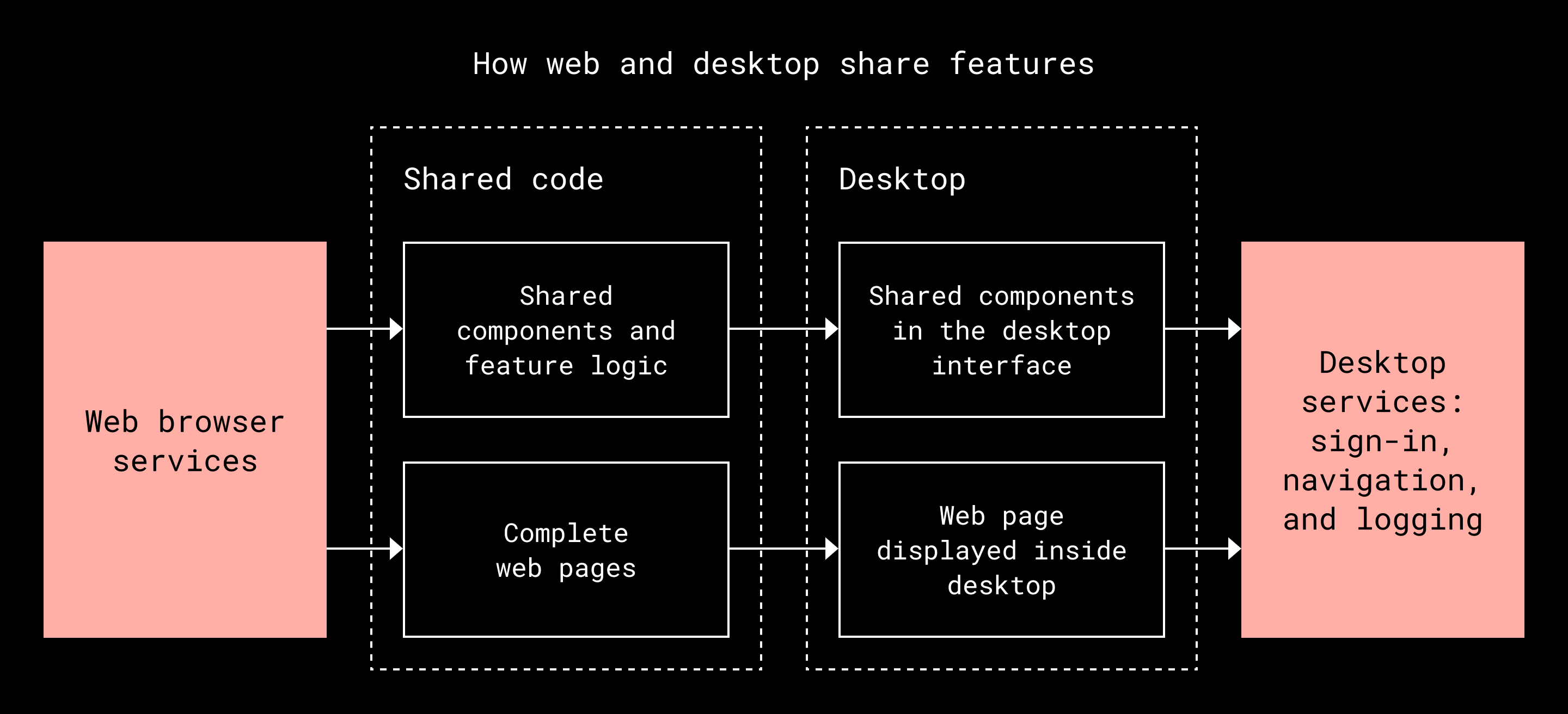
AI helped engineers follow the connections between pieces, extract reusable components, and write the adapters that link a shared feature to each app's services, along with tests—all reviewed by engineers. The approach, discussed for years, landed before launch, and improvements to shared features now have a path to both platforms.
Accessibility, tests, and a two-quarter backlog
The web team gave coding agents clearly defined tasks under a consistent process: each began with a written plan agreed on by engineer and agent, after which the agent made changes, ran the relevant builds and tests locally, and recorded results for engineer review before the code was accepted. Instructions stored with the code spelled out the rules agents follow. A working group and champions across teams established the shared instructions, task formats, and review expectations so the method was applied consistently. With that in place, AI-assisted development delivered 22 accessibility features across Home, All Files, file previews, and Photos—including screen-reader announcements for changes in the Up Next carousel on web and desktop, improvements to All Files table navigation, corrected keyboard focus movement between controls, and layouts kept usable at 200%–400% zoom.
The same approach unblocked a cleanup deferred for two quarters: retiring an older file list whose automated tests needed substantial engineering time to update. Split into 53 tasks, the test updates and removals were finished by coding agents in one week. Agents also added automated tests for five core parts of the web app, including the file browser people use to navigate their content.
Agents additionally exercised the experience during development. In one case an agent found that a deleted item in Chat history could stay visible until the page refreshed; engineers fixed the underlying synchronization issue and added tests to prevent a recurrence. Human reviewers could then spend more time judging whether the experience made sense to customers.
Feedback, then expansion
Customer signals set the pace of rollout. All eight initial design partners chose to keep the new experience enabled. As access widened, the team watched usage of familiar features—upload, preview, search, sharing—along with whether AI actions succeeded and whether customers turned the experience off, and prioritized fixes accordingly. Engineering review and customer feedback, not the tooling, decided what was ready to reach more people.
Shared components now give later improvements a route to both apps, and the delegation-and-review process used for accessibility and testing work is reusable for further changes. Technical expertise remains essential; AI widens the range of work engineers can take on, from understanding customer needs and trying out interactions to weighing product decisions and following changes through release.