
Building the loop from parts
Dropbox's Hack Week 2025 ran under the theme "Keep It Simple," with hubs in San Francisco, Seattle, and Warsaw plus a virtual track. Among the projects that came out of it, "Liquid Cooling CPU/GPU Hardware" took the Learn Fast award. The team—Bobby Woolweaver, Daniel Coultas, Eddie del Rio, Eric Shobe, and Daniel Parker-Focht—set out to address the thermal load of high-powered GPU servers driven by AI workloads.
Unable to source a complete system in time, the team assembled its own loop. A commercial kit typically arrives pre-assembled with pumps, radiators, and fans; Coultas and colleagues instead combined scaled-down versions of the components found in a data center liquid cooling setup: radiators to exhaust heat, fans, a pump, a reservoir, tubing, manifolds, and basic sensors. The sensors let the team confirm flow and performance before connecting any expensive GPUs, at which point the loop was attached to the server itself.
Measured results under stress
Against the current air-cooled production system, the liquid-cooled configuration ran roughly 20–30°C cooler during heavy stress tests. Those were torture-style workloads, harsher than normal production conditions.
The setup also freed the team to experiment with fans. With CPUs and GPUs on liquid, many fans could be removed or run at lower speed, while limited airflow was retained for components such as DIMMs and the network card at the rear—parts that draw far less power and run at lower thermals than the GPUs and CPUs. Coultas proposed an airflow baffle to direct cooling precisely where it is required.
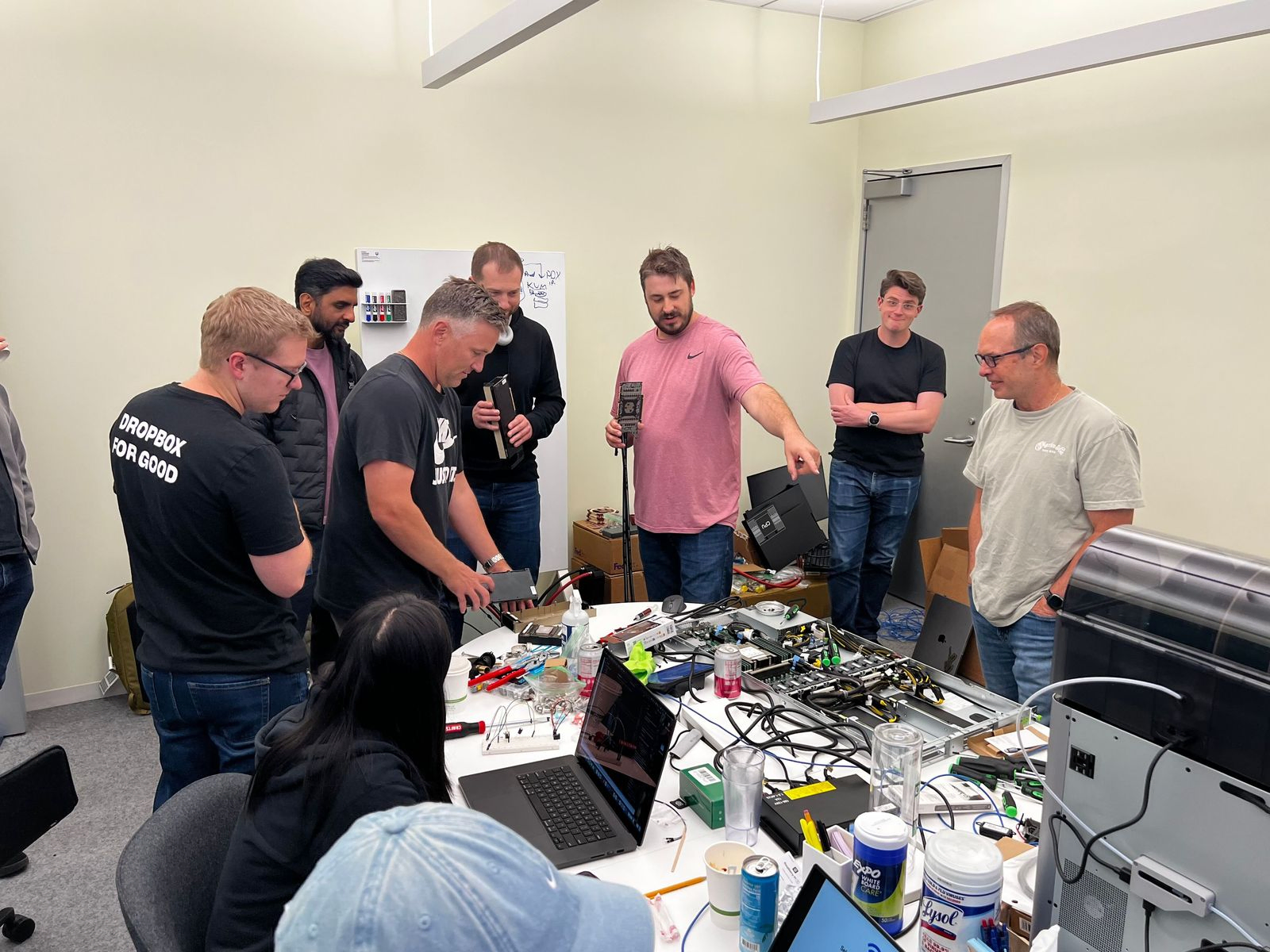
The liquid cooling team’s lab at Hack Week 2025
Why liquid, why now
Liquid cooling is not new, and the industry has been experimenting with it for some time; the pair have followed it closely, including at Open Compute Project summits where it features prominently. Both described carrying the question of how it might apply at Dropbox for years. Woolweaver stressed that plugging in a liquid-cooled server is not enough on its own—the surrounding infrastructure has to be in place so that future high-performance hardware can be supported when it arrives.
The concern spans both per-server power draw and total data center footprint. As servers demand more power, air-only cooling would force operators to spread them across more space; liquid cooling keeps density efficient, using less space and energy and potentially lowering costs.
Vendors do not yet require liquid cooling for their top-tier GPUs, but the team expects that to change, with air cooling eventually limited to mid-range options. Dropbox's growing AI initiatives gave the work its push. As Coultas put it, Hack Week was the opportunity to evaluate higher-powered setups.
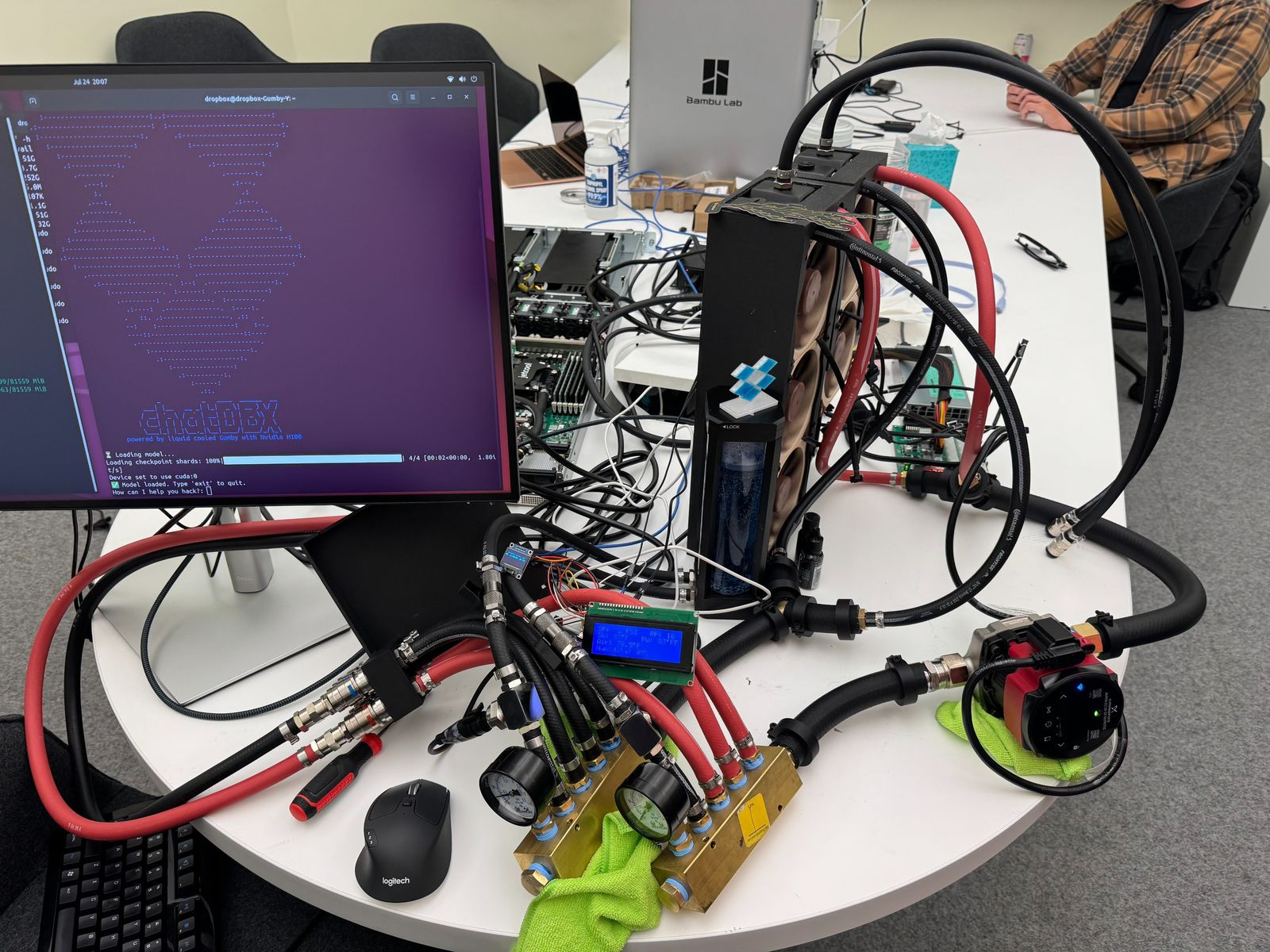
The prototype liquid-cooled GPU server
Support and next steps
Both engineers described a culture that permits experimentation: interest shared across their teams secured funding to start the project, and support ran upward once the case was made, balanced against regular work. Attending Hack Week in person for the first time, they cited the value of working in one room—bouncing ideas off colleagues and resolving problems quickly—echoing how physical infrastructure projects are usually kicked off on site at a data center.
The team plans to expand testing with more liquid cooling labs in multiple data centers.