
GitHub widens Copilot access for development teams
GitHub Copilot, the AI pair programmer first previewed with OpenAI in 2021, has evolved from a personal productivity tool into an enterprise offering. Following adoption by more than 400 organizations, GitHub Copilot for Business extends the extension-based assistant to every team member, with support ranging from small groups to large enterprises. The rollout coincides with a more advanced OpenAI model and several new capabilities announced earlier this month.
Copilot operates inside the developer's editor—Visual Studio, VS Code, JetBrains IDEs, and Neovim—offering real-time code completions drawn from nearby context. Developers can supply natural-language prompts and receive multiple suggestions to accept or reject. The system continually learns individual coding styles and conventions as it processes interaction.
Adoption metrics indicate the tool now accounts for a significant share of generated code. In June 2022, Copilot was behind 27% of developers' code; current telemetry shows the average has climbed to 46% across all programming languages, reaching 61% among Java developers.
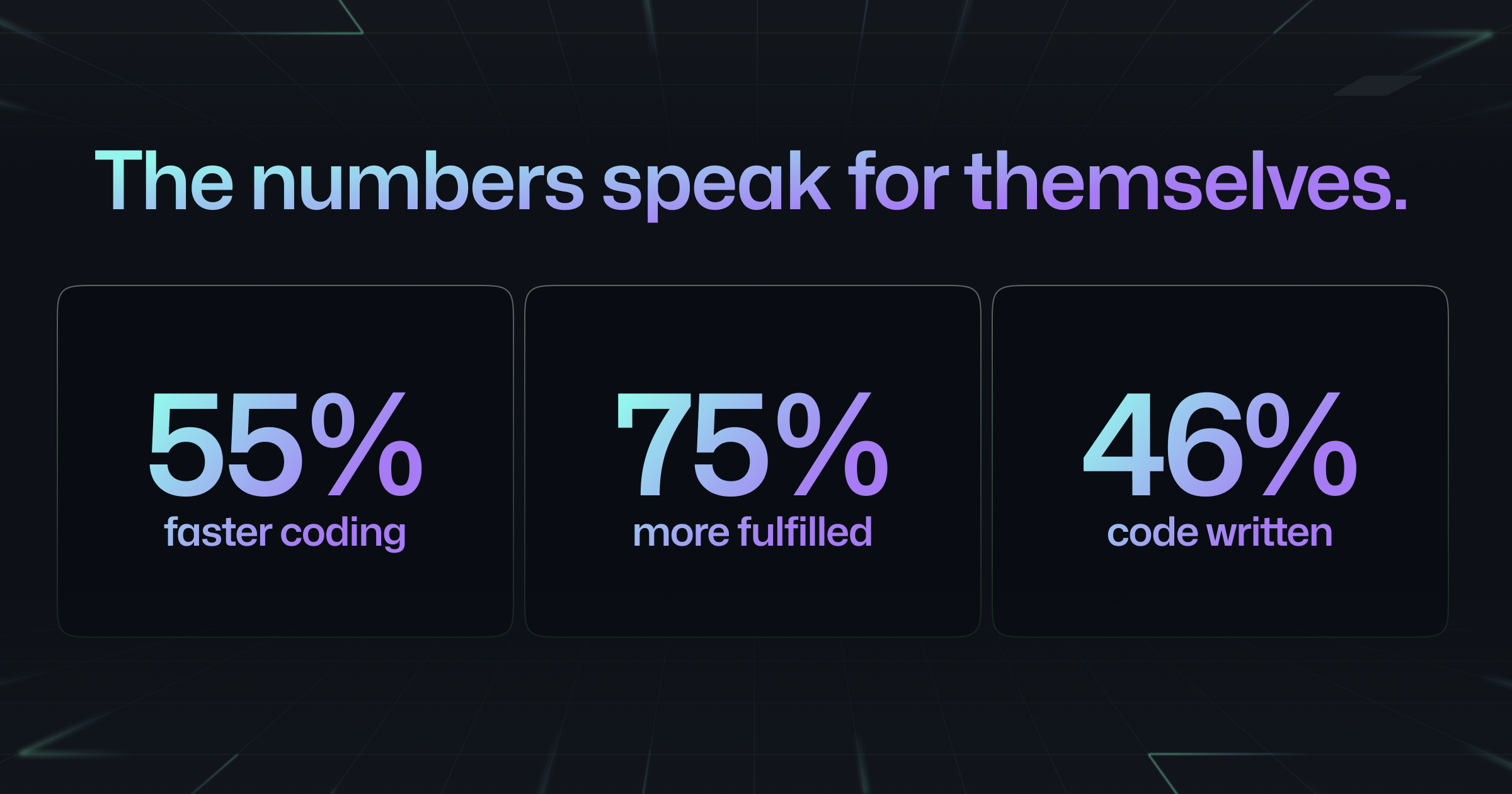
Survey data supports the productivity narrative: 90% of developers report completing tasks faster, 73% say they maintain flow and conserve mental energy more effectively, and up to 75% feel more fulfilled, with greater capacity for satisfying work.
Why enterprises are adopting Copilot
The business case for organization-wide deployment rests on compounding effects. When developers fix bugs faster, product and supply chain security improves. When boilerplate is generated rather than manually typed, teams concentrate on higher-value work. When developers can accelerate their learning curve on unfamiliar technologies, they deliver better solutions for customers. For teams of 100, 1,000, or 10,000 developers, the aggregate impact compounds accordingly.
GitHub frames Copilot for Business as part of a larger strategic direction: embedding AI across the full developer workflow, including pull requests and code deployments. The current release is positioned as the first step in that trajectory, aimed at organizations that see AI-powered development as a competitive advantage during a generational shift in software engineering.