Cutting the Embedded Carbon in Server Hardware
Meta’s data center hardware carries an environmental cost that goes well beyond the electricity it consumes. Manufacturing, transporting, and eventually disposing of servers, storage, and network gear contribute heavily to Scope 3 (value chain) emissions. With a company-wide goal of reaching net zero across its value chain by 2030, Meta’s hardware teams are focusing on reducing those upstream and downstream impacts. To guide that work—and to offer a playbook for the rest of the industry—Meta has published a set of technical guidelines called Design for Sustainability. The focus is on physical IT racks: compute, storage, network, and the power and cooling that support them.
The aim is simple in principle but complex in execution: make new hardware designs that produce fewer emissions and cost less over their lifetime. The levers are reuse, longer useful life, and smarter design choices.
From Efficiency to Full-Lifecycle Thinking
Historically, reducing the energy consumed by hardware during operation has been the main sustainability lever. But with net-zero goals in scope, teams must also account for the emissions tied to hardware before it arrives at a data center—and after it is decommissioned. This means optimizing material selection, designing for lower-carbon alternatives, and working with suppliers to reduce the emissions embodied in their manufacturing processes.
Meta's approach spans several overlapping strategies:
- Design for lowest emissions and extended life: System designs are optimized not only for performance but to extend the useful life of materials as long as possible, with the goal of sometimes skipping new generations of equipment entirely.
- Component harvesting: When racks reach end-of-life, components that still have service life left—such as Dual In-line Memory Modules (DIMMs)—are harvested and redeployed in new builds rather than scrapped.
- Data-driven roadmaps: By tracking the emissions profile of suppliers, components, and system designs, hardware teams can make informed decisions that steer future roadmaps toward lower-impact parts and processes.
- Supplier collaboration: Efforts to reduce scope 3 emissions necessarily include working with suppliers to electrify manufacturing, transition to renewable energy, and adopt lower-carbon materials.
These efforts have a co-benefit: reducing the electronic waste generated by data centers.
The Hardware Landscape: Racks and Components
Meta deploys a variety of rack designs to support different workloads, but from a sustainability standpoint, the principles apply broadly across all of them. The primary rack types are:
- AI: For training and inference workloads
- Compute: General compute for Meta's products and services
- Storage: For storing and maintaining product data
- Network: Low-latency interconnections between servers
While the architecture differs between rack types, they share a common pool of components and suppliers. This allows similar design principles to apply across the board. Within each rack, the targets for emissions reductions fall into five categories:
- Compute (memory, HDD/SSD)
- Storage
- Network
- Power
- Rack infrastructure (mechanical and thermal components)
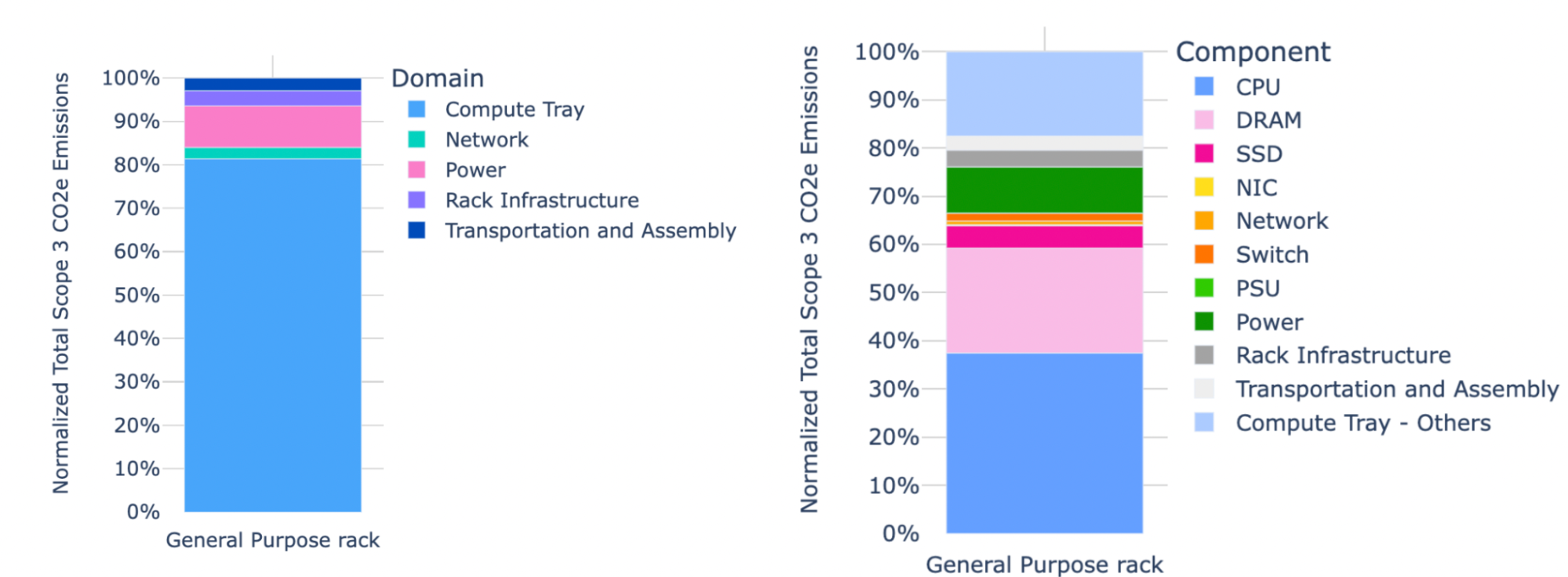
An illustrative emissions breakdown for a generic compute rack shows where the impact is concentrated:
A Shared Industry Playbook
Meta is making Design for Sustainability a public guideline, explicitly inviting wider industry adoption. For rack designers, the opportunity lies in making sustainable choices early in the product lifecycle—when component selection and architecture decisions are made. Sustainability is not a retrofit or an end-of-life activity. Collaboration between hardware designers, engineers, and sustainability experts is required to produce hardware that not only meets performance requirements but limits its environmental impact across its entire existence. The design choices made today determine the cost and the carbon footprint of the racks that will run—and be retired by—the data centers of the next decade. That thinking is now part of the design process.
Four Levers for Lower-Impact Hardware
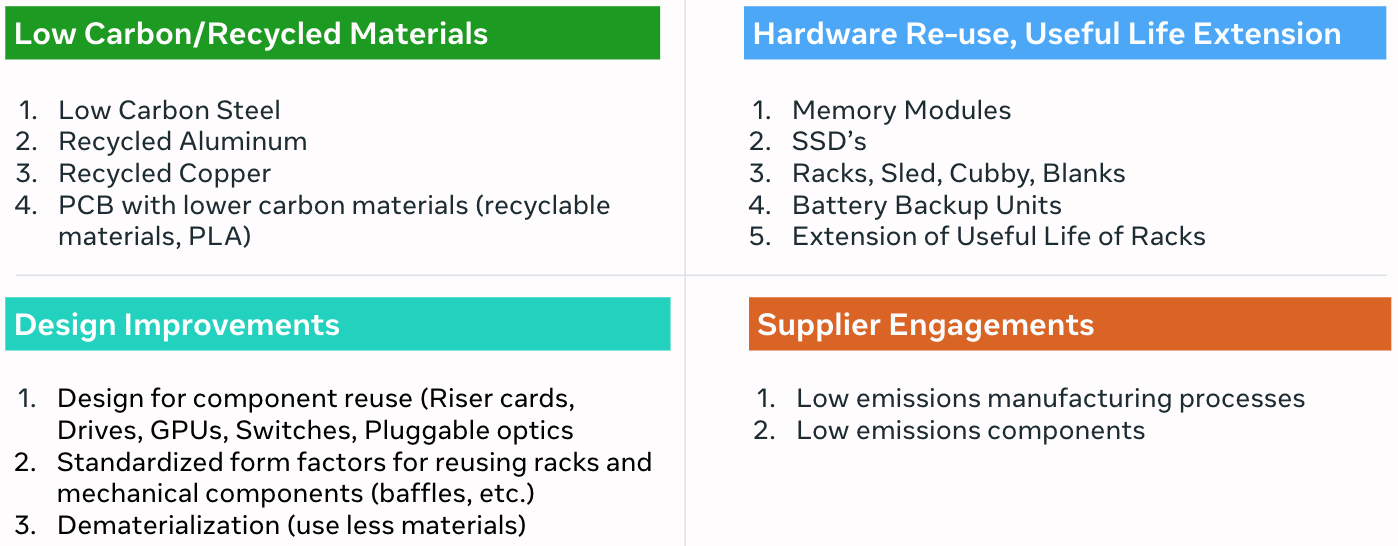
Meta groups its hardware emissions reduction work into four categories: modular rack designs, reuse and retrofitting, materials with lower embodied carbon, and extending useful life through reliability and dematerialization. Across all of these, the goal is to cut the carbon footprint of the racks, servers, memory, and SSDs that make up data center infrastructure.
Modular Rack Architectures
Open Rack designs (ORv2 and ORv3) make up the bulk of high-volume racks in Meta's data centers. The ORv3 specification introduced several features that improve serviceability and flexibility:
- Separate PSU and BBU shelves: Power Supply Units and Battery Backup Units are isolated into their own shelves, with toolless field replaceable units (FRUs) that simplify repairs and replacements.
- Flexible power placement: The 48 V power output lets the power shelf sit anywhere in the rack, unlike ORv2 which confined it to a specific power zone.
- Regional configurability: PSU and BBU shelf configurations can vary by region, for example dual AC input per PSU shelf in North America versus single AC input in Europe and Asia.
- Commonized frame effort: Work is underway to consolidate ORv3 rack variations into a single standard frame, reducing assembly complexity, quality risks, and product costs.
- ORv3N for networking: A derivative of ORv3 for network-specific applications includes in-rack PSU and BBU, improving efficiency and cost over traditional in-row UPS systems.

These modular principles need to carry into successive rack generations. The growth of AI workloads is driving new specialized racks for compute, storage, power, and cooling, which pressures designers to maintain modularity as those designs emerge.
Retrofitting and Reuse
Retrofitting existing rack designs for new purposes or higher density is a cost-effective alternative to purchasing new racks. The benefits include meaningful cost savings, reduced e-waste, faster deployment (no procurement or manufacturing lead times), and a smaller environmental footprint from reusing materials.
The trade-offs are real. Compatibility between old and new components can be hard to guarantee; power and cooling systems may need upgrades; retrofitted designs can limit future scalability; and thorough testing and validation are required to ensure retrofitted racks meet performance and reliability standards. Even so, retrofitting should be examined as an option for every new rack design.
Lower-Embodied-Carbon Materials
Steel represents a significant portion of a rack's and chassis's mass. Green steel, produced via electric arc furnaces (EAF) rather than basic oxygen furnaces (BOF), allows the use of clean electricity and higher recycled content. Meta works with suppliers who use 100% clean and renewable energy in green steel production.
Aluminum and copper are also widely used, particularly in heat sinks and wiring, and recycling these metals saves substantial energy compared with producing them from raw materials. Meta now mandates that all racks and chassis contain a minimum of 20% recycled steel, and that all heat sinks be manufactured entirely from recycled aluminum or copper. Product design teams are expected to work with original design manufacturers (ODMs) to ensure selected steel vendors can supply recycled material.
Reliability as a Life-Extension Tool
Extending the useful life of racks, servers, memory, and SSDs reduces the volume of new hardware that must be ordered, cutting both emissions and cost. Reliability benchmarking is necessary to determine whether life extensions are feasible and for how long. Diminishing availability of spares and vendor support must also be factored in, as must the increased risk of equipment failure, which requires a clear strategy for handling higher failure rates.
Dematerialization
Removing unnecessary components reduces consumption of raw materials, water, and energy. This applies both to large structures (consolidating multiple racks into fewer, more efficient ones) and to individual server motherboards, where extra components are frequently populated for reasons that may no longer apply:
- Future-proofing: Components are added in anticipation of design changes, avoiding a full board redesign later.
- Flexibility: Multiple connectors or interfaces allow one board to serve several applications.
- Debugging and testing: Test points, debug headers, and similar features aid engineers during development.
- Redundancy: Duplicate components protect against failure in high-reliability settings.
- Modularity: Users can customize or upgrade by adding or removing modules.
- Regulatory compliance: Some components are required, such as safety features or EMI filtering.
Shifts in requirements over time also accumulate extra components. Since modifying systems in production is difficult, each hardware design should optimize for the components that will actually be populated. Common examples of excess parts include unpopulated IC sockets or footprints, unused connectors or headers, test points, redundant power supplies or capacitors, optional memory or storage components, and unconnected or reserved pins. Removing these lowers the emissions footprint of both circuit boards and racks.
Productionizing Lower-Emissions Technologies
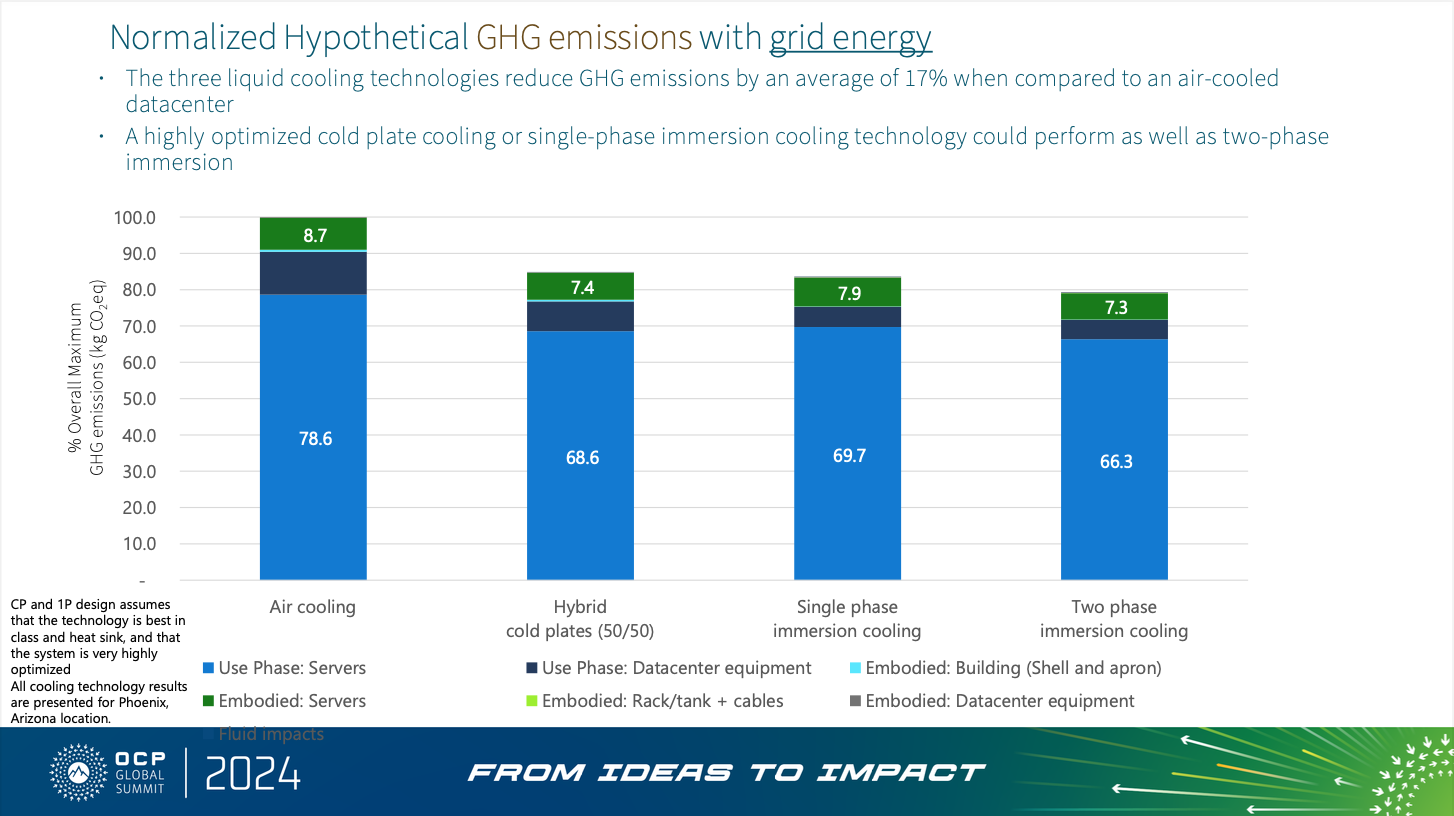
Memory and SSD/HDD are typically the single largest source of embodied carbon in a server rack. New technologies can reduce emissions and costs while improving power-normalized performance. For example, transitioning from HDD to SSD reduces the number of drives, servers, racks, BBUs, and PSUs needed while lowering overall energy use. Depending on local environmental conditions and workload, liquid cooling can be up to 17% more carbon-efficient than traditional air cooling.
Additional approaches for memory and storage include exploring phase-change memory (PCM) or Magnetoresistive Random-Access Memory (MRAM) with equivalent performance and lower carbon; using Low-Power Double Data Rate (LPDDR) memory for low power consumption and high bandwidth instead of DDR; removing, reusing, or down-clocking unused memory modules during idle periods; and using fewer high-capacity modules or High Bandwidth Memory (HBM), which consumes much less energy than DDR memory.
Supplier Engagement
Meta's net zero supplier engagement program sets GHG reduction targets with selected suppliers to support its net zero goal. The program focuses on capacity building, training suppliers to measure emissions, set science-aligned targets, build reduction roadmaps, procure renewable energy, and understand energy markets. It has scaled from 39 key suppliers in 2021 to 183 suppliers in 2024, covering over half of Meta's supplier-related emissions. Meta aims for two-thirds of its suppliers to set science-aligned GHG reduction targets by 2026; as of end-2024, 48% (by emissions contribution) have done so.
The Clean Energy Procurement Academy (CEPA), launched in 2023 with other corporations, helps suppliers, particularly in the Asia-Pacific region, learn to procure renewable energy through region-specific curricula.
Path to Net Zero
These design principles are central to Meta's goal of net zero emissions by 2030. Modularity, reuse, retrofitting, dematerialization, greener materials, and extended hardware lifecycles all contribute to reducing the carbon footprint of data center infrastructure while driving cost savings and operational efficiency.
Achieving these goals depends on collaboration across hardware designers, engineers, suppliers, and sustainability experts. Success will be measured by tangible emissions reductions, extended useful life of server hardware, and broad adoption of low-carbon technologies and materials.