

Securing GitHub Actions: The 2026 Roadmap
Software supply chain attacks are accelerating, and the target has shifted. Recent incidents against projects like tj-actions/changed-files, Nx, and trivy-action show a common pattern: attackers are going after CI/CD automation, not just the code it produces. The playbook is consistent: a vulnerability allows untrusted code execution, malicious workflows run unnoticed, compromised dependencies spread across thousands of repos, and over-permissioned credentials are exfiltrated via unrestricted network access.
These vulnerabilities are easy to introduce and hard to detect. The 2026 roadmap for GitHub Actions focuses on three layers of defense: the ecosystem, the attack surface, and the infrastructure. The goal is not a rearchitecture of Actions, but a shift toward secure defaults that help every team operate with CI/CD security expertise.
Deterministic Dependencies for the Actions Ecosystem
Today, Action dependencies are not deterministic. Workflows can reference dependencies through mutable tags or branches, which are resolved at runtime. That means what runs in CI is not always fixed or auditable. While using immutable commit SHAs helps, managing them at scale is difficult, and transitive dependencies remain opaque.
This mutability has real consequences. When a dependency is compromised, the change can propagate instantly to every workflow referencing it. Since the security posture of every maintainer across the ecosystem cannot be guaranteed, the system must not rely on it.
Workflow-Level Dependency Locking
A new dependencies: section in workflow YAML will lock all direct and transitive dependencies to their commit SHAs. Think of it as Go's go.mod + go.sum for your workflow, providing complete reproducibility and auditability.
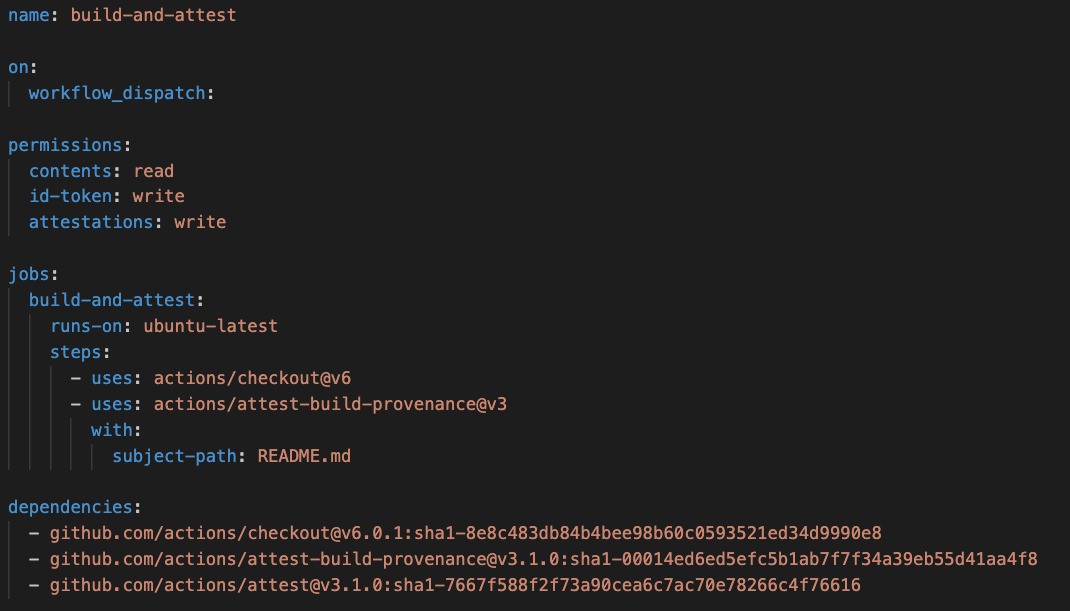
What this changes in practice:
- Deterministic runs: Every workflow executes exactly what was reviewed.
- Reviewable updates: Dependency changes show up as diffs in pull requests.
- Fail-fast verification: Hash mismatches stop execution before jobs run.
- Full visibility: Composite actions no longer hide nested dependencies.
In practice, teams will resolve dependencies via the GitHub CLI, commit the generated lock data into the workflow, and update by re-running resolution and reviewing the diffs.
Milestones:
| Phase | Target |
|---|---|
| Public preview | 3-6 months |
| General availability | 6 months |
Hardened Publishing with Immutable Releases
On the publishing side, the roadmap moves away from mutable references toward immutable releases with stricter release requirements. The goal is to make it clearer how and when code enters the ecosystem and to create a central enforcement point for detecting and blocking malicious code.
Reducing Attack Surface with Policy-Driven Execution
GitHub Actions is flexible by design: workflows can run in response to many events, be triggered by various actors, and operate with varying permissions. As organizations scale, this flexibility leads to over-permissioned workflows, unclear trust boundaries, and configurations that are easy to get wrong. Attacks like Pwn Requests demonstrate how subtle differences in event triggers, permissions, and execution contexts can be abused to compromise sensitive environments.
Addressing this at scale across thousands of repositories requires centralized policy rather than per-workflow reasoning.
Workflow Execution Protections via Rulesets
New workflow execution protections will be built on GitHub's ruleset framework. Instead of auditing individual YAML files, organizations define central policies controlling:
- Who can trigger workflows
- Which events are allowed
The core policy dimensions are:
- Actor rules: Specify who can trigger workflows — individual users, roles like repository admins, or trusted automation such as GitHub Apps, GitHub Copilot, or Dependabot.
- Event rules: Define which GitHub Actions events are permitted, such as
push,pull_request,workflow_dispatch, and others.
For example, an organization could restrict workflow_dispatch execution to maintainers, preventing contributors with write access from manually triggering sensitive deployment workflows. They could also prohibit pull_request_target events entirely and only allow pull_request, ensuring that workflows triggered by external contributions run without repository secrets or write permissions.
These protections apply consistently across repositories without per-workflow configuration, using rulesets and repository custom properties at the enterprise level. This reduces both operational risk and governance overhead.
Safe Rollout with Evaluate Mode
To support adoption, workflow execution rules include an evaluate mode. In this mode, rules are not enforced, but every workflow run that would have been blocked appears in policy insights, similar to repository rulesets insights. This lets organizations assess the impact of new policies before enforcing them: identifying affected workflows, validating coverage, and building confidence without disrupting existing automation.
Milestones:
| Phase | Target |
|---|---|
| Public preview | 3-6 months |
| General availability | 6 months |
Finer-Grained Secret Control
Today, secrets in GitHub Actions are scoped at the repository or organization level. That makes them awkward to use with reusable workflows, where credentials tend to flow broadly by default. The platform is moving toward scoped secrets that bind credentials to explicit execution contexts.
With scoped secrets, credentials can be tied to:
- Specific repositories or organizations
- Branches or environments
- Workflow identities or paths
- Trusted reusable workflows, without callers having to pass secrets explicitly
The practical effect: secrets are no longer implicitly inherited, access requires a matching execution context, and modified or unexpected workflows won't receive credentials.
Reusable workflow trust boundaries
Reusable workflows enable powerful composition, but the implicit secret inheritance that comes with them blurs trust boundaries. Credentials can end up flowing to execution paths that were never explicitly approved. Scoped secrets address this by binding credentials directly to trusted workflows, so callers don't automatically pass them along and trust boundaries become explicit.
Separating code contributions from credential management
The permission model for Action Secrets is also changing. Write access to a repository will no longer confer secret management permissions—a move toward least privilege by default. That capability will instead sit behind a dedicated custom role, while remaining part of repository admin, organization admin, and enterprise admin roles. The goal is to make sure credentials are only issued when both the workflow and the execution context are explicitly trusted.
Milestones:
| Capability | Phase | Target |
|---|---|---|
| Scoped secrets & reusable workflow inheritance | Public preview | 3-6 months |
| Scoped secrets & reusable workflow inheritance | GA | 6 months |
| Secrets permission | GA | 3-6 months |
The long-term goal: a unified policy-first model
Further out, the aim is to reduce implicit behaviors and per-workflow configurations in favor of centralized, enforceable policy. That means enterprises should be able to define clear trust boundaries for workflow execution, secret access, and event triggers without encoding complex security logic into every workflow file. The roadmap includes expanding policy coverage, adding richer approval and attestation gates, and consolidating today's fragmented controls into a single governance surface.
Endpoint Monitoring and Control for CI/CD Infrastructure
GitHub Actions runners execute untrusted code, handle sensitive credentials, and interact with external systems—yet visibility has historically been limited, controls minimal, and investigation reactive. When something goes wrong, organizations often can't tell what executed, where data flowed, or how a compromise unfolded. Recent attacks have demonstrated how unrestricted execution environments amplify impact, enabling secret exfiltration, unauthorized publishing, and long dwell times.
Two new capabilities are arriving to address this: the Actions Data Stream for visibility and a native egress firewall for control.
Actions Data Stream for near real-time telemetry
CI/CD visibility is currently fragmented. The Actions Data Stream delivers near real-time execution telemetry in batches to centralized destinations, with at-least-once delivery guarantees and a common schema for reliable indexing and correlation. Supported destinations are Amazon S3 and Azure Event Hub or Data Explorer.
What organizations can observe:
- Workflow and job execution details across repositories and organizations.
- Dependency resolution and action usage patterns.
- (Future) Network activity and policy enforcement outcomes.
Without centralized telemetry, anomalies go unnoticed until after an incident. The data stream is meant to make CI/CD observable like any other production system.
Milestones:
| Phase | Target |
|---|---|
| Public preview | 3-6 months |
| General availability | 6-9 months |
Native egress firewall for GitHub-hosted runners
GitHub-hosted runners currently allow unrestricted outbound network access, which means easy data exfiltration, no restrictions on which package registries can supply dependencies, and no clear distinction between expected and unexpected traffic. The native egress firewall changes that by operating at Layer 7, outside the runner VM. Because it's immutable even if an attacker gains root access inside the runner, organizations can define precise egress policies covering allowed domains and IP ranges, permitted HTTP methods, and TLS and protocol requirements.
The firewall provides two complementary capabilities:
- Monitor: All outbound traffic is audited and correlated to the workflow run, job, step, and initiating command. Teams can use this to understand what their workflows connect to, build informed allowlists, and assess the impact of restrictions before enforcing them.
- Enforce: Policies block any traffic not explicitly permitted, so only approved destinations are reachable from the build environment.
That pairing supports a safe adoption path: observe first, develop precise allowlists based on real data, then turn on enforcement with confidence.
Milestones:
| Phase | Target |
|---|---|
| Public preview | 6-9 months |
Moving toward runners as protected endpoints
The longer-term direction treats runners not as disposable black boxes but as protected endpoints, with process-level visibility, file system monitoring, richer execution signals, and near real-time enforcement.
CI/CD has become critical infrastructure, and the failures around dependency management, implicit trust boundaries, secret handling, and observability have fueled supply chain attacks. The 2026 roadmap responds by pushing the platform toward secure-by-default, verifiable automation: workflows become deterministic and reviewable, secrets are explicitly scoped rather than broadly inherited, execution is governed by policy rather than YAML alone, and runners become observable and controllable systems. The intent is to move GitHub Actions in that direction without requiring teams to rebuild their CI/CD model from scratch.



