

GitHub repositions itself as an AI-first developer platform
GitHub has expanded beyond its Git foundation with a platform-wide push to embed Copilot throughout the development lifecycle. At Universe 2023, the company detailed a series of product updates that place AI at the center of coding, collaboration, and security workflows, from the editor to the command line to mobile devices.
The centerpiece is Copilot Chat, which will reach general availability in December 2023. It ships as part of existing GitHub Copilot subscriptions for organizations and individuals, and remains free for verified teachers, students, and maintainers of popular open source projects. Copilot Chat is also coming to github.com and the GitHub mobile app for iOS and Android, allowing developers to ask questions about repositories, files, and documentation using natural language, either typed or spoken.
With Copilot Chat integrated into github.com and combined with advanced code search, developers can get suggestions and summaries based on recent changes to popular open source projects. The company positions this as making Copilot available across every GitHub surface area, not just code editors.
GitHub Copilot Enterprise targets organizational context
A new tier, GitHub Copilot Enterprise, brings Copilot Chat to repositories on github.com with the full context of an organization's codebase. Developers can use it to get up to speed on internal code, search through documentation, receive suggestions based on private code, and review pull requests. Smart actions, including generating pull request summaries, are available throughout GitHub. The offering includes enterprise-grade security and privacy protections.
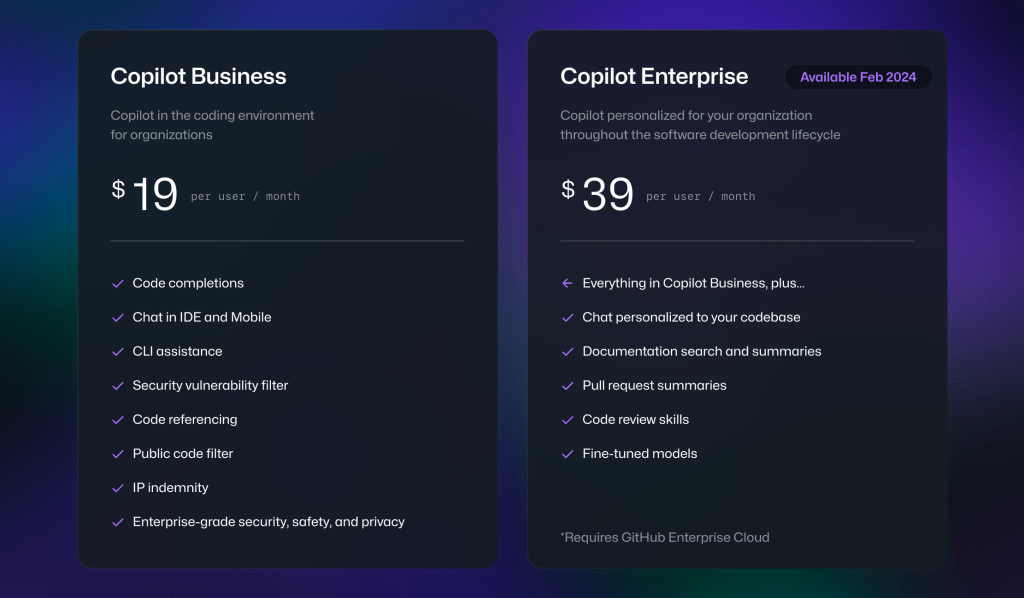
GitHub Copilot Enterprise is scheduled for general availability in February 2024, priced at $39 USD per user per month.
Third-party integrations expand Copilot's reach
GitHub is opening Copilot to external developers through the GitHub Copilot Partner Program, which lets third-party tools and services connect their knowledge into Copilot. The initial cohort includes more than 25 partners, such as Datastax, LaunchDarkly, Postman, Hashicorp, and Datadog. Potential use cases include improving database query performance, checking feature flag status, and viewing A/B test results.
AI-powered security features ship with Advanced Security
On the security front, GitHub Copilot now applies an LLM-based vulnerability prevention system that blocks insecure coding patterns in real time, targeting common issues such as hardcoded credentials, SQL injections, and path injections. Copilot Chat can also identify security vulnerabilities in the IDE, explain how a vulnerability works, and suggest fixes for highlighted code.
GitHub Advanced Security is gaining new AI-powered application security testing capabilities:
- Code scanning autofix generates AI-assisted fixes using CodeQL for JavaScript and TypeScript directly in pull requests, helping developers resolve issues faster and avoid introducing new vulnerabilities.
- Secret scanning for generic secrets and a regular expression generator for custom patterns help detect leaked secrets with low false positive rates.
These features are available in preview now and will be included in the Advanced Security subscription.
Copilot Workspace moves from issue to pull request
GitHub Next, the company's research arm, has developed Copilot Workspace, an early prototype that addresses the planning stage of development. When a developer opens an issue, Copilot Workspace proposes a plan for implementing the change. The workspace is fully editable, letting developers steer the AI while it draws on the issue's intent and the codebase. Developers can build, run, and test the code directly, with automatic error fixing if something fails. Copilot Workspace is expected to arrive in 2024.
Collectively, these announcements reflect GitHub's conviction that AI is fundamentally reshaping how software is built. As with the shift from centralized version control to Git-based collaboration, the company sees Copilot as a new foundation layer—one that spans ideation, coding, review, deployment, and security. The evolution continues, and Copilot remains the common thread through GitHub's roadmap.



