Bringing STARK Proofs to the Mainstream
Proofs of computational integrity (CI) let you demonstrate that a computation was performed correctly without requiring anyone to re-run it. Verification takes just milliseconds, regardless of how long or complex the original computation was. A subset of these proofs, zero-knowledge proofs (ZKPs), additionally allow you to hide some or all of the inputs — for example, proving that a number lies within a certain range without disclosing the number itself.
Despite decades of academic interest and a recent surge of new proving systems — some securing billions of dollars in production — ZKPs have remained largely inaccessible to the average developer. Two factors explain this. First, deploying ZKPs historically required expert cryptographers; while accessible resources now exist, choosing among proving systems and understanding their trade-offs still demands deep expertise. Second, proof generation is computationally intensive, often taking seconds or minutes even for simple computations, with only recent advances making a broad class of programs tractable.
To address both gaps, we are releasing Winterfell, a general-purpose STARK (Scalable Transparent Arguments of Knowledge) prover and verifier written in Rust at Novi Research. Version 0.1 is now available on Crates.io.

Why STARKs
Winterfell is based on the STARK proof-of-computation scheme developed by Eli Ben-Sasson, Michael Riabzev, and colleagues. Compared with other CI proving systems, STARKs offer a distinctive combination of properties:
- Minimal cryptographic assumptions. A collision-resistant hash function (e.g., SHA256) is the only cryptographic primitive required. This also makes STARKs resistant to attacks from quantum computers.
- Full transparency. STARKs require no trusted setup ceremonies, eliminating a potential weakness found in other zero-knowledge protocols where a compromised setup could allow forged proofs.
- Fast, parallelizable proof generation. For computations with regular structures — which describes most real-world programs — STARK proof generation is extremely fast. Nearly every step of the process is massively parallelizable, so proof generation can be sped up by adding CPU cores.
None of these properties is unique to STARKs individually, but no other proving system combines lean cryptography, transparency, and performance to the same extent. Winterfell takes advantage of these benefits while abstracting away most of the underlying complexity.
Design Goals
Winterfell is built with several objectives in mind:
Performance. Proof generation can be distributed across multiple CPU cores to dramatically reduce generation time, with plans for fully distributed generation across multiple machines already in progress. Benchmarks are available in the repository.
Configurability. Nearly all parameters of the STARK protocol can be tuned dynamically to hit specific performance and security targets. Rust's zero-cost abstractions allow this flexibility without sacrificing performance or code clarity.
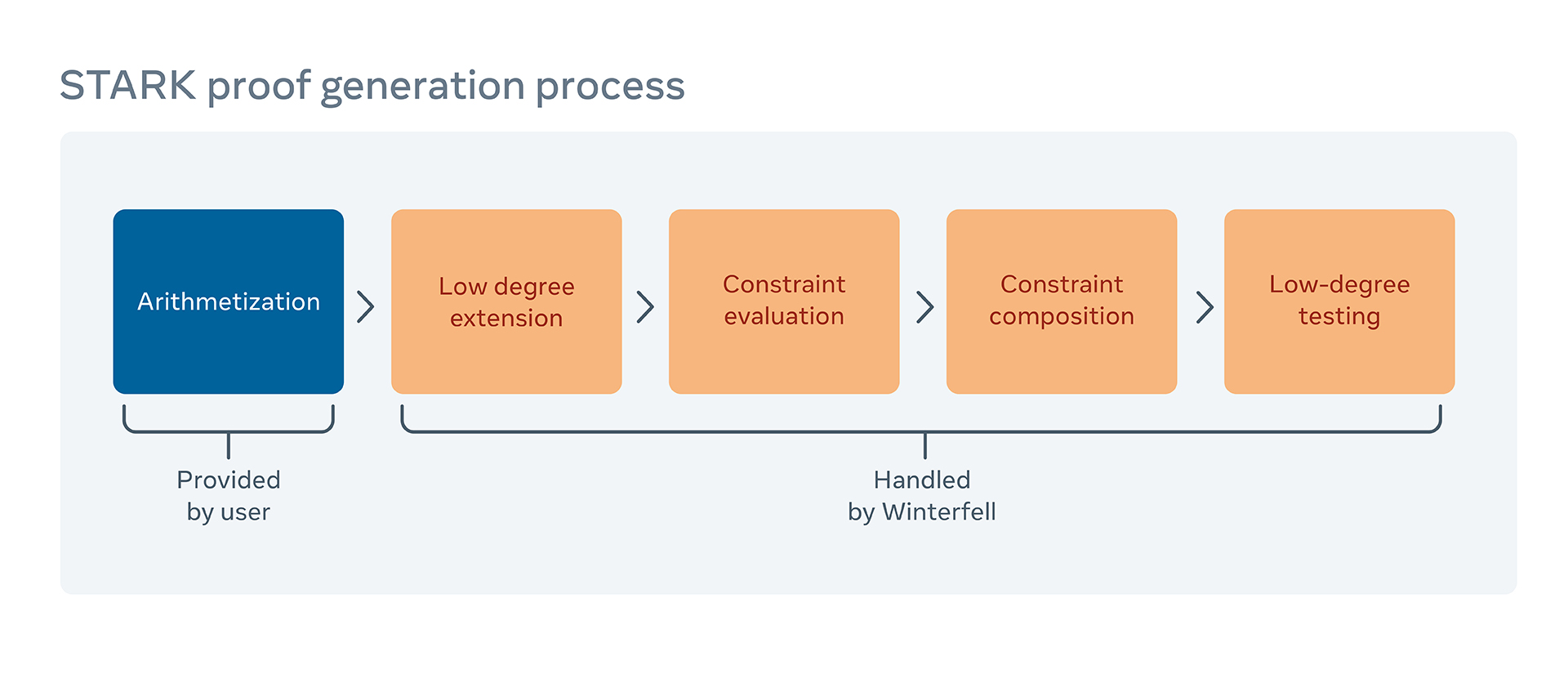
Accessibility. Users do not need to be cryptographers. The only responsibility placed on the user is describing their computation in algebraic intermediate representation (AIR), the format understood by the prover and verifier. The process of translating a program into AIR is called arithmetization.
Using Winterfell
While arithmetization is unfamiliar territory for most developers, Winterfell's interface for describing AIR is relatively simple, and getting started is straightforward. An end-to-end tutorial shows how to define AIR for a basic computation. The examples crate includes cases ranging from a Fibonacci sequence to aggregation of hash-based signatures. AIR for a Fibonacci sequence requires under 100 lines of code and can be assembled in about 15 minutes; the much more complex signature aggregation example fits in roughly 600 lines.
Winterfell is also modular. The crates being published to Crates.io today are general-purpose building blocks for CI proving systems, not just STARKs. For instance, the winter-fri crate implements the FRI low-degree testing protocol, which is also used by other transparent, post-quantum proof systems such as Fractal and Aurora. This modularity may help implementers of those protocols speed up their own work.
Applications
Much of the recent momentum behind ZKPs stems from blockchain use cases, where they offer potential solutions to two pressing challenges: privacy and scalability. However, the technology has numerous potential applications beyond blockchain — in security, privacy, and other fields where verifiable computation is valuable.
Technical challenges remain before CI proofs become practical at a large scale, but Winterfell aims to be a stepping stone between academic research and practical deployment. The code is available in the Winterfell repository, where we welcome feedback via issues.



