
What Vercel Functions take off your plate
Vercel Functions handle request-driven code execution without you provisioning servers or managing hardware. That shift removes a chunk of operational work that comes with traditional infrastructure, particularly for small teams. Beyond the convenience, the managed model brings specific technical benefits worth understanding.
Patched runtimes and smaller attack surface
Self-managed servers require ongoing configuration, patching, and monitoring for vulnerabilities. That maintenance can mean downtime when updates require a restart.
Vercel Functions isolate each workload and automatically patch the OS, kernel, and hypervisor layers. Node.js runtime versions are updated automatically, including critical security patches, so workloads run on a maintained environment without manual intervention.
Layer | Vercel | Virtual Private Server (VPS) |
|---|---|---|
OS | Vercel Managed | Customer Managed |
Runtime | Vercel Managed | Customer Managed |
Hypervisor | Vercel Managed | VPS Managed |
User Code | Customer Managed | Customer Managed |
Vercel uses a shared responsibility model for security. Enterprise customers can opt for dedicated, isolated build and compute via Vercel Secure Compute.
Scaling without noisy neighbors
With traditional servers, you manage capacity yourself, and applications can suffer when requests compete for resources on the same instance. Vercel Functions scale automatically with traffic and do not share resources in a way that causes event-loop queuing or latency spikes.
The runtime itself is built on a Rust-powered core with bytecode caching, which reduces cold starts and keeps latency consistently low.
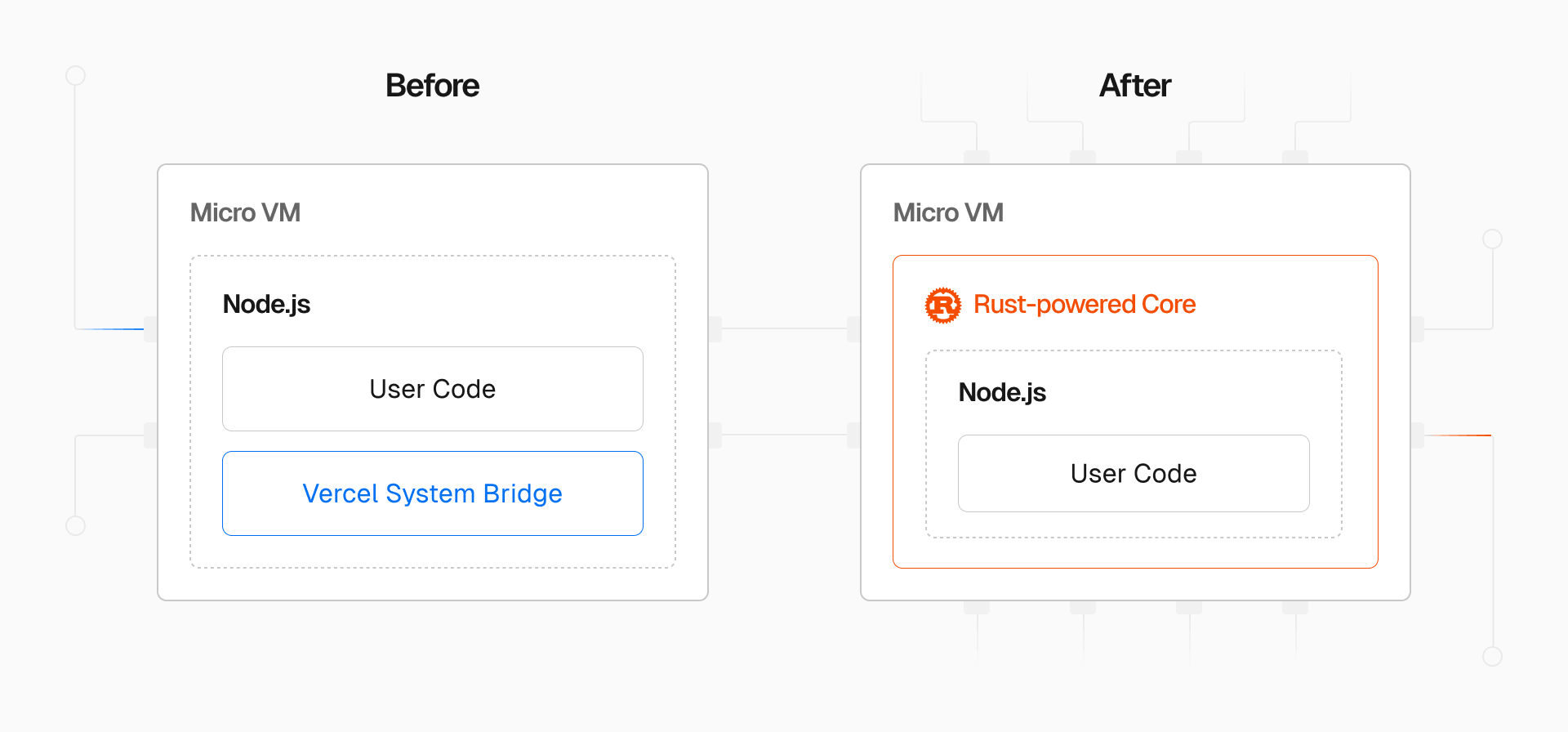
For larger workloads, moving logic from Node.js to the Rust core yields measurable gains:

Automatic scaling should still be paired with spend controls and observability so that elasticity does not turn into unbounded cost.
Availability and regional failover
Functions provide high availability without manual failover engineering. Workloads scale and fail over automatically across availability zones and, for the Node.js runtime, across regions. Additional safeguards such as Instant Rollback and Skew Protection help keep deployments online during rollouts or incidents.
Scaling down as fast as up
Vercel Functions handle spiky traffic patterns, scaling to 30,000 concurrent requests (100,000+ on Enterprise) without intervention. That makes them well-suited to ecommerce, media, or launch-day traffic spikes.
Traditional dedicated servers offer predictable flat-rate data transfer but require manual upgrades when you outgrow the hardware. On-demand compute gives you granular spend control: you pay for the resources used during a traffic surge, then return to baseline without changing hardware.
Infrastructure is created from your framework code, so spinning up compute for a new idea is quick. With Deployment Protection in place, usage and costs scale back to zero when the experiment is done, rather than leaving idle compute running indefinitely.
Keeping "denial of wallet" at bay
Elastic infrastructure should not mean surprise bills. Vercel offers recursion protection, spend controls, and an advanced Firewall for rate limiting and traffic challenges.
You can enforce a maximum function duration, monitor usage in real time, block suspicious traffic patterns, and set soft or hard spend limits. Alerts arrive via dashboard, email, or SMS, giving you visibility to optimize usage and control costs while still accommodating traffic surges.


Observability built in
Most infrastructure platforms expect you to assemble your own monitoring stack. Vercel Functions integrate with an observability suite that includes build and runtime logs, traffic monitoring, and log drains to external services.

Runtime logs show status, duration, and URL for each invocation. OpenTelemetry (OTEL) tracing is also supported, and request metrics display outgoing fetch calls alongside their traces for faster root-cause analysis.


The managed-function tradeoff
Vercel Functions swap manual infrastructure management for automatic scaling, built-in resilience, and usage-based cost. The tradeoff is a less predictable line item than a fixed server bill, but the platform provides enforcement and alerting tools to mitigate that variance.
The result is that teams write framework code and get scalable compute, preview environments, instant rollbacks, SSL, regional deployment options, and CI/CD integrated into their Git workflow without standing up infrastructure themselves.



