Systems Performance Returns, Updated for the Cloud and BPF Era
Eight years after the original publication, Brendan Gregg has announced the second edition of Systems Performance: Enterprise and the Cloud. The new edition, scheduled for release in November 2020 by Addison-Wesley, arrives with substantial revisions reflecting a decade of changes in the field.
The first edition sold over 10,000 copies and became recommended reading at numerous companies, often cited in job descriptions and praised for its value in teaching not just performance analysis but computer internals more broadly. The second edition is written by a more experienced author: the six years Gregg spent as a senior performance engineer at Netflix since the first edition are baked into the new text. A review team of more than 30 engineers also contributed to the revision.
What's New in the Second Edition
The most significant addition is expanded coverage of modern tracing and observability tooling. The book now includes dedicated content on BPF, BCC, bpftrace, perf, and Ftrace, shifting the focus significantly toward the Linux ecosystem. Solaris content has been mostly removed, with updates throughout to Linux and cloud computing topics.
To illustrate the scale of change, Gregg shared visualizations of the revised text. Chapter 6, CPUs, for example, uses a color-coding scheme to show reviewers where text has been added, with yellow, green, aqua, blue, purple, and red marking changes from oldest to newest. The image below shows how much of the chapter consists of new material, and a similar visualization for the entire book is available as a 3.1 MB JPEG. These visuals were captured from a draft from July 2020 and don't yet capture final copy edits or figure changes.
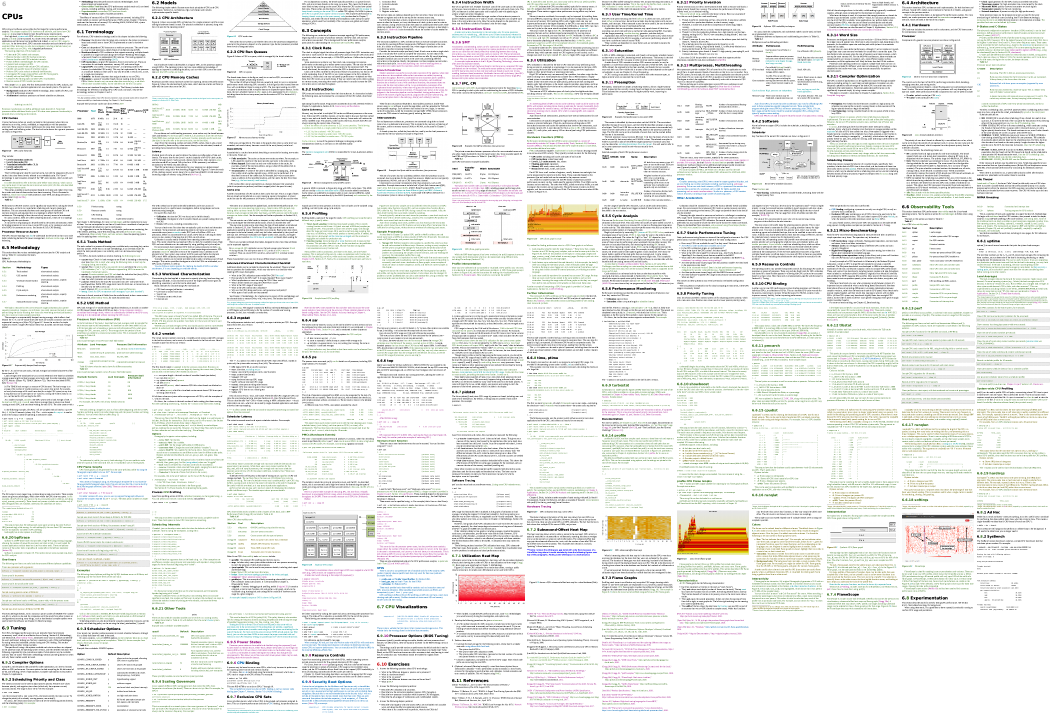
Chapter 6, CPUs, with changes highlighted in color.
A Two-Volume Set
Gregg frames the second edition as volume 1 of a two-volume set, with his 2019 book BPF Performance Tools: Linux System and Application Observability serving as volume 2 on BPF tracing tools. The books have minimal overlap, and each serves a different audience.
The updated Systems Performance targets a wider audience, balancing models, theory, architecture, observability tools (both traditional and tracing), experimental tools, and tuning. It functions as a handbook for anyone learning performance engineering or seeking to understand computer internals. BPF Performance Tools, by contrast, is more focused for readers who want to jump straight to advanced tooling and quick wins.
The book will run around 800 pages and is already listed on Amazon.com. Full purchasing details are available on the book's dedicated website.



