
A pricing model that charges only for compute in use
Fluid compute was built for a different kind of workload: I/O-bound backends such as AI inference, agents, MCP servers, and other systems that must scale instantly but often sit idle between operations. Those workloads are long-running and unpredictable, which makes them a poor fit for conventional request-response infrastructure.
Fluid quickly became the default compute model on Vercel, reducing costs by as much as 85% through techniques like in-function concurrency. The new Active CPU pricing extends those savings by billing CPU time only when code is actually executing, rather than for the entire time a function is alive. For workloads with significant idle periods—AI inference among them—this can mean additional savings of up to 90%.
From always-on servers to the serverless trade-off
The first cloud generation required long-lived servers, manual provisioning, and a plan for traffic spikes. Over-provisioning was common, and idle servers were pure waste. Serverless removed much of that management burden and introduced automatic scaling, but at a price: each request triggered its own ephemeral, single-purpose instance. That led to cold starts, duplicated overhead, and underutilized compute. Teams were back to paying for resources they did not actually use.


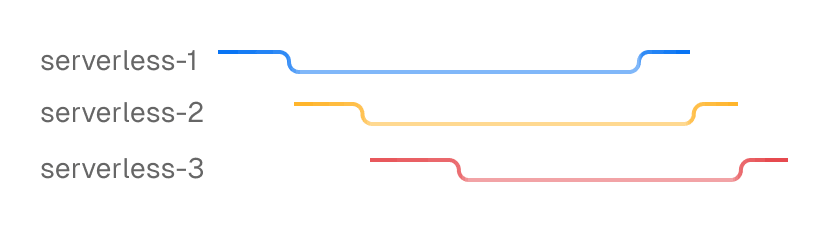

Fluid’s break with one-request-per-instance
Fluid compute discards the one-to-one serverless model. Rather than creating a fresh instance per invocation, it orchestrates compute across invocations, allowing concurrent requests to share the same underlying resources. That removes cold starts and puts idle memory to work, which is why Fluid became the default for AI workloads on Vercel and has powered more than one trillion invocations. Teams have seen up to 90% cost reductions as a result.




What Active CPU changes
Even with high concurrency, there are periods where every invocation is waiting on an external response and no code is running. During that time, functions remain in memory and accrue CPU cost without doing any work. Active CPU pricing fixes that by measuring compute time only when the CPU is actively utilized.


Fluid compute bills by execution time, not wall time.
That shift ties pricing to actual usage: compute costs scale with real work, not with how long a function happens to be alive.
How the new billing breaks down
Fluid compute now charges on three metrics that map to real resource consumption:
- Active CPU: time your code spends actively executing on a virtual CPU (vCPU), measured in milliseconds and calculated as vCPUs allocated times time actively used. Pricing starts at $0.128 per hour.
- Provisioned Memory: the memory needed to keep a function alive while running, measured in GB-hours. This is billed at a rate under 10% of Active CPU because Fluid can reuse memory across concurrent invocations. Pricing starts at $0.0106 per GB-Hour.
- Invocations: charged per function call, as in traditional serverless.
A practical example: a function on a Standard machine running at 100% Active CPU now costs about $0.149 per hour (1 Active CPU GB-Hour plus 2 GB of provisioned memory). Under the previous pricing model, the same function cost $0.31842 per hour (1.7 GB Memory at $0.18).
Built for how modern apps run
Fluid is Vercel’s proprietary compute platform, designed around concurrency, reuse, and efficiency. It supports standard runtimes like Node.js and Python so existing code runs unchanged. The same compute engine powers core products including Functions and the recently announced Sandbox, all with unified billing across the stack.
Availability
Active CPU pricing is on by default for Hobby, Pro, and new Enterprise teams. Existing Enterprise customers get access depending on their plan configuration; most will have it immediately. Teams on Enterprise plans should contact their Vercel account representative to enable the new pricing model.



