
Scaling Codebases Without Sacrificing Velocity
Growth is inevitable for software organizations, and the way a codebase is structured determines whether that growth accelerates or constrains development. There are plenty of architectural buzzwords — monoliths, monorepos, micro frontends, module federation — but the real question is how to keep releasing code quickly as teams and projects expand. Common pain points include slowing frontend performance, release cycles stretching from hours to days, and teams rolling their own configuration and tooling instead of sharing it. When repositories proliferate, even locating code becomes a chore.
The goal isn't to follow trends but to solve concrete problems: releasing frequently with fast iterations, adopting new technology without big-bang migrations, letting teams work independently on different parts of the UI, and sharing scripts and configuration rather than reinventing them. A well-structured monorepo is the foundation for achieving all of these.
Monorepos: One Home for All Code
A monorepo holds multiple projects in a single repository. It preserves the main benefit of a monolith — a single place for onboarding, local setup, and contributions — while solving the monolith's core weaknesses: difficulty adopting new technology incrementally and inability to let teams own distinct parts of the UI independently.
Historically, monorepos were the domain of giants like Google and Meta. Open-source tooling like Turborepo has made them accessible to teams of any size by bringing the workflows of large-scale development to everyone. Turborepo is a high-performance build system with sensible defaults and escape hatches for custom configuration. It lets you split a codebase into logical sections — a component library, frontend slices per team, shared business logic — while automating task orchestration based on the dependency graph. When a team changes their section, only that code builds or triggers CI runs, thanks to caching. Code reuse across teams becomes a simple import statement.
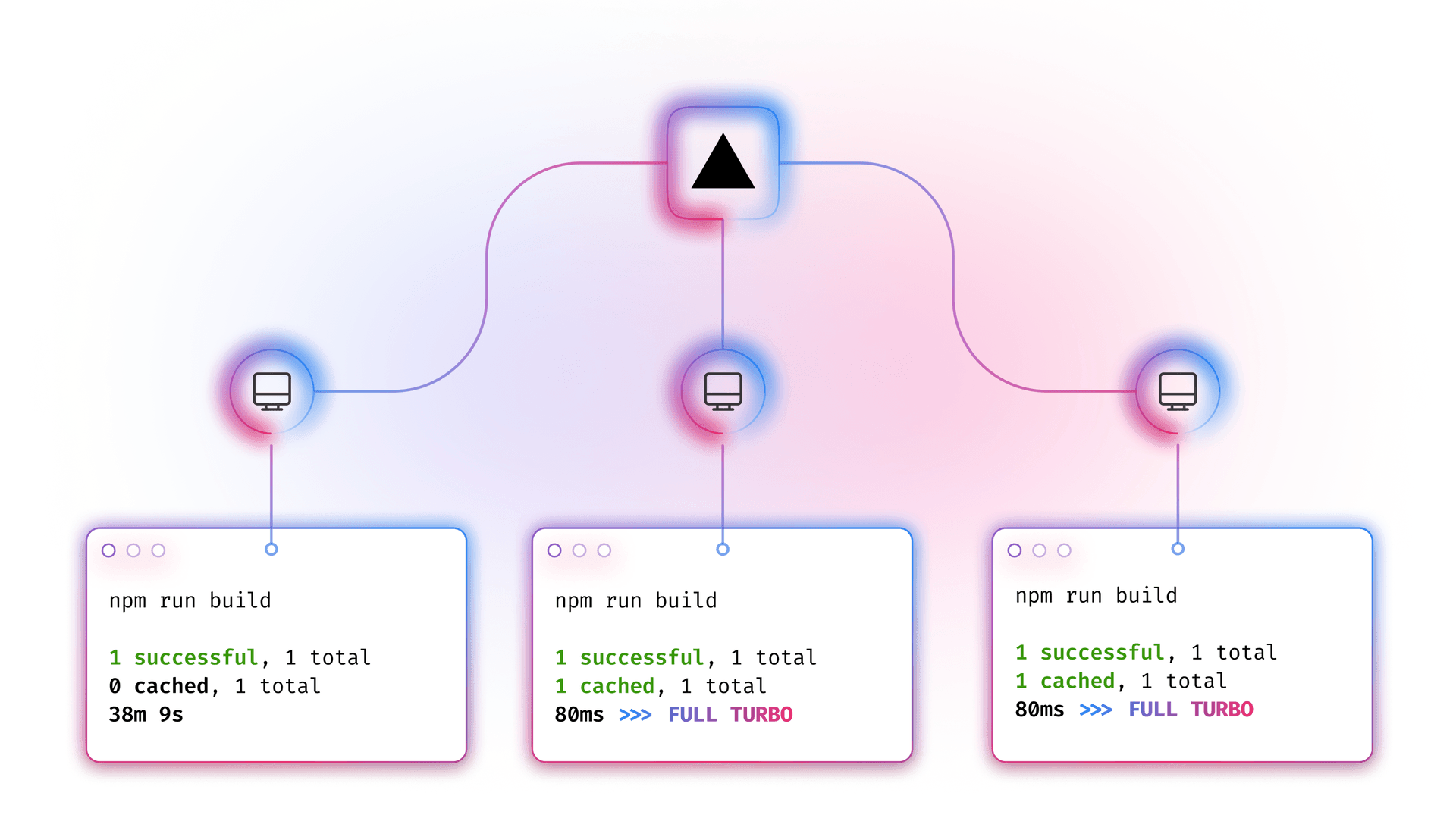

Each team can own their portion of the UI with appropriate code reviews and ownership scoped to that section. Sweeping changes across shared code are orchestrated as a single change, rolled out safely behind feature flags. Turborepo handles task ordering automatically, so there's no need to remember whether package A must be built before package B.
Recommended tooling for this architecture: Turborepo for monorepo management, build scripts, and code generation; pnpm as the package manager.
Feature Flags: Decoupling Deploy from Release
Monorepos enable teams to release independently, but high iteration velocity demands confidence in those releases. The way to get that confidence is to separate deployment from release using feature flags. Flags let you change UI and behavior without redeploying, and compile-time checks in the monorepo maintain safety and performance while runtime behavior remains dynamic.
Performance is a common concern with features flags — reading flag values dynamically on every request could add latency. The recommended architecture pushes flag values to low-latency data storage in every region. At Vercel, flag values live in Edge Config, which is synchronized across the Edge Network. Most reads complete in roughly ~5ms, with 99% within ~15ms. Changes made in a flag provider automatically sync and push to all regions, so the UI can change without a redeploy.
"The combination of Vercel Edge Config and the LaunchDarkly integration for Vercel lets us update our feature flagging configurations comfortably and automatically push them to our Edge Config store in real time. We are able to change the UI and behavior of our application without the need to re-deploy, which keeps us highly flexible. The low latency that Edge Config provides reduces the overhead of fetching flag configurations over HTTP, allowing us to have minimal latency and create a better experience for our users."

Vincent Derks, Lead Engineer at Joyn
Recommended providers include LaunchDarkly, Statsig, Opti, Hypertune, and other Edge Config integrations.
Incremental Builds for Faster Experimentation
Experimentation requires fast iteration, but long build and deploy times inhibit it. Scaling requires making every part of the build incremental — reusing completed work through caching and only running code that has changed. Build processes grow with the application: type checking, testing, prerendering static pages, bundling assets, installing dependencies, restoring caches, and uploading outputs.
Turborepo tackles this by running independent tasks in parallel and fingerprinting the result of each for caching. When input changes, only the affected task is invalidated and re-executed, with changes propagating through the dependency graph with minimal re-computation. A remote cache extends this to CI and local development. On Vercel's remote cache, customers have saved over a decade of cumulative CI time — time that goes back into building features rather than waiting on builds.
For CI/CD, Vercel's remote caching is recommended alongside Turborepo for incremental builds and task execution.
Skew Protection: Consistent Client and Server Versions
Frequent releases introduce the problem of version skew: when a client runs a different version of the application than the server, unexpected errors occur. For example, a new deployment that adds a required field to a user profile will break older clients that don't expect it.
With customers deploying over 6 million times per month, Vercel solves this with Skew Protection at the platform and framework layer. It uses version locking to ensure the client and server always run the exact same version. Outdated clients continue communicating with servers that understand the old data structure, while updated clients get the most recent deployment — no cross-version errors.
Recommended: Vercel Skew Protection for deployment safety.
Composable Architecture and Incremental Change
Large-scale, one-time migrations are no longer a practical option. The risk and cost of a failed migration are simply too high. The more responsible path for evolving a large codebase is through incremental migrations, which requires the codebase to be built from smaller, independent pieces that can be updated or replaced over time.
This composable approach lets teams select the best tool for each task and continue refining those choices as needs evolve. Most modern architectures reflect this reality, combining the strongest options from different cloud verticals for each specific use case. A frontend cloud platform can serve as the connective layer that orchestrates these pieces to deliver the final user-facing product experience, with the goal of minimizing the time required for engineering teams to iterate and deploy changes safely.
Practical starting points for incremental adoption
- Incremental migration guides
- Frontend cloud integrations
- Monorepo-based composable architecture
Building a Foundation for Velocity
Scaling a codebase is ultimately about creating a foundation that raises the baseline for iteration speed. The objective is to ensure your team can continue delivering value to customers regardless of how large the organization becomes. With the correct tools and strategies, this can have a transformative impact on the business.
The most significant obstacle is usually organizational, not technical. Adopting this workflow requires a cultural shift—viewing these challenges not as obstacles but as opportunities for ongoing iteration and refinement. The success criteria for this strategy are straightforward:
- Releasing new changes frequently, with fast iterations
- Integrating new technologies into an existing codebase with ease
- Enabling teams to work independently on separate parts of the UI
- Sharing and reusing scripts and configuration instead of starting from scratch
Meeting these goals comes down to embracing monorepos, using feature flags effectively, implementing incremental builds, and adopting skew protection. When these practices are in place, teams can safely move faster and adapt without waiting for a high-risk "big bang" release cycle.



