Subsea Cables and Africa's Digital Economy
Submarine fiber optic cables form the backbone of global internet infrastructure, yet they remain largely invisible to the people who depend on them. These undersea links connect countries, carry communications traffic, and enable commerce and education across continents. The relationship between internet connectivity and economic growth is well documented, but few rigorous studies have quantified the specific effects of cable landings on national economies — particularly in Africa, where access gaps remain wide.
The 2Africa cable project, currently in development with regional and global partners, is one of the largest subsea cable initiatives ever undertaken. At 37,000 kilometers — nearly the circumference of the Earth — it will interconnect 23 countries across Africa, the Middle East, and Europe. The system will deliver more capacity than the combined total of all subsea cables currently serving Africa and will link the continent from east to west for the first time. The timing is significant: broadband traffic worldwide is growing rapidly as more industries depend on high-quality, reliable connectivity to produce and sell goods and services.
Projected Economic Impact of 2Africa
RTI International, an independent nonprofit research institute, estimates that 2Africa could increase African GDP by 0.42 to 0.58 percent within the first two to three years of going live in 2023–2024. At purchasing power parity (PPP) — a metric that adjusts for differences in living standards between countries — that translates to USD 26.4 to 36.9 billion. The analysis draws on empirical evidence, current market conditions, and expert consultations on how broadband affects the African economy.
RTI's projections, based on patterns observed from previous subsea cable deployments, anticipate gains in employment — including high-skilled positions — along with greater business efficiency and productivity, and improved access to education, healthcare, and commerce. The research team notes that additional benefits may accrue beyond the initial two- to three-year window, though those longer-term effects remain difficult to quantify at this stage. The research was conducted prior to the COVID-19 pandemic.
Evidence from Six Sub-Saharan Countries
RTI has also released a series of country-level studies examining how subsea cable landings have shaped economic development in six sub-Saharan African nations over the past six to ten years. Researchers used advanced statistical techniques while controlling for technology trends, population characteristics, and other variables. The results vary across countries, but four of the six showed notable employment gains attributable to improved connectivity.
- Nigeria: Subsea cable landings completed since 2010 have produced a 7.8 percent increase in the likelihood of employment in areas connected to terrestrial fiber. For every 1 million people in connected areas, that translates to 78,000 additional jobs.
- Democratic Republic of Congo: Following a cable landing in 2012, connected areas saw an 8.2 percent increase in the likelihood of employment and a 19 percent increase in GDP per capita by 2017 ($789 vs. $663 at PPP).
- Kenya: Connected areas experienced an 8.4 percent overall increase in skilled employment. Of those gains, 30 percent were new skilled jobs while 70 percent represented lower-skilled positions transitioning toward higher-skilled work.
- South Africa: Cables that landed in 2009 contributed to a 6.1 percent increase in GDP per capita by 2014 ($12,097 vs. $11,401 at PPP), plus a 2.2 percent increase in employment in fiber-connected areas.
- Mozambique: Urban, university-educated populations — particularly in Maputo — saw a 13.6 percent employment increase. National-level impacts remain limited because fiber infrastructure is still being developed and reaches only a small share of the population.
- Tanzania: Select fiber-connected areas recorded an 18.7 percent increase in employment, but limited internet adoption across the broader population means GDP and national indicators show little overall change.
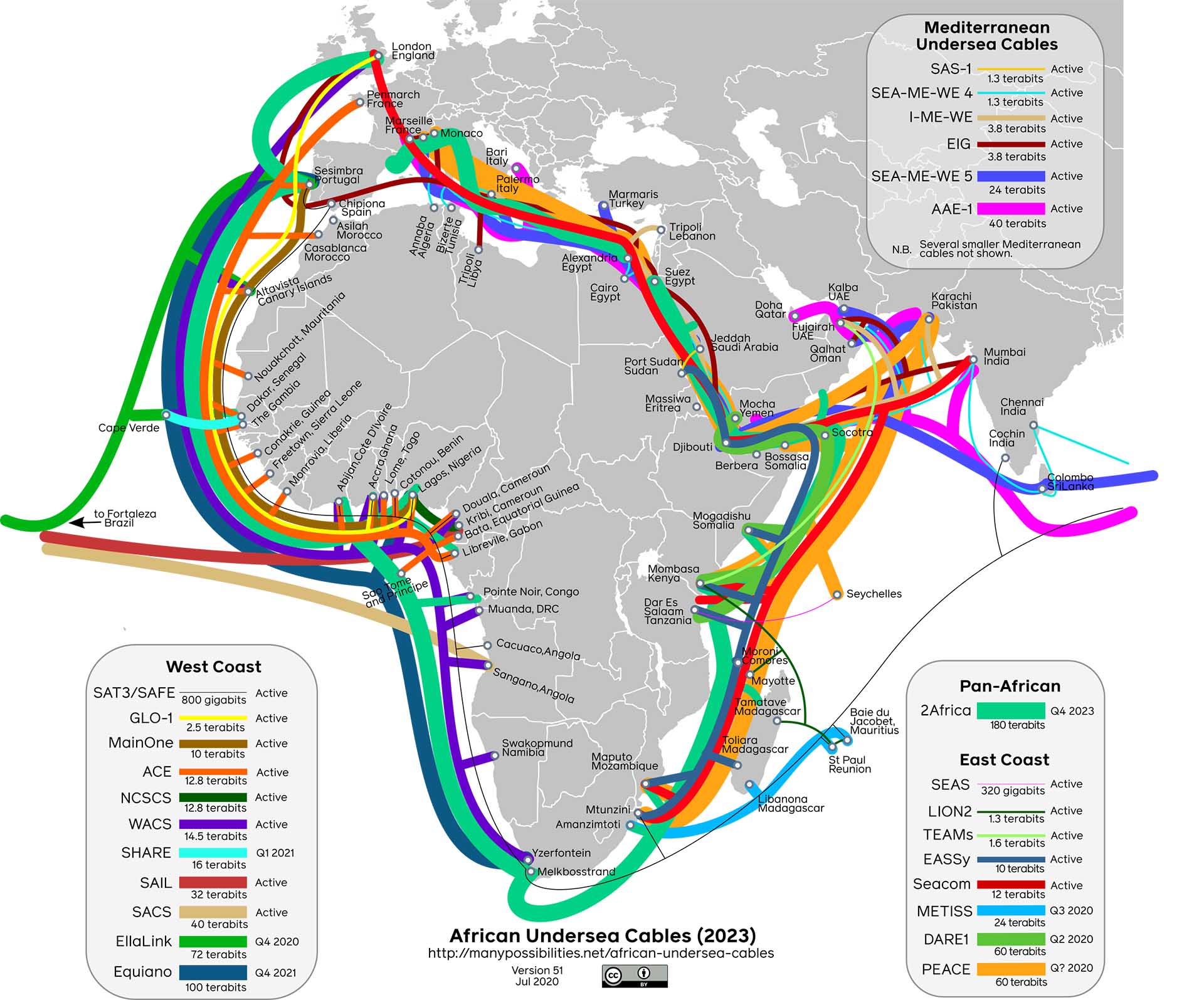
These findings underscore the importance of subsea cable investments as a policy lever for economic development. Sub-Saharan Africa will account for more than half of global population growth between now and 2050, making infrastructure that supports connectivity increasingly critical. The 2Africa project represents a significant investment in that infrastructure at a time when the continent is focused on economic recovery and building a digital economy. Addressing affordability challenges will be equally important to ensure that the economic benefits of connectivity reach all segments of society, not just those in well-served urban areas.