Why ILA sites are getting a rethink
In-line amplifiers (ILAs) are a quiet bottleneck in long-haul fiber networks. Sitting in remote roadside huts between data centers, they boost optical signals over intercity routes — and a single failed or undersized ILA can cap an entire route's capacity. Meta's ILA Evo project is an attempt to modernize these sites, which have changed little in decades even as fiber and optics have advanced dramatically.
ILA Evo sets aggressive targets: deploy a complete building and inside plant (ISP) in three to four days; eliminate the need for heavy-lift cranes and extensive concrete work; and cut power usage effectiveness (PUE) below 1.5. For context, Meta's data centers averaged a PUE of 1.09 in 2023 — but typical North American ILA sites run between 2.5 and 3.0. The 1.5 target is modest by comparison yet represents a significant efficiency gain for sites that have historically ignored the metric.
From telephone offices to roadside huts
ILA site design traces its roots to the earliest days of commercial fiber. GTE launched the first fiber optic network in 1977; by 1985, U.S. operators had installed 20,039 miles (32,250 km) of intercity fiber routes, which quadrupled to 83,618 miles (134,570 km) by 1989 and doubled again to 159,779 miles (257,149 km) by 1998.
As fiber was laid along roads, railways, and pipelines, repeater huts were built on a model borrowed from Bell Telephone central offices — just smaller. Concrete shells or stick-framed buildings on concrete slabs, wall-mounted HVAC units, -48V power distribution, lead-acid batteries, and diesel generators, all inside chain-link fences. Early spacings of 18-to-25 miles (30-40 km) stretched to 50-60 miles (80-100 km) as fiber quality and optronics improved.
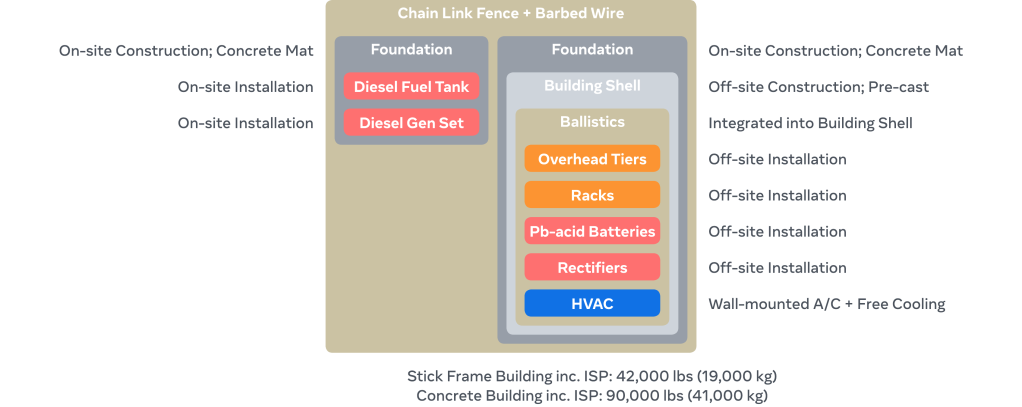
The buildings themselves were fabricated at a central location with the ISP installed, then trucked to the site and lifted into place with a heavy crane. That model still holds today. Components have gotten more modern — better HVAC, upgraded security and access systems — but the fundamental construction and deployment approach hasn't budged. As capacity demands accelerate, that's the problem ILA Evo addresses.
Breaking down the redesign
Working with engineering consultancy AECOM, Meta organized the ILA Evo effort into six functional areas: building systems, foundations, ISP installation, ballistics, cooling, and backup power.
Buildings that arrive flat-packed
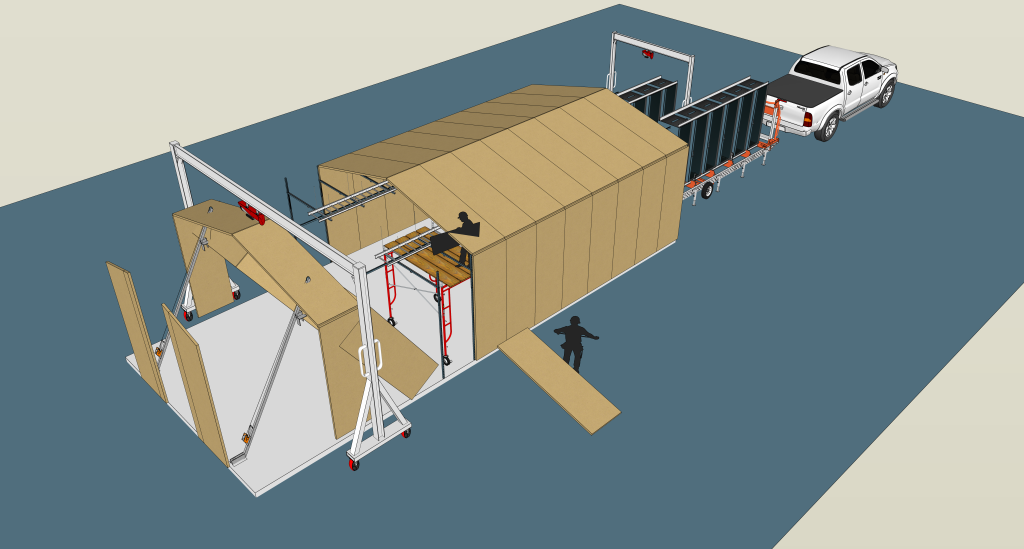
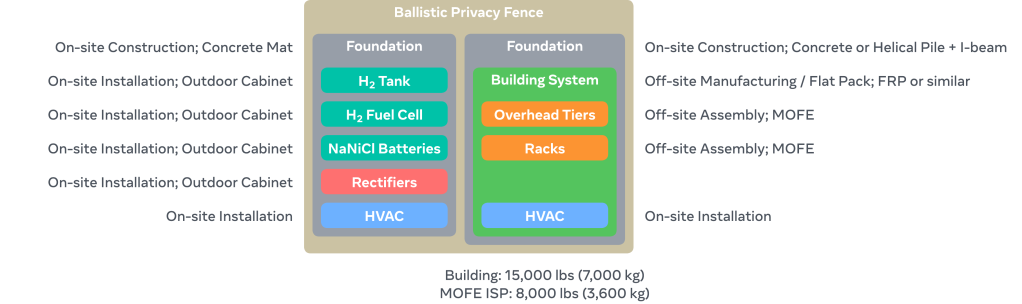
The project is evaluating flat-packed lightweight buildings that can ship on standard trucks and be unloaded with a lift gate — no crane required. The focus is on fiberglass-reinforced polymer (FRP), also called glass-reinforced polymer (GRP), wall and roof panels light enough for two people to handle. The FRP approach also allows slightly taller buildings than prefabricated alternatives, creating overhead space for HVAC or other components.
Foundations without the concrete pour
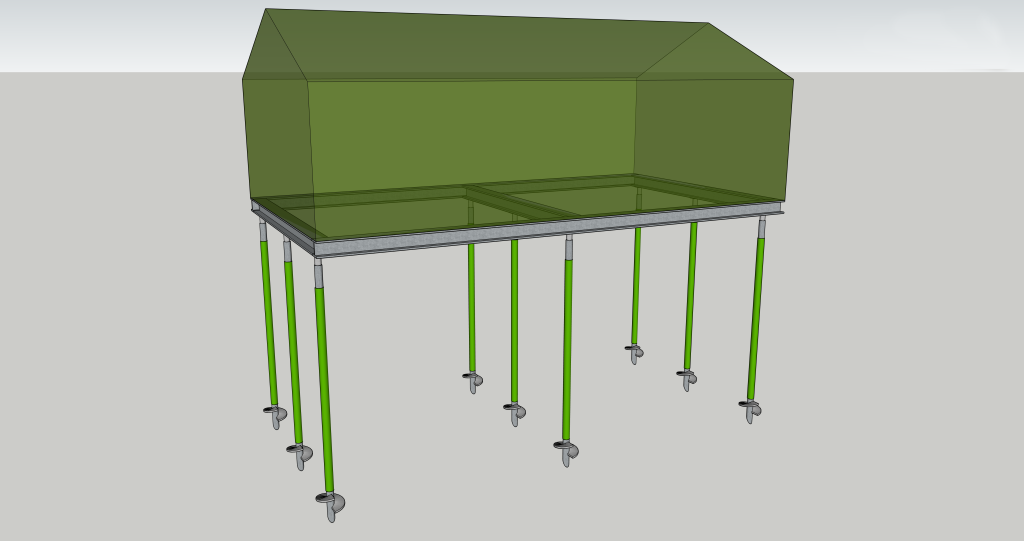
Current ILA buildings sit on slab-on-grade foundations with perimeter edge returns — a design that works across soil types but requires forming, rebar, pouring, and curing time on site. Where geology allows, ILA Evo is pursuing foundations built from steel or FRP I-beams over concrete pad footings, or helical steel screw piles. Both cut cost and deployment time versus a full slab.
A factory-built inside plant
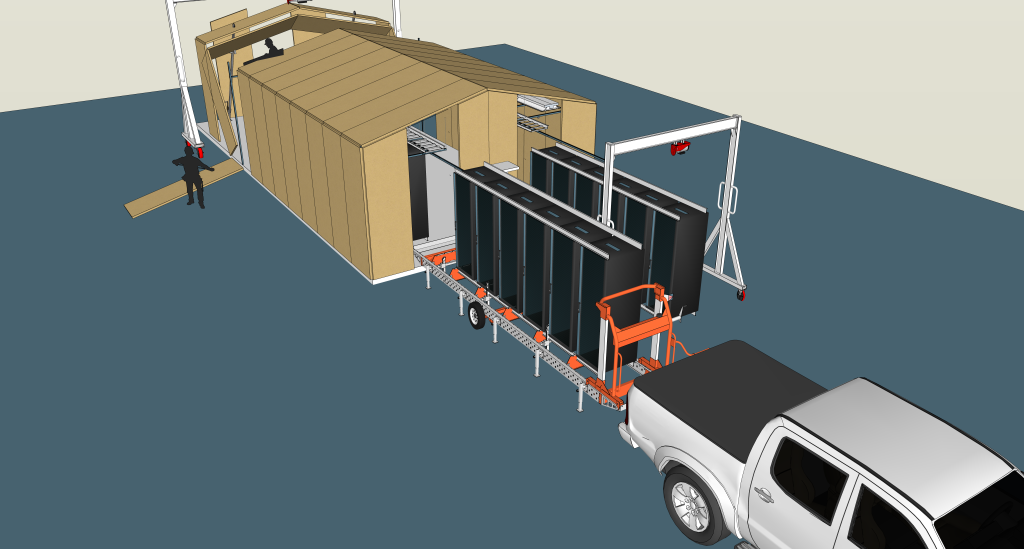
Instead of constructing ISP on site, ILA Evo envisions a manufactured owner-furnished equipment (MOFE) process. Six rack modules — equipment racks and overhead cable tiers mounted on an exoskeleton with casters — are preassembled in a clean, factory-like environment. The modules ship on standard trucks with lift gates and roll directly into the building, where they're bolted down. This avoids the interior dust and debris cleanup that follows traditional construction.
Ballistics as a separate decision
Ballistic protection (NIJ 0101.06 Level IIA, where required) doesn't have to be built into the walls. ILA Evo keeps open the option of ballistic privacy fences or other perimeter solutions, which gives more flexibility for what sits inside the fence line.
Cooling: the biggest PUE lever
Rack power has climbed from 600–800W into the 2–4 kW range, pushing traditional wall-mounted HVAC units past their efficiency sweet spot. ILA Evo is pursuing several approaches to cut cooling overhead significantly:
- Advanced passive, compressorless cooling or liquid-based systems
- Raising temperature set points from the typical 22°C (72°F) to above 35°C (95°F) — most optical transport gear is GR-63-CORE NEBS-3 compliant and rated for continuous operation at 40°C (104°F)
- Deliberately lower-R-value walls, letting the building shed heat rather than trapping it
- Moving rectifiers and batteries outside into cabinets, freeing interior space and reducing heat load
- Cool roof coatings and heat-reflective paints to cut solar gain
The project evaluated chilled beams paired with ground-loop heat exchange, but none handled the 24 × 2 kW heat load. A loop thermosyphon system with a high-efficiency compressor assist — used only on the hottest days — can hit the PUE target. Scaled-down chiller and computer room air conditioning (CRAC) systems with liquid cooling and a thoughtful floor plan also work. No final selection has been made; the challenge is finding options that don't reintroduce the need for cranes during deployment.
Backup power beyond diesel and lead-acid
Diesel generators and lead-acid batteries are the historical standby, but ILA Evo is weighing alternatives — hydrogen fuel cells, capacitors, or other location-dependent options. Battery economics at this scale aren't attractive yet. A near-term combination under consideration pairs an H2 fuel cell with a small NaNiCl molten salt battery that carries site load for a few minutes while the fuel cell spins up and takes over.
Supply chain and stockpiling advantages
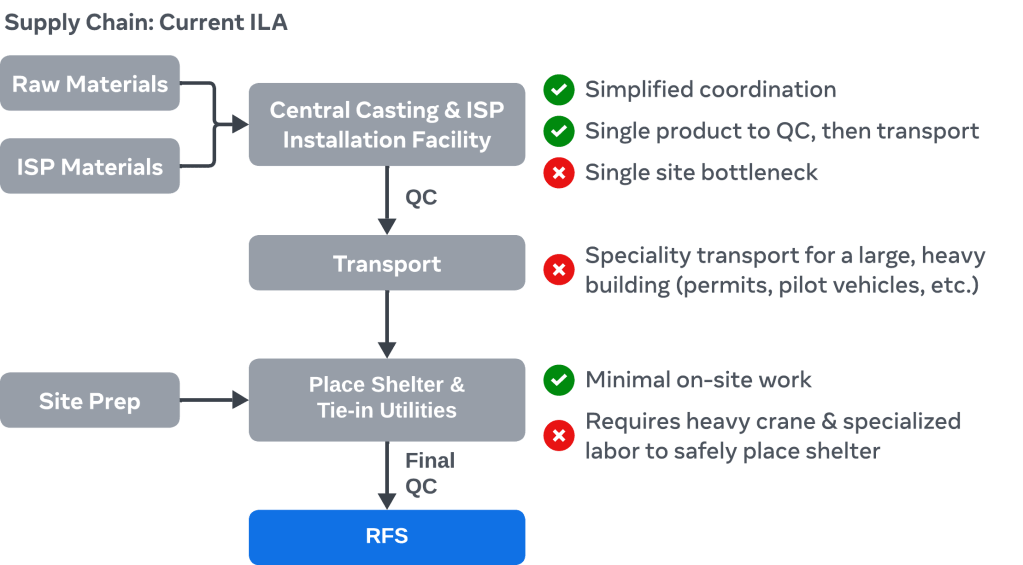
The current ILA model concentrates most work at a single production site, which simplifies quality control but creates problems: scaling production up or down is expensive, transporting heavy buildings to remote sites is costly, and stockpiling finished buildings eats valuable real estate and compounds transport issues.
ILA Evo disaggregates the supply chain. Standard items like HVAC units come from existing, already-scaled sources. The building system and MOFE ISP modules come from manufacturers — some outside the traditional telecom ecosystem — in processes oriented toward manufacturing and assembly volume rather than bespoke construction.
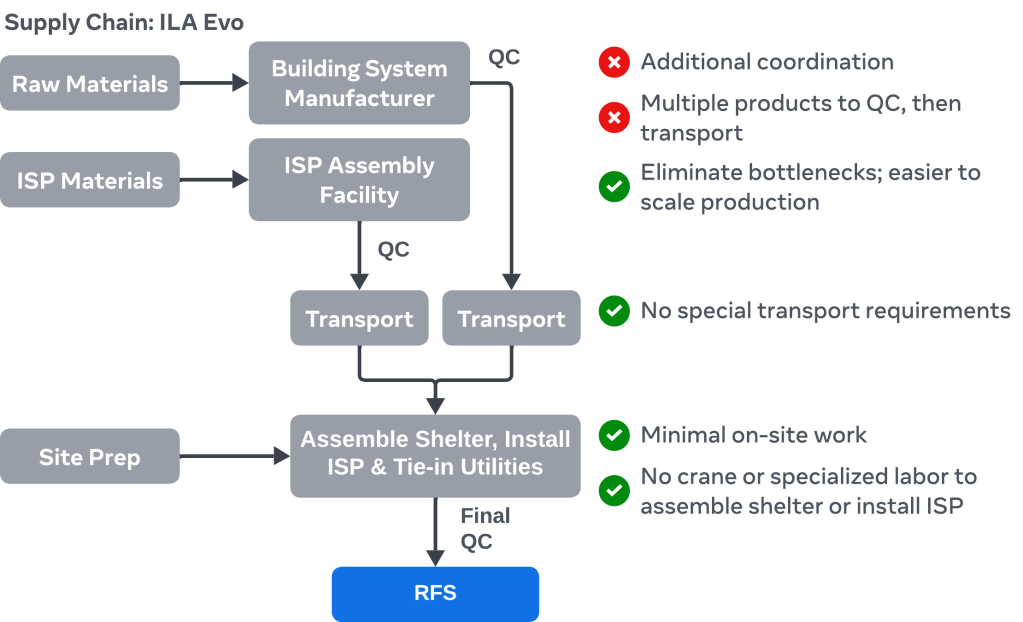
The shift enables genuine stockpiling: 500 flat-packed building systems ready for next-day shipment, or 2,000 preassembled MOFE ISP modules (four per 24-rack building). Bulk purchasing also lets vendors de-risk investments and achieve cost compression impossible with today's one-off designs.
Retrofit potential for existing sites
Several ILA Evo concepts translate directly to current deployments. The HVAC system, higher temperature set points, and other efficiency tweaks could be dropped into existing buildings. H2 fuel cell backup power is similarly applicable. Meta also plans to test commodity ISP materials made from FRP — equipment racks and ladder racks with a lower carbon footprint than steel or aluminum — as a retrofit option for legacy sites.
Path to deployment
Following the research and design phase, ILA Evo has several milestones planned for 2025:
- Broadening operator consultations beyond North America and Europe to Latin America, Africa, the Middle East, and Asia
- Building a prototype site showcasing the strongest ideas from the work
- Publishing blueprints, bills of material, and analyses to seed other operators' own research and development