

When Autofill Gives Away More Than You Typed
Dark patterns are deceptive UX tactics that push users into actions they wouldn't knowingly take. Autofill — the browser feature that saves and inserts personal data into web forms — is fertile ground for such tricks. Most users have accepted autofill at some point, either deliberately or by accident. The question is: how much privacy does that convenience cost?
Consider a newspaper sign-up form asking only for name, email, and password. Typing the name field triggers an autofill suggestion that includes a mailing address — a field that doesn't even exist on the page. A quick click, and the form advances to a second page requesting address, phone, date of birth, and more. All pre-populated. Harmless in that case, but the interaction reveals a fundamental risk: browsers may share far more data than a form visibly asks for.
That risk isn't hypothetical. It's baked into how autocomplete and autofill work together.
Autocomplete vs. Autofill
Though often conflated, autocomplete and autofill are distinct:
- Autofill is a browser feature that stores personal data locally and inserts it into web forms.
autocompleteis an HTML attribute that tells the browser what kind of data a field expects, guiding how autofill behaves.
Think of autofill as the data store, and autocomplete as the instruction manual. The attribute supports many value types: personal information like name, address, phone and date of birth; financial data including credit card numbers and expiration dates; demographics such as location, age and language; and professional details like company and job title.
Widespread autofill usage becomes problematic when paired with careless autocomplete usage, especially in an era of rampant phishing.
Two Privacy Risks
Both features expose users to two principal dangers:
- Invisible fields can be populated — not fields with
type="hidden", but fields hidden via CSS (e.g., offscreen containers). - Autofilled data is readable via JavaScript before any form submission happens.
The implication is direct: once a user selects an autofill suggestion, developers can read whatever fields the browser populated, whether the user hits submit or not — and without the user knowing which fields were filled.
How transparent each browser is about that varies significantly. Safari and Firefox are reasonably clear about what data will be shared. Chrome, the most widely used browser, is notably less so, offering an experience that can fool even experienced users.
Testing the Browsers
To see how much data each browser actually exposes, test forms were built with several fields, most hidden offscreen rather than with hidden attributes. The hidden fields were removed from tab order so keyboard users wouldn't encounter them. Field order in the markup was also varied — which turned out to alter autofill behavior in one browser.
<form method="post" action="javascript:alertData()">
  <label for="name">Full name</label><input id="name" name="name" autocomplete="name" /><br/>
  <label for="email">Email</label><input id="email" name="email"/><br/>
  <label for="postal-code">ZIP</label><input id="postal-code" name="postal-code" autocomplete="postal-code"/>
  <div style="position:absolute;top:-10000in" class="hide-this">
    <!-- Hidden -->
    <label for="firstname">First name</label><input tabindex="-1" type="hidden" id="firstname" name="firstname" autocomplete="given-name" /><br/>
    <label for="lastname">Last name</label><input tabindex="-1"  id="lastname" name="lastname" autocomplete="family-name" /><br/>

    <label for="honorific-prefix">honorific-prefix</label><input tabindex="-1" id="honorific-prefix" name="honorific-prefix" autocomplete="honorific-prefix"/><br/>
    <label for="organization">Organization</label><input tabindex="-1" id="organization" name="organization" /><br/>
    <label for="phone">Phone</label><input tabindex="-1" id="phone" name="phone" autocomplete="tel" /><br/>

    <label for="address">address</label><input tabindex="-1" id="address" name="address" autocomplete="street-address" /><br/>
    <label for="city">City</label><input tabindex="-1" id="city" name="city" autocomplete="address-level2" /><br/>
    <label for="state">State</label><input tabindex="-1" id="state" name="state" autocomplete="address-level1" /><br/>
    <label for="level3">Level3</label><input tabindex="-1" id="level3" name="state" autocomplete="address-level3" /><br/>
    <label for="level4">Level4</label><input tabindex="-1" id="level4" name="state" autocomplete="address-level4" /><br/>
    <label for="country">Country</label><input tabindex="-1" id="country" name="country" autocomplete="country" /><br/>

    <label for="birthday">Birthday</label><input tabindex="-1" id="birthday" name="birthday" autocomplete="bday" /><br/>
    <label for="language">Language</label><input tabindex="-1" id="language" name="language" autocomplete="language" /><br/>
    <label for="sex">Sex</label><input tabindex="-1" id="sex" name="sex" autocomplete="sex" /><br/>
    <label for="url">URL</label><input tabindex="-1" id="url" name="url" autocomplete="url" /><br/>
    <label for="photo">Photo</label><input tabindex="-1" id="photo" name="photo" autocomplete="photo" /><br/>
    <label for="impp">IMPP</label><input tabindex="-1" id="impp" name="impp" autocomplete="impp" /><br/>

    <label for="username">Username</label><input tabindex="-1" id="username" name="username" autocomplete="username" /><br/>
    <label for="password">Password</label><input tabindex="-1" id="password" name="password" autocomplete="password" /><br/>
    <label for="new-password">Password New</label><input tabindex="-1" id="new-password" name="new-password" autocomplete="new-password" /><br/>
    <label for="current-password">Password Current</label><input tabindex="-1" id="current-password" name="current-password" autocomplete="current-password" /><br/>

    <label for="cc">CC#</label><input tabindex="-1" id="cc" name="cc" autocomplete="cc-number" /><br/>
    <label for="cc-name">CC Name</label><input tabindex="-1" id="cc-name" name="cc-name" autocomplete="cc-name" /><br/>
    <label for="cc-expiration">CC expiration</label><input tabindex="-1" id="cc-expiration" name="cc-expiration" autocomplete="cc-expiration" /><br/>
    <label for="cc-zipcode">CC Zipcode</label><input tabindex="-1" id="cc-zipcode" name="cc-zipcode" autocomplete="cc-postalcode" /><br/>
  </div>
  <button>Submit</button>
</form>
A reduced version with a single visible email field — the kind used for newsletter signups everywhere — was also tested.
See the Pen [Showing autofill/autocomplete dark pattern (II)](https://codepen.io/smashingmag/pen/xxLKVga) by Alvaro Montoro.
If you autofilled that form, you likely shared more than just your email, despite how normal the form appeared. Here's what each browser did.
Safari
Safari displays an icon in the form field on click. Opening it reveals a popup listing all data the browser will share — including hidden fields.
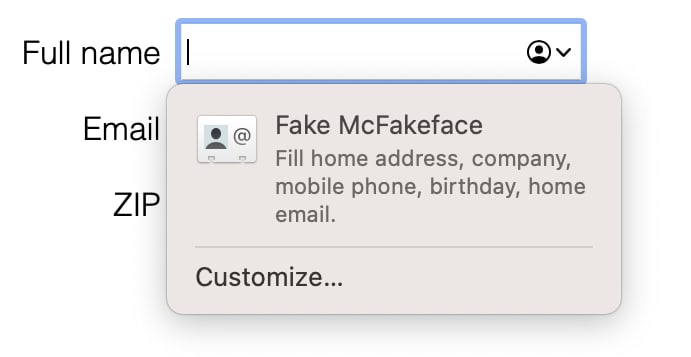
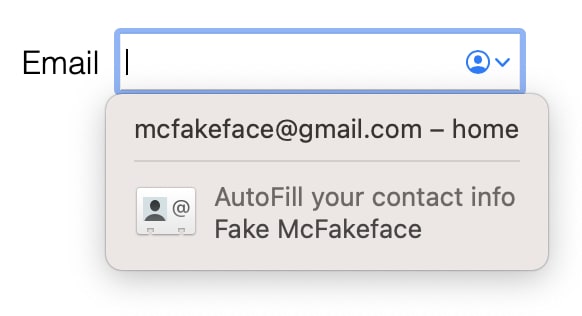
That transparency should raise suspicion. In the email-only test, Safari's behavior shifted: the popup claimed it would share only the email, and indeed it did. But a "contact info" section below invites the user to click through and autofill a fuller profile. Nothing says that will populate the hidden fields too. After confirming, the entire form gets filled — not just the email.
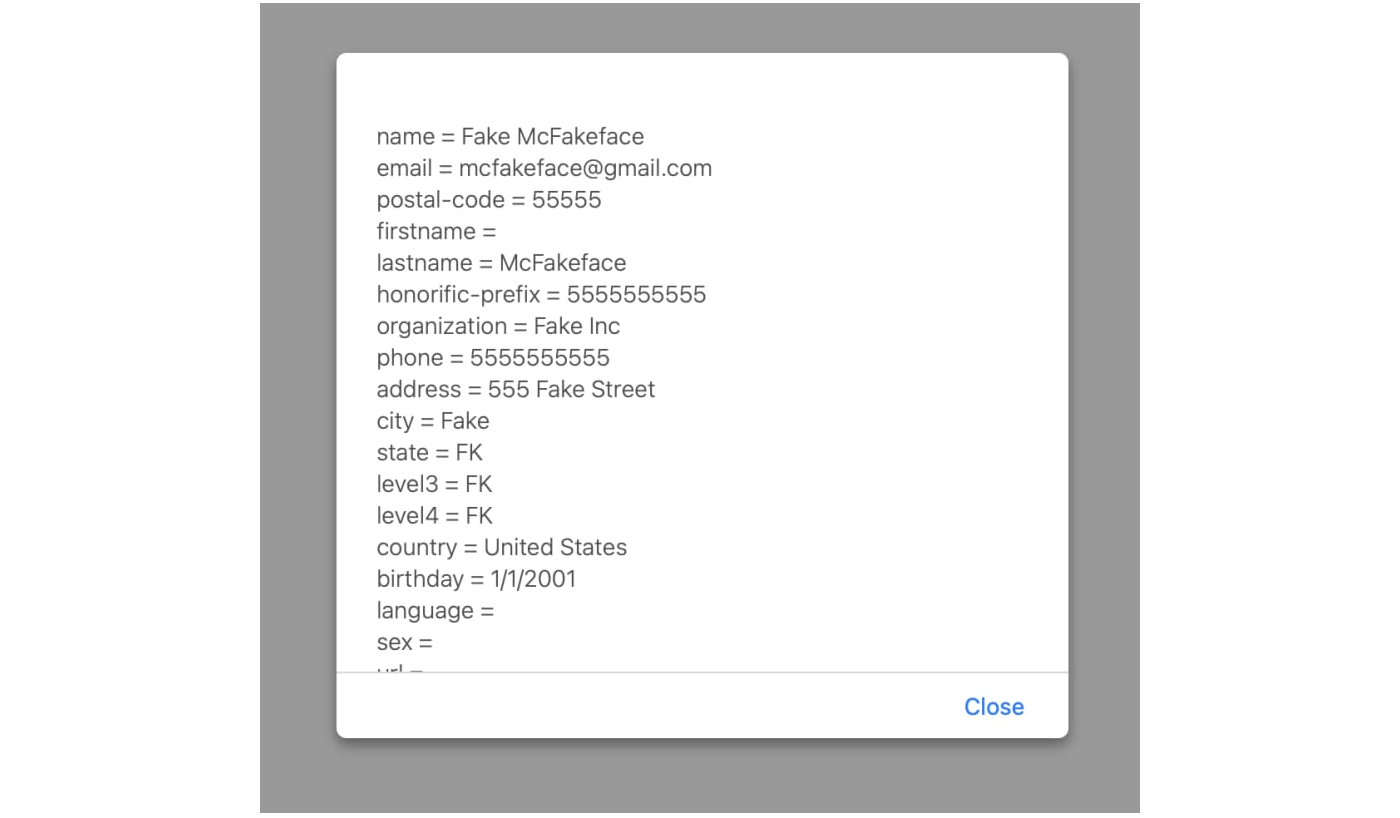
One quirk: despite separating personal and credit card data, Safari populated credit card fields (name and ZIP) from personal profile info.
Firefox
Firefox requires more deliberate action. No icon appears, and the autofill popup only shows after typing or an explicit second click. When it appears, it lists each category of data that will be filled — including hidden fields.
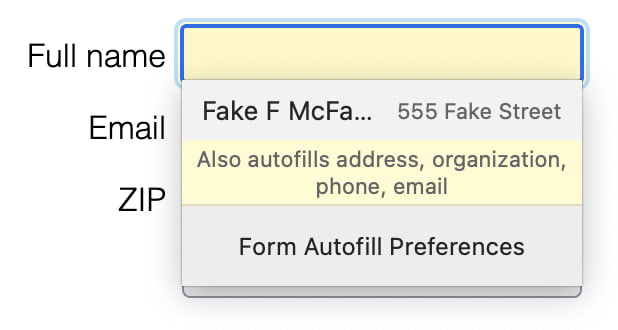
With the email-only form, the same popup appeared, listing categories to be populated. After autofill ran, JavaScript could still read all values.
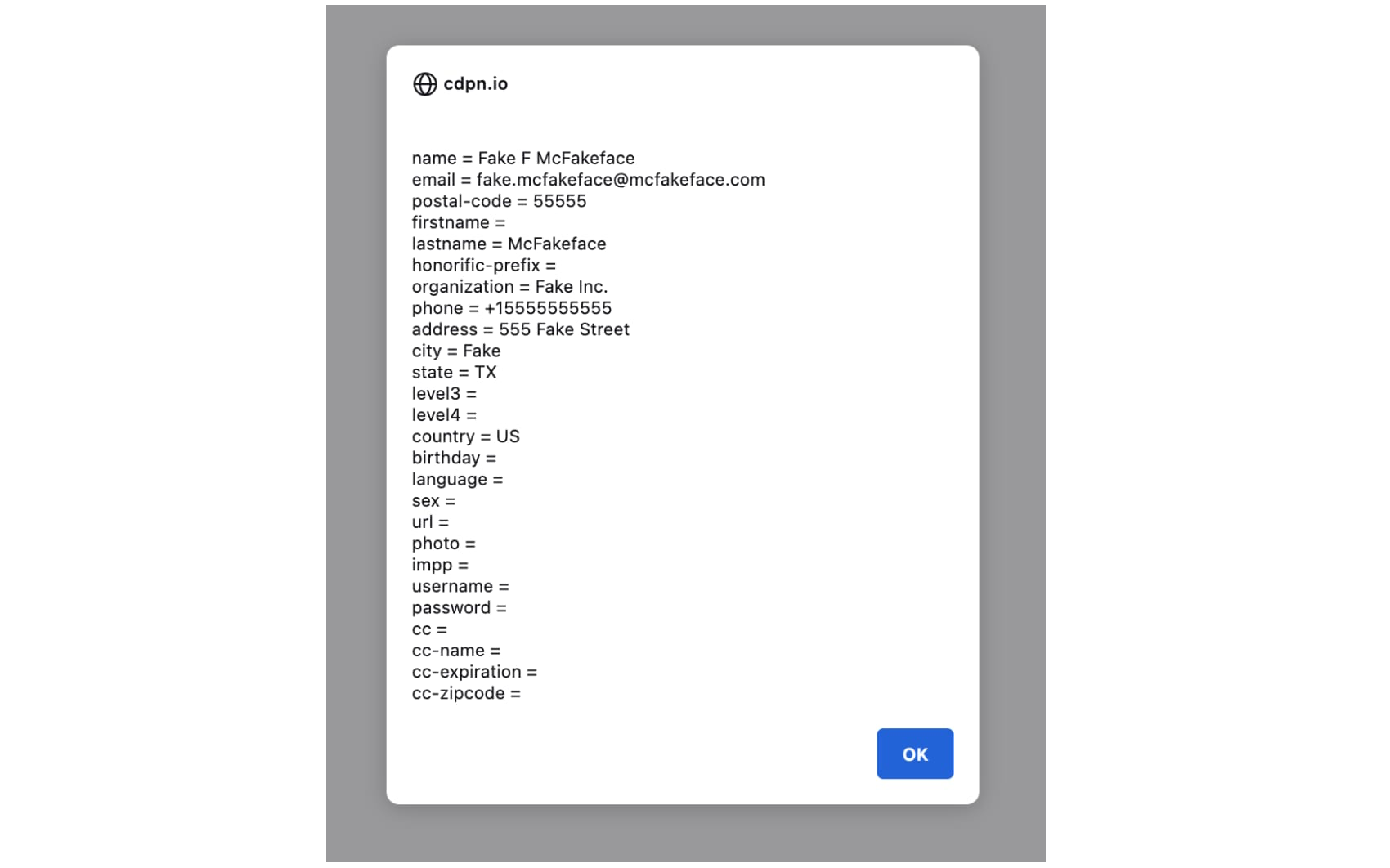
Firefox emerged as the clearest: it always states what will be shared regardless of field order, and it doesn't autofill without explicit additional interaction. Keyboard users, though, could activate the autofill while tabbing through the popup without realizing.
Chrome
Chrome — and several other Chromium-based browsers tested — behaved entirely differently. A single click on the field brings up the autofill popup. Unlike the competition, it shows only two suggestions.
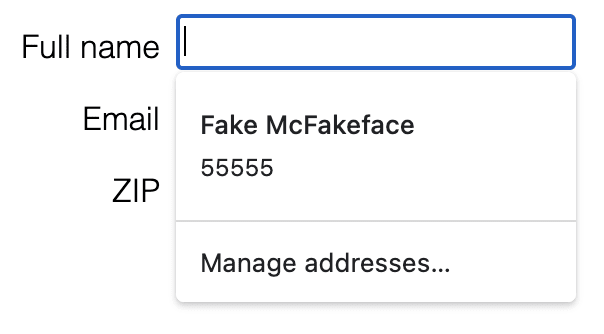
That result was intentional in the test: field order matters in Chrome. Certain autocomplete values receive more weight in the second suggestion, so the popup contents shift based on how fields are arranged in the markup.
The email-only mini form didn't improve things:
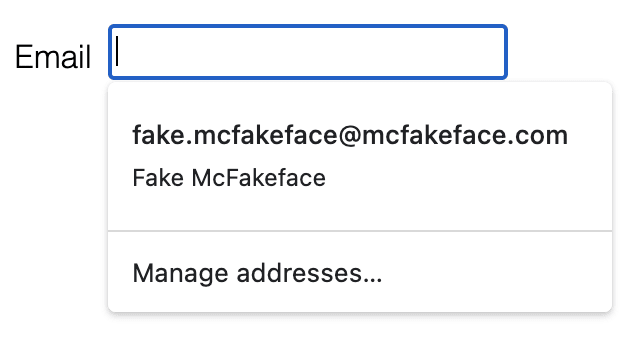
The popup displayed an invisible field (the name), but nothing explained why. Experienced users might deduce the name is being shared; average users could reasonably interpret it as the profile label under which the email is saved. No indication of actual data release exists on screen.
Clicking the suggestion promptly exposes all data to JavaScript.
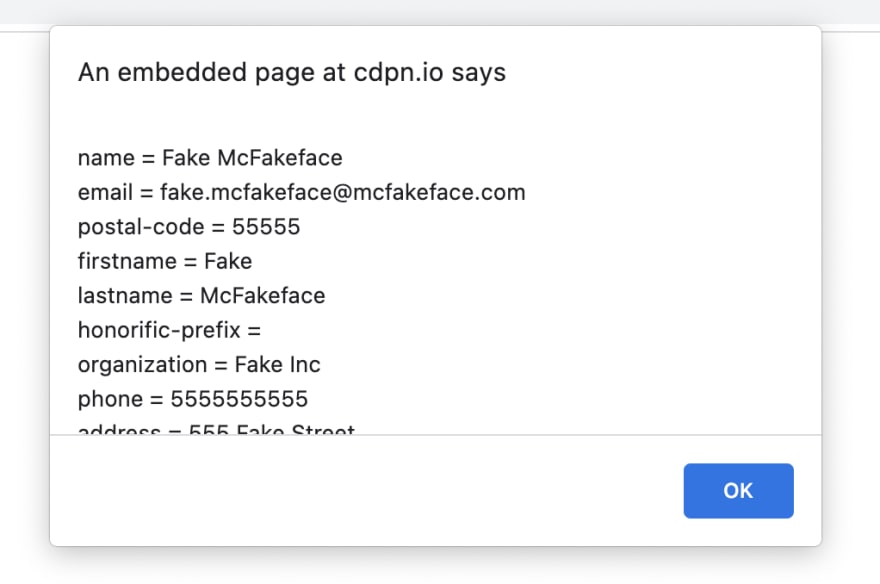
Chrome was the worst offender on three counts: it autofills on a single click, it gives no clear signal of what data will be shared, and its suggestions change based on DOM structure and order — a combination ripe for exploitation. Given Chrome's dominant market share, that's not a niche concern.
An Exploitable Deceptive Pattern
A dark pattern, per Harry Brignull's definition, exploits how users skim pages and make assumptions, designing interfaces to say one thing while doing another. The behavior above qualifies: non-experienced users won't realize their personal data is being released, and even adept users can be deceived by Chrome's presentation, which makes a selection appear associated with a profile rather than revealing the scope of data transfer.
“When you use websites and apps, you don't read every word on every page — you skim read and make assumptions. If a company wants to trick you into doing something, they can take advantage of this by making a page look like it is saying one thing when it is in fact saying another.” — Harry Brignull, darkpatterns.org
Browsers enable this behavior, but developers activate it. Some companies already do, promoting the tactic as a lead-generation feature. It may also violate the GDPR's Article 5 principles on personal data processing:
- Lawfulness, fairness and transparency — the process is far from transparent;
- Purpose limitation — data collected is often used incompatibly with the stated purpose;
- Data minimization — the pattern maximizes data collection rather than minimizing it.
By way of illustration: if a user signs up for a newsletter or product info with an email address, the site has no legal basis to collect their name, address, birth date, or phone number without informed consent. Autofill clicking does not constitute that consent, and the purposes served by the data do not match what the user sought.
What Each Party Can Do
Fixing the autofill dark pattern is not a single-party responsibility. Users, developers, designers, and browser vendors all have a role to play. Some fixes are simple and practical; others are aspirational and would require significant changes to browser behavior.
Users: Check Before You Click
On the user side, the only defense is making sure that the data shown in the autofill popup is correct before selecting it.
That said, users are the victims here, not the perpetrators. Blaming someone for not scrutinizing every autofill popup is unfair. Plenty of people — even careful, experienced ones — click by mistake and share data unintentionally. There are too many scenarios in which a well-intentioned person accidentally submits more than they intended.
Developers And Designers: Be Honest
Developers are not the root cause of this pattern, but they are the ones who can choose to exploit it — either accidentally or deliberately. The industry needs to be honest about that.
To build trust and use autofill responsibly, teams should follow a few basic principles:
- Only autocomplete the fields you actually need.
- Clearly indicate which data will be collected.
- Never hide form fields that will later be submitted.
- Never mislead users into sending more data than they agreed to.
As an extreme measure, some forms could skip autocomplete entirely for certain fields. That would reduce usability and accessibility, so it is a tradeoff — but in some cases, it might be the right call.
None of this even accounts for XSS vulnerabilities, which could turn this pattern into a much more serious exploit. That is a different class of problem entirely.
Browsers: Improve The Autofill UX
Most of the heavy lifting will have to happen in the browser — especially in Chromium-based ones. Browsers already do several things well:
- Limit what can be shared: They expose only a subset of the autocomplete field values defined in the HTML spec.
- Group data logically: Personal and financial information are kept separate, which protects sensitive values like credit card numbers.
- Warn about data sharing: Some browsers do this incompletely (Chrome) or unclearly (Safari), but they all provide some alert.
Nevertheless, meaningful gaps remain in all browsers.
Show All Fields That Will Be Autocompleted
The autofill popup should always list every field that will be populated, not just a partial subset. Moreover, the presented data should be explicitly labeled as information to be shared with the form — not styled like a regular contact card, which can be misleading.
Firefox does this well. Safari is decent overall. Chrome lags behind both.
Don't Trigger onChange On Autofill
This would be a controversial change because the HTML specification explicitly states that autofill must behave as if the user had typed the data:
"The autocompletion mechanism must be implemented by the user agent acting as if the user had modified the control's data [...].
Browsers must therefore fire events and display values even in hidden fields. Preventing this on non-visible elements could solve the problem. However, visibility checks are computationally expensive, and developers could still read the values directly without waiting for any events.
Don't Let Developers Read Autocompleted Values Pre-Submission
This is also difficult. Many developers rely on reading field values before submission, e.g., for validation once the user moves on to the next input. But there is a privacy argument: if a user hasn't submitted the form, the browser shouldn't hand over their data.
A workable alternative already exists in another part of the web platform: like the privacy handling for visited links, browsers could return placeholder data when autofilled fields are read before submission — a generic name, a synthetic address, a fictitious phone number. This would satisfy validation logic while shielding the actual personal information.
Showing the full set of fields and values the browser intends to share would be an immediate, clear step forward. The other two ideas are more ambitious, but they would materially improve privacy.
The dark pattern would still be technically exploitable, but far harder to pull off. At that point, remaining risk would fall squarely on user behavior and developer ethics.
Conclusion
Autofill is not a critical vulnerability on its own — not even in Chrome — because it always requires the user to actively select the suggested info. But the potential for data loss is significant enough to justify intervention. Browsers have shipped larger changes for smaller security and usability concerns, including restrictions on alert(), prompt(), and confirm() in cross-origin iframes.
The fix is a shared one:
- Users should be cautious about which forms they autofill.
- Developers must avoid exploiting autofill data.
- Browsers need to better safeguard personal information.
Fundamentally, this is a browser problem, and primarily a Chrome problem. Privacy matters, and ignoring it is not acceptable. That said, developers still hold the final choice — whether to exploit the pattern or act responsibly. Choosing the latter is the right call.


