Instagram Live now carries its live video ingest over Media over QUIC (MoQ) on iOS and Android. MoQ is an emerging IETF standard built for both ingest and playback, and Meta frames the switch as a way to collapse several purpose-built media stacks into one transport that is lower-latency, more resilient on unreliable networks, and reusable across future live and interactive products. The work was presented at DEMOQED 2026.
Why one transport instead of several
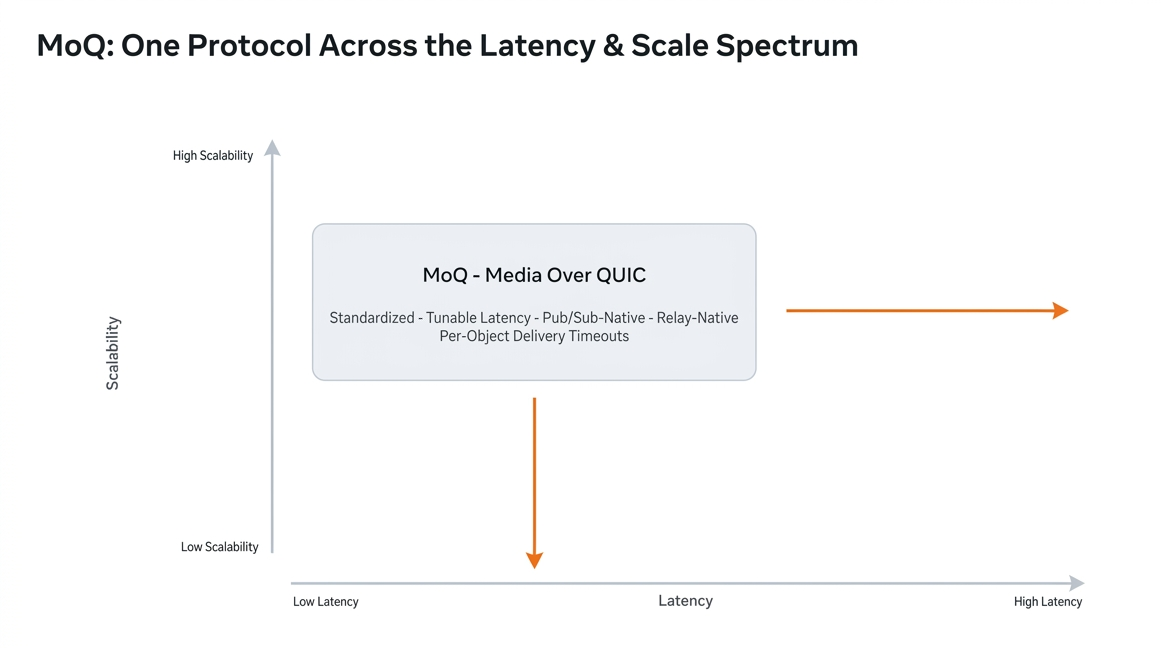
The industry's media protocols each answered the problem in front of them: RTMP for ingestion, HLS and DASH for playback, WebRTC for real-time calls, and Meta's own RUSH for everything that did not fit elsewhere. The practical cost shows up inside a single app — someone who starts a live stream and then places a voice call touches three protocol stacks, each with separate serving infrastructure, monitoring and operational expertise.
That split was reasonable while the experiences were distinct. It is less reasonable now that live video, real-time AI and generative AI creation tools share product surfaces. A common protocol spanning ingest, delivery and playback reduces the number of custom transports and operating models engineering teams have to maintain.
How MoQ is put together
MoQ is being developed at the IETF with participation from Meta, Google, Akamai, Cisco, Cloudflare and academia, and it runs media over QUIC. Meta's live streaming previously ran on RUSH, an in-house QUIC-based protocol built to move past RTMP; roughly a decade of running RUSH in production informed the bet on MoQ. QUIC itself was already proven inside Meta, where an earlier rollout produced lower request errors, tail latency and video stalls than HTTP/2.
The core abstraction is a Track: an addressable stream of media objects that publishers push and subscribers receive through a network of relays. Relays cache and forward objects without parsing the payload — they only need the MoQ framing and delivery metadata. Several properties follow from that design:
- QUIC underneath. Independent streams make progress without TCP-style cross-stream head-of-line blocking, and connection setup and migration are cheaper. Any future QUIC feature, such as FEC, is inherited automatically.
- Fan-out and caching in the protocol. Relays are caching and request/stream-coalescing endpoints, so streams scale through CDN relays without bolted-on machinery.
- Per-subscription latency. Two subscribers to one track can run at different latencies simultaneously — around 100 ms for an interactive participant, several seconds for an archival or buffered service.
- Track-aware delivery. Relays can drop, prioritize or replay objects from metadata, which yields better congestion behavior under loss than byte-stream protocols.
- Media context modeled natively. Tracks and their quality variants are protocol constructs, so adaptive bitrate logic builds on them rather than reconstructing them at higher layers.
- Standards-based TCP fallback. Where QUIC is blocked, MoQ can fall back to TCP through a standardized mapping, such as WebTransport over HTTP/2 or the emerging QMUX mapping, instead of forcing parallel transports into the ecosystem.
Why Instagram Live went first
Three considerations put live ingest ahead of other Meta surfaces. Instagram Live is the largest-scale test available, so proving MoQ there clears the bar for the most demanding ingest workloads while complementing the low-latency properties real-time use cases need. RUSH, stable and performant for nearly a decade, was falling behind the open ecosystem; moving to MoQ shifts development from a protocol operated mainly by Meta to a shared standards effort where multiple implementers contribute experience, test interoperability and improve the specification. And metric parity is a prerequisite for everything after it — matching RUSH at the largest live surface without regression establishes the baseline for further exploration, including live playback.
Rolling out without a backend rewrite
Replacing the ingest protocol changes the foundation under every broadcast, and the difficulty lies mostly outside the protocol: broadcaster apps must learn it, the backend pipeline expects the old framing, the rollout has to be reversible in seconds, and some networks cannot carry the new transport at all. Meta treated these as three separate constrained problems.
- Client integration across four apps. A MoQ publisher built on moxygen, Meta's open-source MoQ library, was integrated into the apps. moxygen supplies publisher, subscriber and relay roles, works with Meta's QUIC stack (mvfst), and exposes hooks for custom media handlers. A single config parameter selects MoQ or RUSH per broadcast.
- Edge translation instead of a backend rewrite. MoQ ingest connections terminate on dedicated edge endpoints, where a translation layer converts MoQ frames into the RUSH format the existing backend understands. Nothing downstream changed. The translator is scaffolding: once MoQ is the only ingest path, the backend will consume MoQ natively and the shim disappears.
- Server-side routing for fast ramps. Stream URL generation sends experiment-eligible broadcasts to MoQ-capable endpoints based on experiment-group membership, so phased rollout does not wait on app-version adoption and the experiment can be resized in minutes.
Operational friction
Three issues shaped day-to-day work. Because MoQ is an active IETF draft that kept evolving during development, Meta pinned to specific draft versions, kept compatibility shims for older clients, and contributed improvements back to the working group. UDP/443 remains blocked or rate-limited on a non-trivial slice of enterprise and carrier networks, so the transport — TCP or QUIC — is chosen at the start of a live stream based on which handshake wins, and that choice holds for the session. Debugging required new tooling, since QUIC's encryption hides framing both from middleboxes and from Meta's own packet captures; MoQ-aware tracing was built into the edge to expose object-level events without decrypting the wire.
Parity, and what it unlocks
After months of experimentation on Instagram iOS and Android, MoQ launched for Instagram Live ingest and matched RUSH across the streaming-quality indicators and reliability measures used for the rollout. Parity was the goal of this phase, and it demonstrated that a production transport can be replaced without disrupting creators or viewers, while leaving the next phase with a production-tested transport, rollout controls and observability.
That baseline now supports extending MoQ toward an end-to-end live video delivery and playback architecture. In the target design, media is pushed as it is produced, and partial reliability lets the player skip stale video after loss rather than accumulate delay; adaptive bitrate work can trade resolution for continuity as bandwidth shifts. Meta describes these capabilities as the basis for a next-generation live video architecture.
Remaining directions
Finishing the ingest story means carrying MoQ across the rest of Meta's apps using MoQ-native constructs such as subgroups to put audio, video and metadata on independent streams for better resilience under loss, and adding a standards-based TCP fallback in QMUX. Today the deployment relies on RUSH's existing TCP fallback for QUIC-blocked networks; standardizing on QMUX removes that dependency, so a blocked network no longer forces a second protocol and RUSH can eventually be retired. Separately, conversational and real-time AI surfaces push architectures toward continuous human-to-server communication, where one low-latency bidirectional transport carrying signaling and media together is a natural fit; meeting real-time communication's latency, loss-recovery and media-quality requirements is under active exploration.
By ingest stream count and total volume, the Instagram Live deployment is one of the largest application usages of MoQ Meta is aware of in the industry. Further detail is available in the MoQ Transport IETF draft and the moxygen library.