

Why Front-End Testing Feels Broken
Nearly every front-end team eventually hits the same wall: unit tests don't catch the failures that actually matter to users, while end-to-end tests are slow, brittle, and painful to configure. The sheer number of tools — Jest, Cypress, Playwright, React Testing Library — makes the problem worse, because choosing tools feels like progress when the real issue is architectural.
The examples here use React, but the underlying principles apply to any UI paradigm.
The root cause is that front-end code is rarely authored as a system. Components and functions are written to satisfy individual UI stories, and with JSX blending view markup and logic in the same file, it's easier than ever to mix presentation with business rules. When it's time to test, teams reach for a rendering library or attempt to wire up an E2E harness, often ending in misconfiguration or abandonment.
This ambiguity makes it impossible to estimate testing work or explain its value to managers. It also collides painfully with process mandates. A forced TDD workflow or a coverage gate becomes a burden when a bug fix spans several components, hooks, and reducers — writing a failing test first at that point is fiction, not discipline. Requiring a test after the fact, purely to satisfy coverage, produces something that isn't TDD at all.
Tools Are Not a Strategy
"What's your testing strategy?" is usually answered with a tool name: "We use Cypress," "we mock with MSW," "we use Jest." Coverage tools and mandatory unit tests reflect an industry fixation on process over design. A good test plan is rare, and even when QA organizations attempt one, it's often disconnected from how development actually happens.
Jest, Cypress, Playwright, code coverage, and TDD all have legitimate roles. But they are too frequently used as substitutes for real architecture: well-defined interfaces, sensible function signatures, clear system APIs, and a precise product-level UI definition. A process is not a design.
The Trap of Mock-Heavy Unit Tests
The typical response to a coverage gate is to mock every dependency around the changed code and write a "unit" test asserting the expected output. Apart from being awkward to write, such a test silently becomes a contract. It locks in not just the function's result, but also its signature and the way it consumes the simulated environment. Any future refactor of that signature, or any drift between the mock and reality, makes the test a liability. It can fail while the feature works, or pass because the fake environment no longer resembles production.
These tests are worse than useless. They consume time and actively degrade both product quality and delivery speed. If a team's tests depend on unspecified, heavily simulated environments and internal implementation details, dropping them entirely would be an improvement.
Contracts, Not Implementation Details
Separating good tests from bad ones starts with writing the contract in plain language. A solid contract states a clear precondition and expectation: "Given username U and password Y, the login function returns OK." That's a test worth having.
The trouble starts when the contract is polluted by implementation specifics: "Given a useState hook currently holding 14 and a Redux store with an array called userCache containing three users, the login function should…" A contract like that is bound to the current implementation, which makes it inherently fragile. Contracts should change only when business requirements change, while implementation details remain free to evolve. Every environmental dependency should be sturdy and explicitly defined.
Why E2E Tests Get Flaky
When systems lack clear APIs and internal boundaries, E2E tests become the only plausible way to verify features. That's not inherently wrong — a true E2E test exercises the whole stack and confirms a realistic user story.
The problem is scope. A full user journey requires setting up state from scratch, authenticating, navigating to the relevant screen, and running the specific scenario. Every step depends on multiple systems that may be down or slow during CI, and each requires carefully crafted selectors to simulate user actions. Isolating a regression in a single function can mean running an entire product to reach it. When unrelated environment failures break tests far from the actual change, the test suite becomes a constant source of noise.
E2E suites have a place — they catch issues that span subsystems. But leaning on them heavily is usually a signal that internal boundaries are not well-defined.
Integration Tests as the Middle Path
Integration testing resolves much of the tension. The front-end runs as a complete, unmodified system, while only the genuinely external dependencies — the backends it talks to — are mocked. This isolates the system under test from external flakiness without resorting to internal stubs.
If the front-end itself is too large and complicated to test as one unit, consider extracting parts of the logic into separate subsystems with well-defined APIs between them. That keeps each subsystem independently testable and the front-end's integration surface clear.
Finding the Right Boundary
Not every codebase benefits from subsystem extraction. If every change requires touching both the subsystem and the front-end, the split is just overhead.
Extraction is worth it when the contract between the front-end and the subsystem is stable enough that each side can evolve independently. This is also where micro-front-ends should raise caution: they are occasionally the right tool, but adopting one is a solution-first move rather than a response to the actual problem at hand.
Component Testing: Match The Strategy To The Component
UI component testing is hard for a fundamental reason: components often don't have a clean API. In React, a component's inputs are a mix of props and hooks (context, Redux, and so on). Outside React, the same problem shows up as reliance on globals. When dependencies are scattered, it's unclear what a test should set up, what it should exercise, and what it should assert.
That ambiguity is inherent to UI code, but you can reduce it dramatically by making architectural cuts before you write a single test.
Pull Logic Away From The View
The less component code you have to test, the easier component testing gets. Go through your component and ask whether each piece actually needs to be connected to the document, or whether it's a pure unit of logic that can be verified in total isolation.
Any code you can express as framework-agnostic, view-unaware JavaScript is code you'll never have to test through the browser. That logic is also more portable: it can move to a worker or a server without a rewrite, and the remaining UI layer carries less framework-specific weight.
Know Whether You're Testing A Building Block Or An App Widget
Not all components are equal. A DatePicker is a reusable, general-purpose widget; a TheAppDashboard is a one-off screen that pulls in all the app's specific data. These are different types of code and need different testing strategies.
UI building blocks are parametric. They compose well across situations, ask little from their environment, and have no knowledge of your app's business data. App widgets are contextual. They appear rarely, take few parameters, and draw heavily on the surrounding app state.
How To Test UI Building Blocks
Because building blocks are parametric, they should be nearly prop-driven. They shouldn't reach too deep into global state or context, which means they also shouldn't demand much per-component environment setup.
For these components, set the test environment up once — a browser plus any minimal context — and run all assertions against it without resetting. The Web Platform Tests suite shows this pattern in practice: the test runner and browser start once, and tests reuse them instead of incurring the cost of a fresh environment with every case.
How To Test App Widgets
App widgets are the trap zone. It's tempting to build a fake environment that satisfies every hook they touch and unit-test them like building blocks. Those fabricated environments age poorly: as the app's data shapes and flows change, the mocks drift and the tests document a widget that no longer exists.
Contextual components are best tested in their real habitat — the running app as a user sees it. Verify app widgets with UI integration tests, or occasionally e2e tests, and skip the mock-heavy unit tests that stitch together fake versions of the other front-end modules.
Testable UI At A Glance
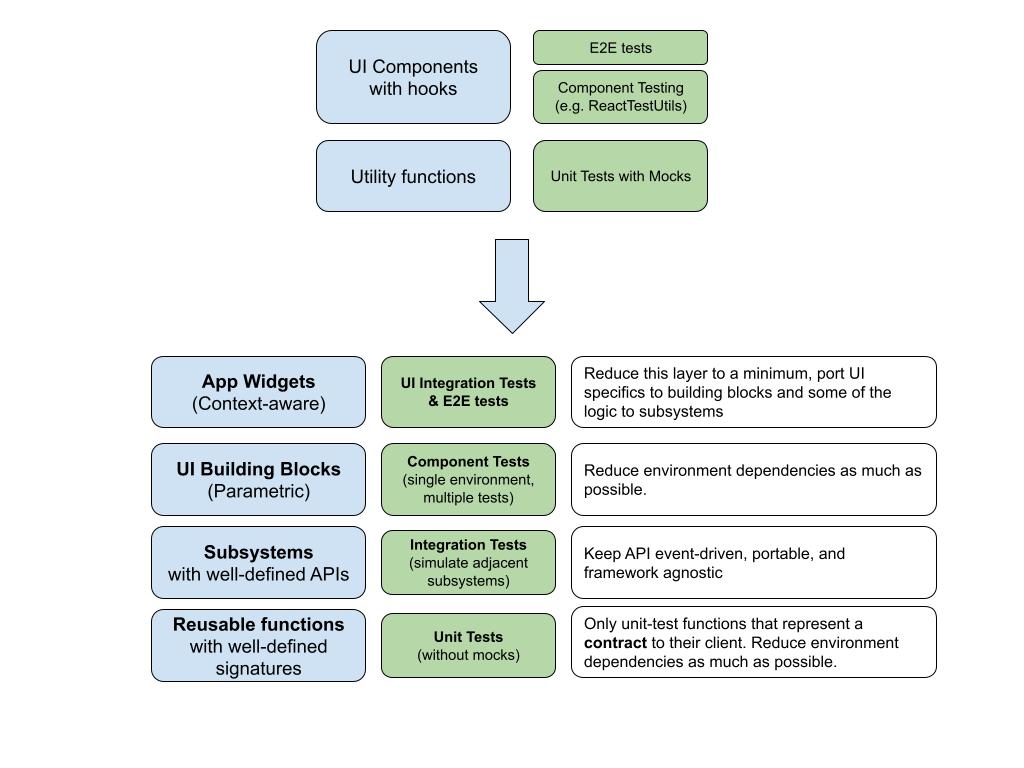
Architecture Before Tooling
Most front-end testing friction traces back to a lack of separation of concerns. Business-logic state machines live inside framework-specific view code, and contextual app widgets are tangled up with isolated, parametric building blocks. When that entangling exists, the only viable strategy is the worst one: flaky, expensive e2e tests that check "the whole thing" without any granular guarantee.
The fix is structural, not procedural. Favor the following patterns over any particular test framework:
- Migrate business flows into view-agnostic code, such as state machines, that have no awareness of the framework.
- Keep building blocks and app widgets distinct, and test them with different techniques — never one-size-fits-all.
- Mock your own subsystems and backends, never other parts of your front-end.
- Put real thought into your system signatures and contracts; clear boundaries make test setup a solved problem.
- Treat test code as a first-class artifact of your system, not a throwaway afterthought.
Choosing the right split between front-end code and its subsystems, and between unit, integration, and e2e strategies, is a craft that develops with practice. The testing itself exposes where the architecture is weak, and fixing that structure is where the real gain comes from.



