

Why Sustainability Belongs On The Web Team’s Agenda
The internet is estimated to account for 3–4% of global emissions, a figure comparable to the output of entire countries. For people who build digital products, that means the work they do everyday has a measurable environmental footprint. It also means they are in a position to reduce it — both through their own engineering and design choices, and through the influence their products have on large audiences.
Still, getting sustainability initiatives off the ground inside a company usually requires more than good intentions. Presenting a clear business case, building internal consensus, and knowing how to measure results are all part of making the effort stick.
Making The Business Case
The first challenge is convincing stakeholders that time spent on sustainability is time well spent. Different arguments will land with different audiences, but several angles tend to be effective.
Cost Savings And Efficiency
Not every organization will prioritize environmental impact over financial concerns. But many sustainable practices also reduce costs. A more efficient database architecture lowers server spend. Performance improvements to a client's site build goodwill and can lead to more business. Finding where environmental benefit and cost savings overlap is a practical starting point for any proposal.
The Push From Regulation
Regulation — or the threat of it — is perhaps an even stronger driver. Asim Hussain, a green software expert, noted in his Smashing Conference talk that this is the biggest shift he is seeing in the industry. With many countries legally committed to Net Zero goals, companies are increasingly likely to face oversight of their carbon emissions. The UK, for example, has carbon budgets enshrined in law, and its Greening Government ICT and Digital Services Strategy already sets standards for organizations building digital services for the government.
Some companies are choosing to get ahead of this curve. Demonstrating a commitment to sustainability can open doors to new opportunities, particularly for those bidding on public sector contracts or partnering with larger enterprises that have their own environmental requirements.
Accreditation And Brand
Formal credentials carry weight. ISO14001 certification for environmental management helped Ada Mode — the company I work for — win more work and partner with larger organizations. BCorp status is another marker that companies use to signal their values, with benefits that reportedly include greater employee motivation, customer loyalty, and innovation. Positioning a company as environmentally conscious also helps attract the growing number of professionals looking for meaningful work.
Hussain's advice on branding is worth emphasizing. The "eco" label has long carried a connotation of sacrifice — using less, doing without. Framing is important. Microsoft Edge's Performance Mode, for instance, promises users a faster experience while also saving resources. That is a much easier sell than an "Eco Mode" that sounds like it takes something away. Sustainability efforts should be presented as delivering more, not less.
From Individual Action To Organizational Change
Small actions can add up to significant impact at scale. Smashing's Vitaly Friedman made this point by showing what happens when image files on an organization's fact sheets page are reduced in size. Negotiating an 85% reduction in file size was achieved without a noticeable loss in quality. Given roughly 1,300,000 annual page views, that single change translates into over 5.2 Terabytes of wasted traffic that would otherwise have been transferred each year.
Scaling that up, the figures become hard to dismiss:
- Estimated savings of EUR 1000–1650 in costs on a single page.
- 17.28 tons of CO2 avoided annually, the equivalent of planting 925 trees or driving an electric car for 295,000km.
This kind of calculation helps people understand the real-world consequence of optimization decisions that might otherwise seem trivial.
Building A Green Team And A Plan
Creating change in an organization is nearly always easier when done collectively. Forming a "green team" within your company allows people to support each other, share findings, and make the case for sustainability as a group. ClimateAction.tech offers resources for starting such a group. In smaller organizations, or where interest is thin, finding an external community like ClimateAction.tech can provide the same encouragement and advice, as can connecting with sustainability-focused peers at other companies.
Once a team exists, it needs a way to prioritize. Mapping potential actions by their impact and effort is a useful exercise. This allows a group to identify and target clusters of activity. Plotting actions as high or low impact against high or low effort produces a clear picture:
- Low-effort/high-impact actions are quick wins. Completing several of these early builds momentum.
- High-effort/high-impact actions may require more commitment but are worth slotting into long-term strategy.
- Low-effort/low-impact actions are often still worthwhile since they consume few resources.
- High-effort/low-impact actions are usually best avoided.
Switching to a green hosting provider, for example, is typically a medium-effort change with high impact. Rewriting an entire app to swap in a lighter JavaScript framework could be effectively low impact for a very high effort — a poor trade in most cases.
This framework is only part of the story. Any decision should also account for existing workload, available budget, and staffing. If development teams are overstretched, it may be more sensible to focus on goals in design or project management. Not every initiative needs to be burdened with a full project plan or scheduled implementation; a spontaneous, low-cost change can yield disproportionate benefits. Jamie Thompson from Kaluza described how a developer in his organization spent half an hour of spare time removing database logs, and the resulting reduction in CO2 emissions was apparently enough to offset Thompson's own train journey to the event.
Measuring What Changed
Quantifying the effect of a sustainability effort is rarely straightforward. For websites, several tools exist to estimate their footprint, including the Website Carbon Calculator, EcoPing, and Beacon. Their utility often lies in translating abstract carbon figures into everyday equivalents, such as the emissions from a car journey or boiling a kettle. Where an initiative also results in lower server load or faster pages, it may be possible to attribute a straightforward financial figure.
Still, it pays to be precise about what is being measured and why. A carbon reduction is not the same as a cost reduction, and it is important not to dismiss one by demonstrating the other. Encouraging feedback is essential, but remaining honest about the baseline and gains ensures the sustainability argument stands on credible ground for the next round of proposals.
Where To Focus Your Efforts
If you’re unsure which initiatives will move the needle most in your organization, start by evaluating the areas below. Each one offers concrete levers for cutting emissions without waiting for a company-wide mandate.
Website And Hosting
The products your team ships are an obvious starting point. Optimizing images, reducing data transfer, and even choosing a low-energy color scheme all shrink a site’s footprint. Tom Greenwood’s book Sustainable Web Design covers these tactics in depth. A well-known example is Dezeen, the architecture site, which measured its pollution and then cut its carbon footprint dramatically — the reductions were equivalent to the carbon sequestered by 96,600 mature trees.
Your host matters just as much. Moving to a provider powered by renewable energy is one of the highest-impact switches available; The Green Web Foundation maintains a directory of such hosts. Similarly, reconsider your analytics stack. Google Analytics runs heavy scripts on every page load. Lighter, lower-carbon alternatives like Fathom or Cabin can do the job, and as a bonus you may be able to drop the cookie banner entirely.
Developer Toolchain
The code you write has an embodied cost too. As Eric Bailey put it in a Thoughtbot article:
“If I was a better programmer, I’d write a script that shows you the cumulative CO₂ you’ve generated every time you type npm install.”
Audit your dependencies regularly and remove anything unused, especially in packages that other developers will install. For many content-driven projects, a static site generator will serve the need with a fraction of the overhead of a sprawling WordPress build. Bailey’s article includes more practical advice along these lines.
Hardware, Energy, And Travel
Manufacturing a single laptop or phone emits several tonnes of carbon before the device ever reaches a desk. Resist the default upgrade cycle. When a machine can be repaired, repair it; when it truly must be replaced, sell or donate the old one so its useful life continues. Gerry McGovern has documented this e-waste problem extensively, including in his book World Wide Waste.
Electricity use is another straightforward target: switch off idle devices and power supplies, and choose a green energy tariff where available. Travel deserves explicit attention as well. Driving and flying are among the most carbon-intensive activities an individual can undertake, so setting organizational targets for reducing work-related travel — and favoring alternatives where feasible — can produce sizable savings.
Working Inside A Large Organization
Big companies can feel like the hardest place to push climate action, but they also offer the greatest leverage. A small efficiency gain on a site used by millions of people is a large absolute reduction. Corporate policies on travel, procurement, and electricity scale similarly across thousands of employees.
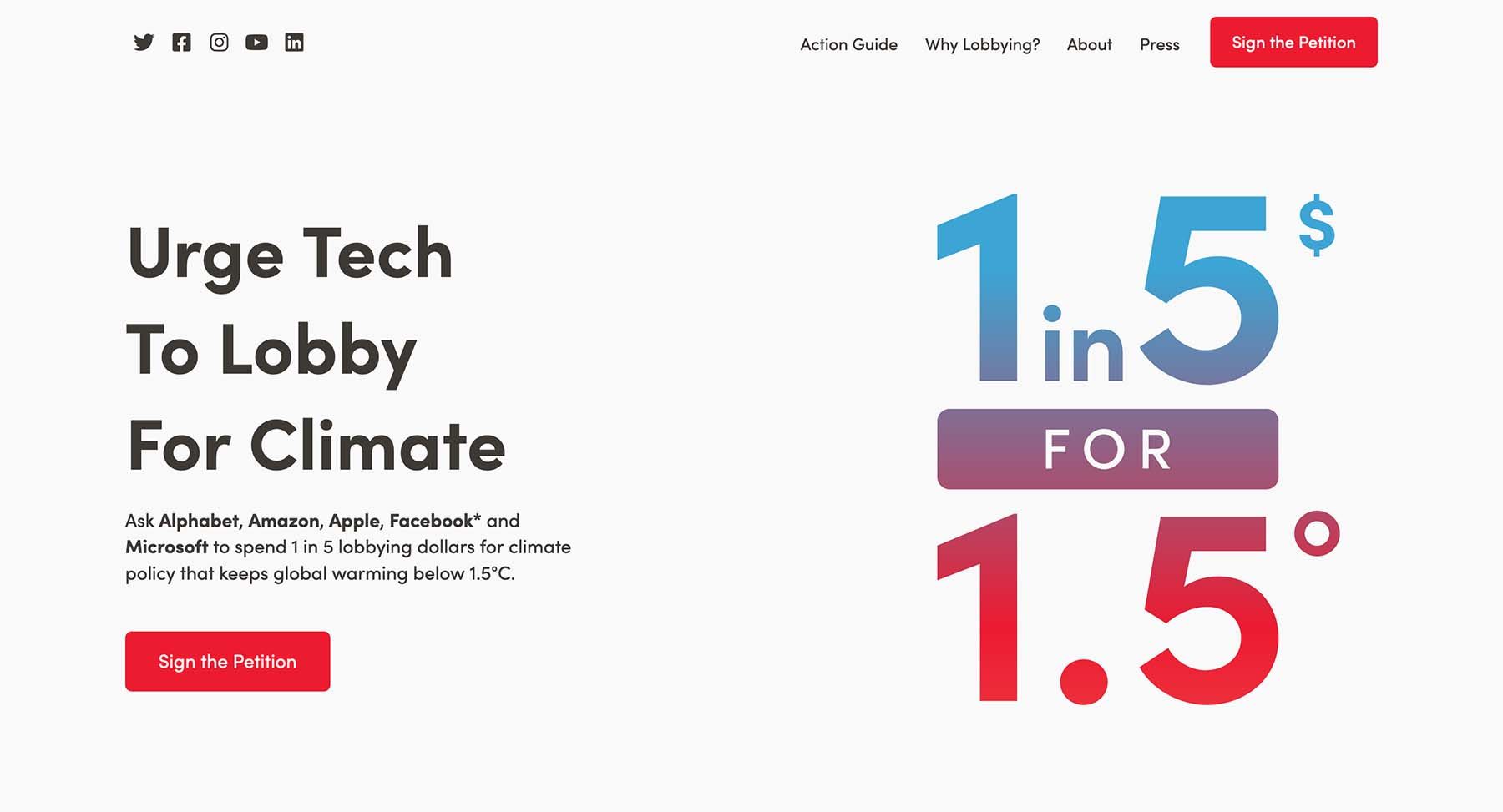
Tech giants also hold lobbying power. Workers inside those companies can help steer that influence toward climate-friendly outcomes; Climate Voice documents ways tech employees are already trying to do so.
The Value Of Talking About It
A familiar objection is that individual action is meaningless against a global problem. The podcast How To Save a Planet takes up this exact question in its episode “Is Your Carbon Footprint BS?” The counterargument, articulated by Dr. Anthony Leiserowitz of the Yale Center for Climate Change Communication, is that action spreads through conversation:
“One of the single most important things that anyone, anyone can do. When people say, ‘What can I do about climate change?’ My answer, first and foremost, is to talk about it.”
Your workplace already extends your influence beyond yourself. Encourage colleagues to communicate your company’s climate commitments openly — the ripple effect from one organization can inspire many others.
Keep Climate Action Inclusive
Sustainability efforts must not exclude anyone. Well-intentioned policies can place disproportionate burdens on marginalized groups: people with disabilities, communities of color, those in developing nations, lower-income households, and LGBTQ+ individuals. Climate change itself widens these inequalities, hitting hardest those who pollute least. Every initiative should be audited for fairness, ensuring the transition to lower-carbon operations is equitable and leaves no one behind.
Further Reading
- Jon Gibbins, founder of the UK agency As It Should Be, gave a talk titled “Leave No One Behind” on accessible, sustainable digital design; it is available from the Green Tech South West website.
- The Green Software Foundation’s Environment Variables podcast dedicated an episode to the intersection of accessibility and sustainability.
- Carbon Brief published a detailed explainer on what climate justice means in practice.



