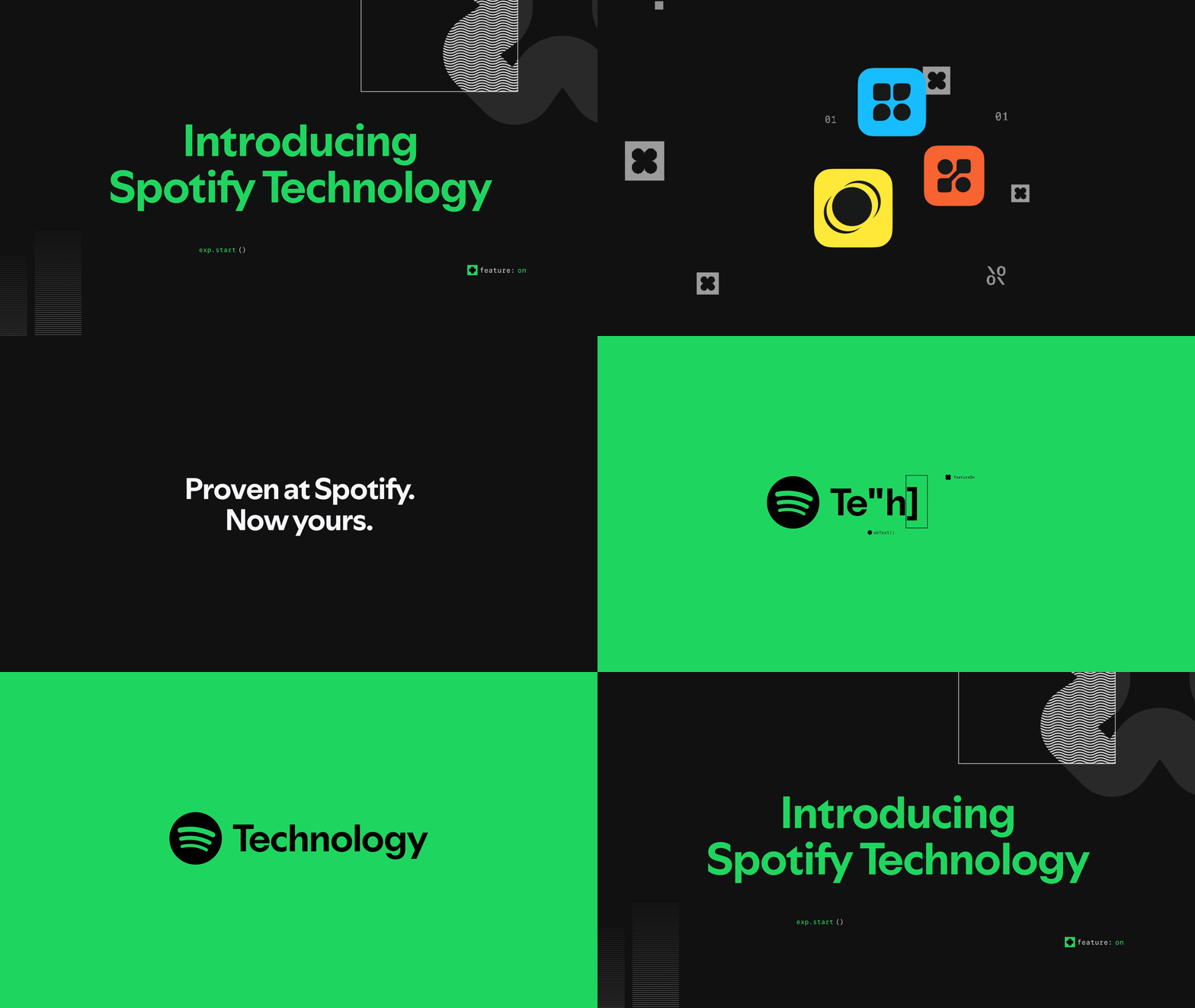
Spotify has consolidated its in-house developer products under a single brand: Spotify Technology. Portal, Confidence, Xirp, and Spotify for Backstage were designed to operate as one system, and now they share an identity as well as an architecture.
Why Spotify sells software
Backstage was open sourced in 2020. Confidence has been commercially available since 2023, Portal by Spotify since 2024, and Xirp launched earlier this year. Behind the consumer app sit hundreds of cross-functional squads building across music, podcasts, and books for 777 million monthly active users — a scale that demanded purpose-built engineering tools, which Spotify built rather than bought.
The scope extends past developer tooling to the full product development lifecycle, from idea to impact, alongside media technology built for Spotify's own needs. Running any of it cost-effectively at that scale is treated as an engineering discipline in its own right.
Autonomy with alignment
The Spotify Way still holds: teams decide what to build, how to build it, and how to work together, with ownership running through every level of the company. Scaling revealed that autonomy alone fragments. The response was "One Experience," a push toward one unified product rather than a federation of separately good ones. Neither extreme works alone — teams keep real ownership while a shared ecosystem keeps their choices fitting into one product and one stack.
Every product follows the same path: a real problem surfaces, Spotify builds something to solve it, proves it at scale with its own backend engineers, data scientists, ML engineers, product managers, and designers, then shares it as open source or a commercial product. The cycle takes years by design, including the rebuilds after things break in unforeseen ways.
Operating principles
- We do the hard work so you don't have to. Years of solving infrastructure, tooling, and operational challenges at Spotify's scale are effort customers don't repeat.
- Proven at Spotify, first. Every product sold runs on real production workloads inside Spotify daily, and reaches customers only after earning the trust of Spotify's own teams.
- Our tools earn their place. Spotify teams choose their own tools and may build or buy elsewhere. Everything in Spotify Technology won out over the alternatives in front of those engineers.
How the pieces connect
The system's value comes from closing the loop on the product development lifecycle — discovering what to build, building and shipping it, measuring whether it worked, and deciding what comes next. Building and shipping is only one element.
- Portal by Spotify supplies the context layer, encoding architecture, standards, and systems so every person and agent builds with that knowledge.
- Xirp carries that context into agentic development, letting teams work across multiple coding agents without losing state or building in silos.
- Confidence closes the loop as a product intelligence layer, grounding decisions about what to build next in evidence.
The connection is structural: one context layer and one agent runtime, so the products compound rather than coexist.
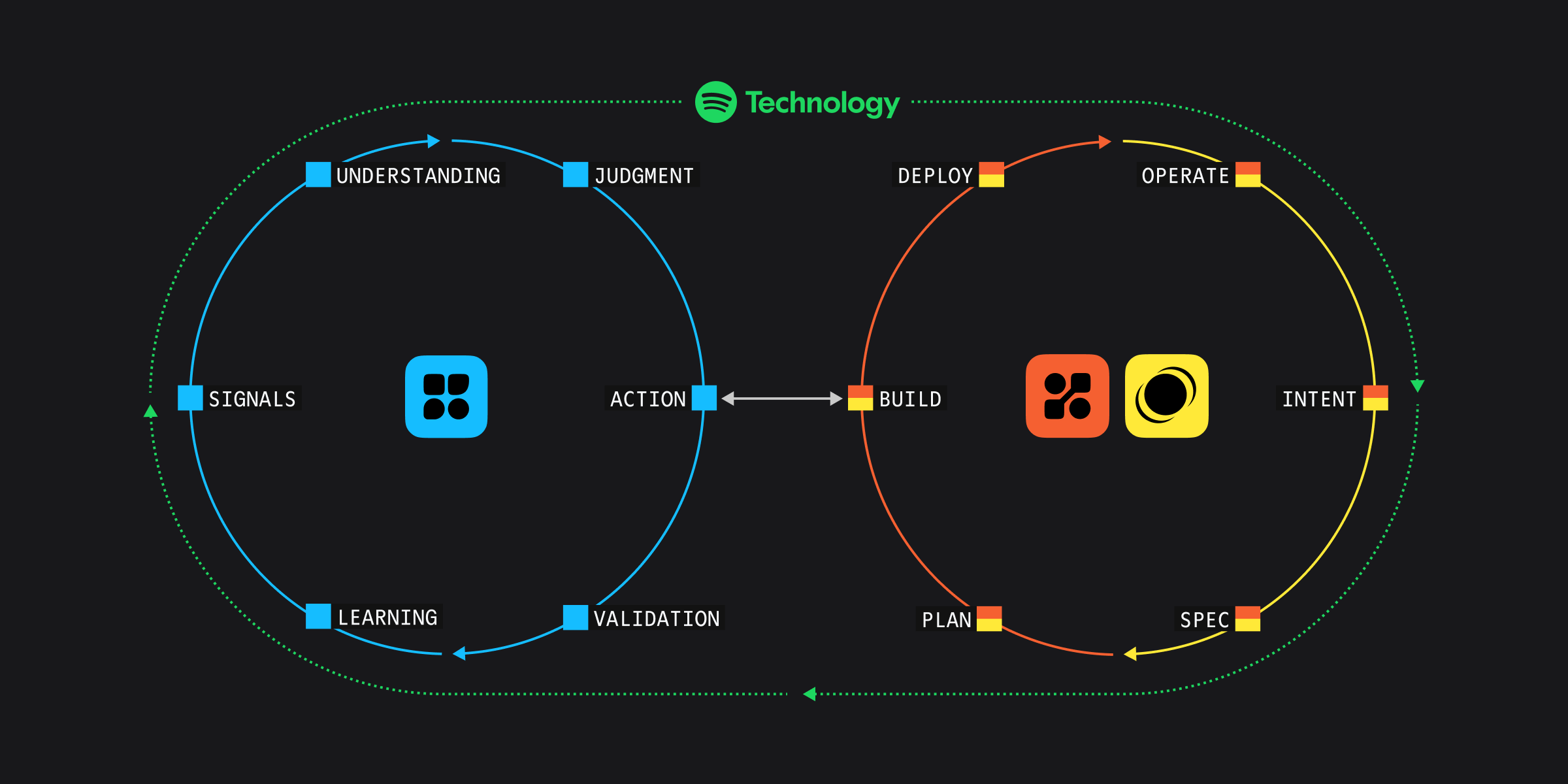
Adoption can start with one engineer, one team, or an entire R&D organization. The components are built to connect, and each cycle makes the system smarter — modular products spanning the lifecycle rather than a locking monolith or a self-assembled patchwork.
The constraint moves
AI has made building faster, but not simpler: complexity, cost, and operational surface area grow with output. More software to secure and operate, more fragmentation in how things get built, more data sprawl across models, pipelines, and artifacts nobody sees in full. Budgets risk outpacing plans, and teams ship more while measuring less, accumulating software no one can say is earning its keep.
Underneath the speed, judgment becomes the constraint — deciding what to build matters more when anything can be built. AI also makes forgetting expensive: without shared memory, teams and agents re-learn what the organization knows, rebuild what exists, and retest settled ideas, now at machine speed. Spotify has navigated these problems for years as AI compounded them, and credits tooling that lets learning persist and compound.
Toward an R&D operating system
Spotify expects software product development to require the same base ingredients whether a human or an agent does the work, and bets that organizations with their context organized and accessible benefit most from whatever capabilities arrive next. Current work deepens the connections between products and invests in agent-readiness across the portfolio.
The longer-term aim is for Spotify Technology to become the R&D operating system — not control over what teams do, but connective tissue: the layer that captures what an organization knows, how it builds, and what it has learned, and makes that available to every person and agent doing the work.