Figma and Adobe call off the acquisition
On December 18, 2023, Figma and Adobe ended their pending acquisition. After fifteen months of regulatory review, the two companies no longer saw a path toward approval. The deal had been announced on September 15, 2022 as an agreement for Adobe to acquire Figma.
The case Figma took to regulators
Brendan Mulligan, Figma's Vice President of Legal, described during the review period how the company spent its time explaining to regulators what Figma is and who it serves. He noted that despite Figma's impact, what it builds and the space it operates in are not widely understood, and said the company put in thousands of hours helping competition regulators place it in the software landscape.
At its most basic, Figma is a web-based design tool for teams building digital products together — mostly apps and websites. Its tools serve every member of a product team, including designers, developers and product managers, across the development process: brainstorming and concepting in FigJam, UI design and prototyping in Figma, and turning mockups and prototypes into coded products in Dev Mode, which launched at Config in June 2023.
Mulligan drew a line between this work and marketing or graphic design. Figma's customers are not creating a compelling picture or illustration for an advertisement or poster; they are building an interactive product, which takes many people, complementary skill sets and, increasingly, many different tools.
A crowded and shifting market
As well-built apps and websites became an expectation rather than a novelty, the market for product development tools grew significantly. Mulligan's picture of the landscape includes "all-in-one" products such as Sketch, Figma and Penpot; specialized "point tools" such as Miro, Flinto, Anima, Protopie and Zeplin; and low-code environments from companies like Salesforce that let more people build an app. AI, he said, has only quickened the pace of innovation.
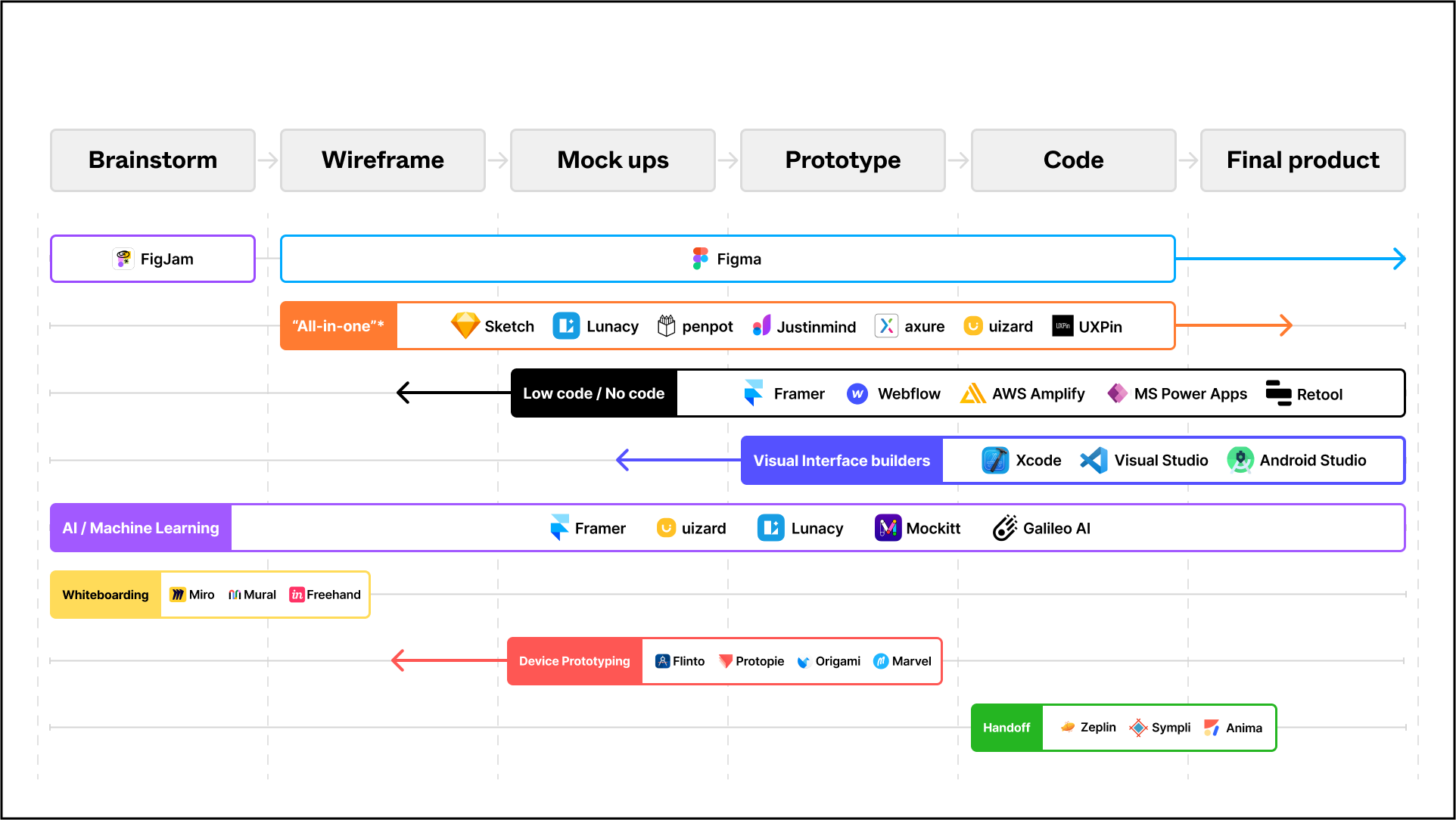
Figma shared a slide with regulators to illustrate this dynamism, and by Mulligan's own account it isn't the best-designed slide — it also went out of date three weeks after it was made. He framed that churn as typical: new startups and companies enter the space seemingly every week.
Adobe itself was absent from the slide. Its competing product, Adobe XD, was never a viable competitor, and Adobe moved it into "maintenance mode," halting new feature development long before. Photoshop and Illustrator, while very powerful, target creative use cases such as photo editing and advanced illustration and are not suited to helping teams build websites and apps.
The claimed benefits of combining
Figma's pitch for the deal rested on complementary strengths: its focus on collaborative product design and development, paired with Adobe's creative tools and reach to hundreds of millions of people. Mulligan argued the combination could unlock benefits neither company could deliver alone, and cited folding Adobe's 345+ million Font and Stock Image assets into Figma as a way to make product design and development faster and more efficient. He also pointed to commentary from Ben Thompson's Stratechery newsletter on "Figma's Disruption" and to a Wall Street Journal piece describing the deal as signaling a new era in collaboration and productivity.
FigJam was cast as a major part of that future, with Adobe's reach combined with FigJam's productivity tools seen as a route to new ways of working together — what some have called "collaborative creativity."

The community discussion extended to how a shared future might look. Figma acknowledged it had talked a lot about that future without showing it, and since the companies legally could not plan together, their product teams instead sat down to share preliminary ideas. Designer Helen Tran was quoted saying the acquisition meant "more competition, innovation, entrepreneurs, dreams."
What happened next
At the time of the interview, the plan was to keep building and shipping while engaging constructively with regulators on who Figma serves and why the deal would benefit its users. That path ultimately closed: with no route to regulatory approval, the merger was abandoned in December 2023, and Figma continues as an independent company.