Figma’s IPO Day Becomes a Public Block Party
When Figma’s banner went up over the New York Stock Exchange on July 31 with the message “Design is everyone’s business,” it signaled the start of a different kind of listing celebration. Rather than sticking to the traditional confines of the NYSE, Figma’s events and community experience teams took the milestone public with “Figma Commons,” a series of citywide moments designed to welcome both longtime community members and first-time onlookers.
The activation included a massive mural in Brooklyn, poster campaigns across New York City, a digital billboard in Times Square, and the main event outside the NYSE. The scope required weeks of planning and approvals from multiple city agencies, including the NYC Department of Buildings, the NYPD, and the mayor’s office. Community and events leads Jordan Scott and Kelley Sauer shaped the experience from the ground up. “I’ve never been part of an IPO, and the standard run of events for an NYSE listing felt easy. But I like a challenge, so we went bigger,” Sauer says.
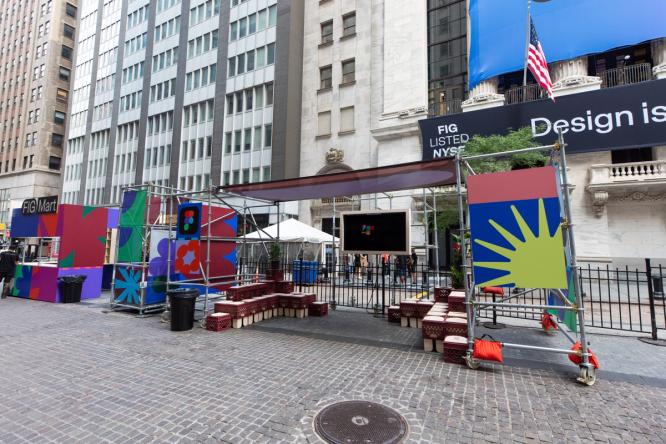
Setup did not go smoothly: stormy weather forced crews to halt work for 30 minutes after each lightning strike due to the metal structures involved. Still, the team pushed forward, with the digital billboards for Figma Make going live in the weeks before the listing day and remaining up through the end of the year.
Getting the Word Out in Under 15 Hours
Promotion for Figma Commons had a unique constraint. The team had to hold all communications until a press release was published, leaving them with less than 15 hours to build awareness. The answer was purely on-the-ground: flyers distributed at subway stations and ferry terminals, wildposting throughout the city, and direct outreach to local long-term customers.
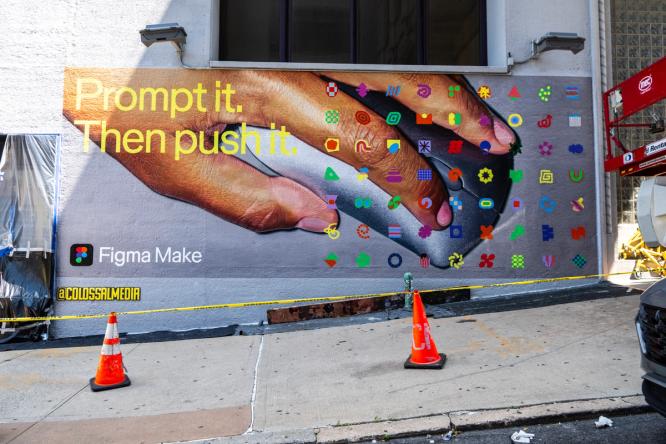
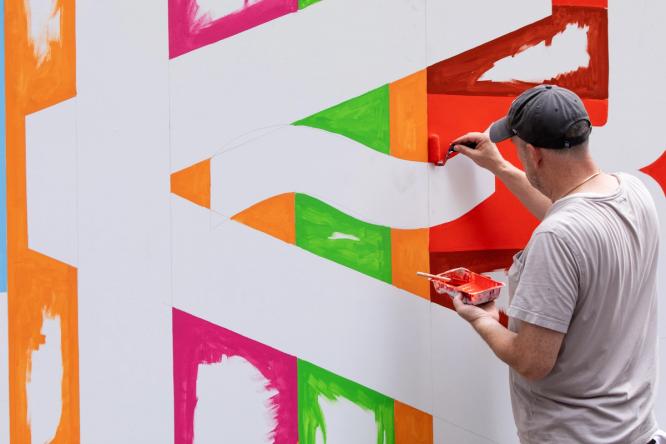
The Brooklyn mural promoting Figma Make was built from over 200 hand-drawn glyphs created by Figma’s Brand Studio team, tying the citywide visual campaign together.
A Focus on Design Details and Intentional Swag
For a community that appreciates the nuances of design, the details mattered. “What's special about our community is that they love Figma as a product, but they also love all the nitty gritty design details,” Sauer says. Every element at Figma Commons was deliberate, from the bespoke signage designed by the brand team to limited-edition merchandise that felt design-forward without being overly branded.
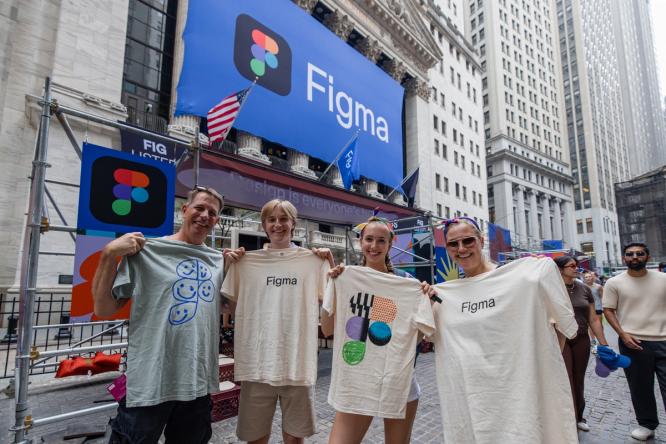
Custom trader jackets marked the NYSE listing, while hats emblazoned with “maker” underscored the message that anyone can be a creator. The food and drink offerings were similarly curated, with trucks serving local favorites like Peter Pan Donuts and Bleecker Street Pizza. New York graffiti artist Greg Lamarche painted a mural on-site, using code characters to construct the word “make” over the course of the day.
Hands-On Product Play
The centerpiece of Figma Commons was the Figma Make interaction area. To bring it to life, the events and product teams generated 30 Figma Make creations in a single week. These ranged from practical applications, such as a widget recommending nearby restaurants, to more whimsical experiences like a kaleidoscope explorer and a pigeon game. The night before the event, the team stayed until 3:30 am fine-tuning every interaction.
Community members also contributed their own Figma Make creations, including a “Friends of Figma directory.” Easter eggs like Figpals were woven into the various experiences. Each creation was tested, refined, and QAed before the public got a chance to try it.
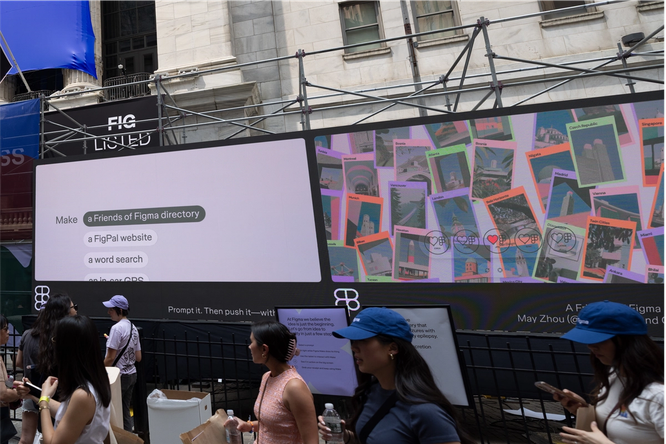
A popular poster-making station, which had its debut at Config Commons earlier this year, returned for the IPO celebration. “We wanted to give away keepsake moments we know our designers liked,” Sauer says. DJs kept the energy up, and lounge areas scattered throughout the space gave attendees a place to connect and watch Release Notes, Figma’s livestream of product updates. The event drew roughly 4,500 visitors, who went through about 15,000 pieces of swag and 300 items from local food vendors.
“We wanted to build out something that was really delightful for people, whether they were longtime members of our community or interacting with us for the first time,” Scott says. For Sauer, the measure of success was direct feedback. “The number of people who came through and said 'I walk through this area everyday and I’ve never seen anything like this,’ means we did our job,” she says.