The horseradish problem
When the only tool you hold is a hammer, everything starts to resemble a nail. A parallel idiom describes worms in horseradish, which perceive the world as horseradish. That framing applies neatly to someone who spends two decades writing HTML, CSS and JavaScript: code becomes the lens through which every medium is read, and every blank canvas looks like markup waiting to be written.
It took a project outside that medium to make the point concrete. Working on an album of covers, recorded in sound rather than code, meant the usual paint brush was no longer the right one. The concepts, tasks and challenges of the work stay largely the same — only the brush and the canvas change.
Someone raised by an art teacher sees this early. A former high school art teacher, herself a gifted painter, put many tools and materials in front of a child years before AOL and 56K dial-up modems existed. There is craft in producing a 2D visual with wet paint on a brush, and craft in designing interfaces written in code; there can be poetry in code just as there is code in poetry.
Building a workspace, whatever the craft
Sound is no different from the web when it comes to tool selection. A stack for the web might include an editor, a local virtual server, GitHub for version control and collaboration, a build process that compiles and deploys, and a host that serves the finished product to the web. A stack for music includes recording software, microphones, guitars, and an audio interface that captures physical vibrations and turns them into digital sound waves — plus a distributor to serve the music, playing the role a host plays for a webpage.
Complexity is a choice in both domains. A site can be HTML written in a plain text editor and manually uploaded over FTP; an album can be a boombox with a built-in mic. The indie or punk spirit applies equally. What can't be skipped is establishing a working environment at all, because that environment's decisions shape how the work gets made. The goal is to personalize the process and make it joyful.
Call it the Recording Experience (EX) — the same concern the field already recognizes as Developer Experience (DX).
What you're painting on
Paper raises its own questions: college rule or heavier card stock, and a surface that supports the paint being used. Screens introduce a different constraint model. Space is measured in pixel units, and though hardware caps how large a display gets, the scene itself is boundless — content scrolls into view indefinitely. (AJAX-based infinite scrolling patterns are best avoided regardless, and the emphasis is in the original.)
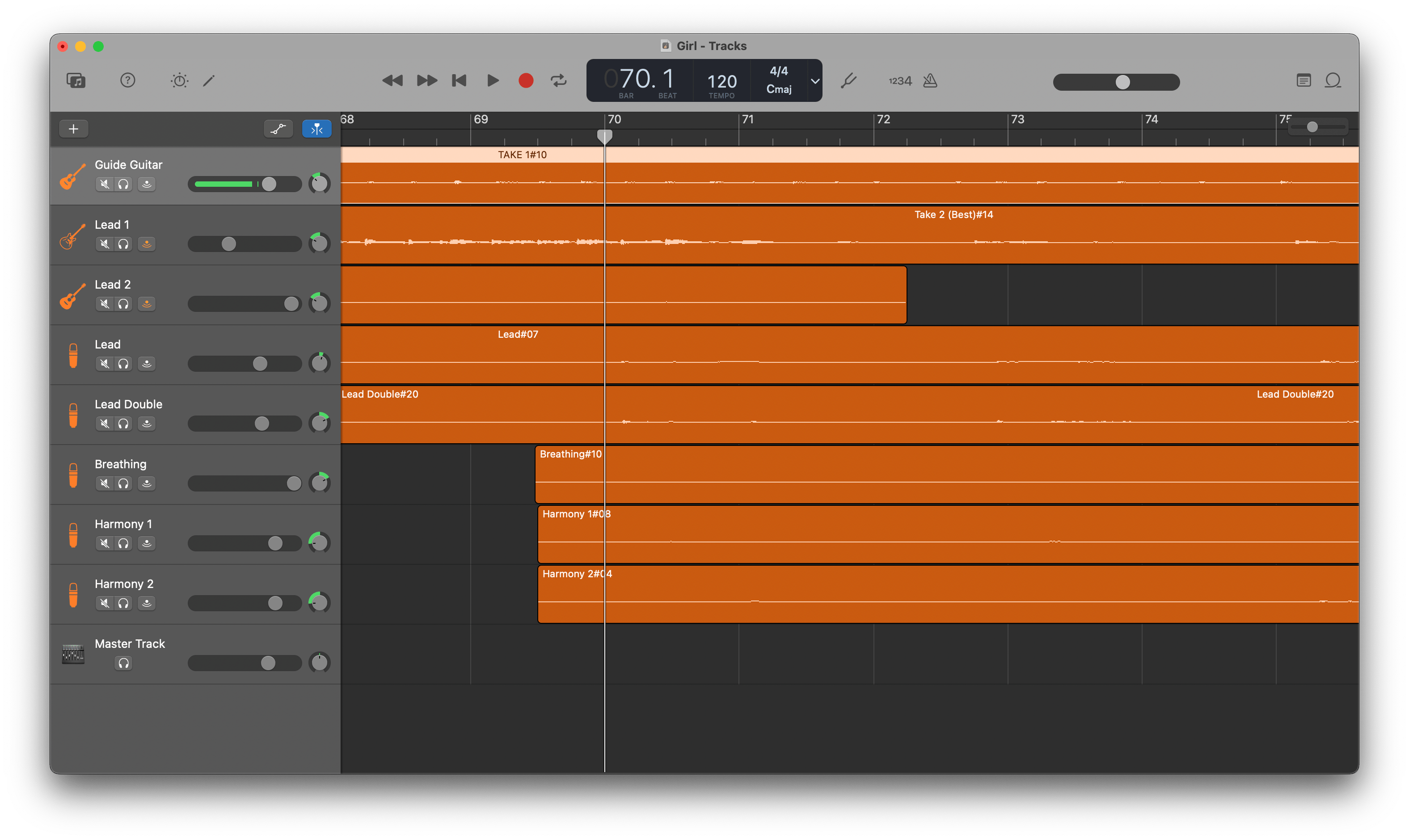
Recording software offers a canvas of comparable scope: a timeline stretching away, with sounds painted on top of time and layered at the same instant. Call them sound pictures, if you like.
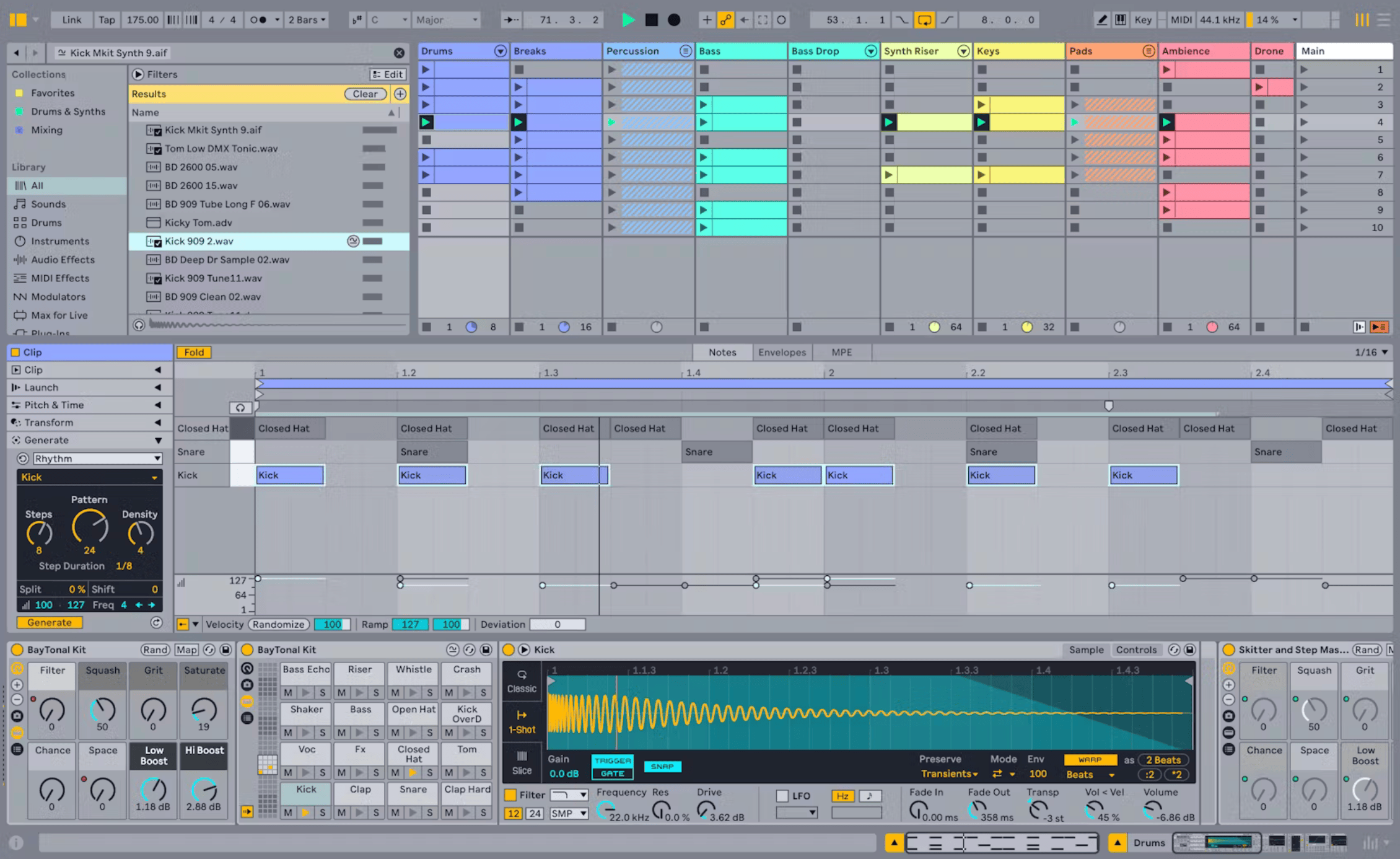
Other applications present that same canvas as movements holding buckets of sound samples instead.
Authoring code follows the same pattern. It can mean typing in an editor, or a point-and-click interface that never shows the code underneath — Dreamweaver, for instance. It can mean so-called "vibe" coding without any awareness of how the code assembles itself, or, at the other extreme, sketching code on paper before touching a keyboard.
Nobody knows what device or speaker is on the other end
Developers obsess over how their work renders on every device: resizing browsers to check responsiveness, opening the same site across a slew of hardware.
⚠️ Auto-playing media

Recorded music behaves identically. Each song gets countless listens because its sound shifts from speaker to speaker. One track nearly got scrapped after a struggle to make it sound good on AirPods Max, which are bass-ier than a typical speaker, versus a more broadly used output like car speakers. Whether anyone will even hear it on a bass-heavy pair of headphones is unknowable — the same way nobody knows if a site is being viewed on a screen built into a fridge or a washing machine.

The user can't be controlled on either side, and both disciplines carry the same UX and quality assurance burden. The same also invites a further layer around accessibility and inclusive design.
One big difference remains: hearing your own voice. A website never feels personally attached the way a recording does; listening back to your sounds takes a certain vulnerability and humility.
How a song and a site get made
Songs rarely arrive fully formed. Most musician accounts of the process describe the "magic" of a melody falling into a writer's lap — a germ of an idea that takes minutes, days, weeks, months, or even years to become a complete piece. Keeping Voice Memos at the ready allows quick sketches: a hum, a few chords on the guitar that sound nice together. Those phone recordings are low-fidelity sketches, much like sketching layout and content blocks with paper and pencil.

Shipping is its own minefield
Release is where the comparison gets uncomfortable. Shipping an album involves as many moving parts as deploying a website, if not more, and both bury the process in steps and dependencies. Learning music publishing and distribution has been more confusing than learning how websites get published and deployed ever was.
That website pain is well documented: so many hosting paths exist that the "right" one hides behind "it depends" on what the site needs to accomplish.
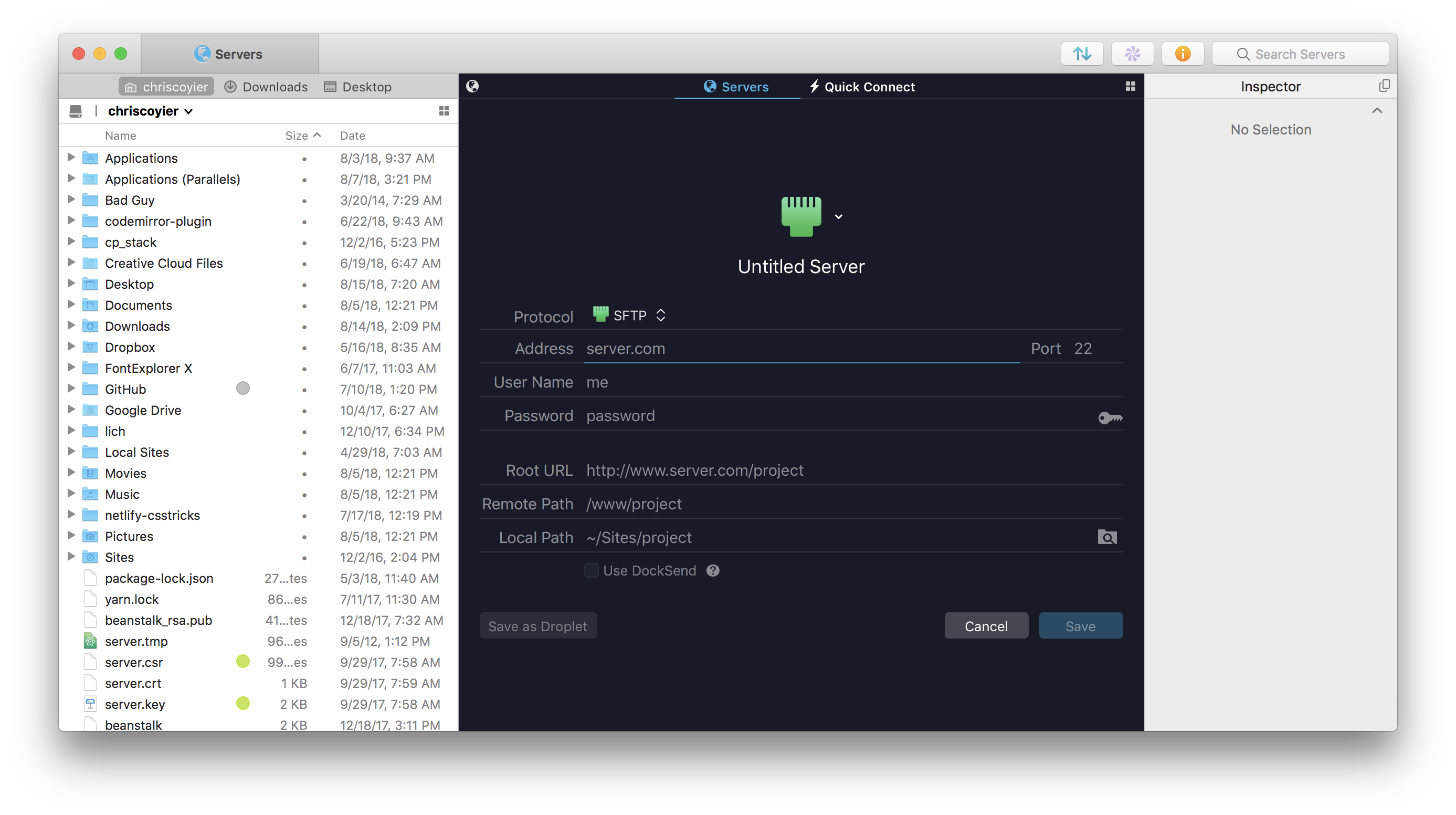
Music follows the same template. A professional rights organization establishes ownership of the recordings, much like registering a domain. A distributor makes the songs available for anyone to hear, exactly the concept of a host distributing a site over the wire. The missing piece is a way to programmatically push changes to a music catalog; uploading and configuring album content feels like manually uploading hosted files over FTP. Nothing wrong with that, but it leaves obvious room to improve the recording experience.
Stepping outside the groove
The whole exercise exposed a self-made rut — not a bad one, more the motion of an automated script running efficiently in a single direction. A project outside the usual medium forced a new context where the existing development environment and the brush of code are far less effective than the task requires. It's a bit like breaking out of the grid: the layout has been fixed for a while, and drawing new tracks opens up a way of working that had been in plain sight the whole time, drowned in the horseradish ocean. Music, painting, engineering, architecture, working on cars — there is much to learn from other disciplines, and front-end development turns out to resemble a lot of them.