
Why an Ethical Design Handbook Arrived at Just the Right Time
Early this month, The Ethical Design Handbook joined the Smashing Library, and despite a release period disrupted by worldwide lockdowns, the book has found an eager audience. The timing, it turns out, was serendipitous: as digital services became lifelines for millions, conversations about how those services treat their users grew more urgent than ever.
The book is the work of Trine Falbe, Martin Michael Frederiksen, and Kim Andersen, who previously co-authored White Hat UX. It aims to move beyond legal compliance and offer practical strategies for evaluating existing practices, sparking change where needed, and weaving ethical considerations into everyday workflows.
From Print Run to Pandemic
Physical copies of the book began reaching readers in March, drawing thoughtful responses from the design community. Mie Oehlenschlager, writing for DataEthics.eu, called attention to how clearly the book exposes manipulative design in the digital realm, adding that it teaches readers to recognize "design for the most vulnerable" and to understand surveillance capitalism as the root cause of unethical design. Per Axbom highlighted the book's practical tools and templates for assessing ethical considerations, particularly the strong emphasis on minimizing personal data collection and the useful walkthrough of different types of website cookies.
The authors faced challenges from the start. Finding positive examples of ethical design proved difficult, with DuckDuckGo, Goodwings, and LINGScars among the few showcased in the Handbook. Then came the release itself, timed almost perfectly with the spread of COVID-19. As quarantine orders disrupted everything from events to shipping, the traditional book launch plans fell apart.
"We felt it made most sense to stop actively marketing the book at that point. It just didn't feel right to celebrate and to ask people to support us, when they clearly had so much to worry about."
— Trine Falbe
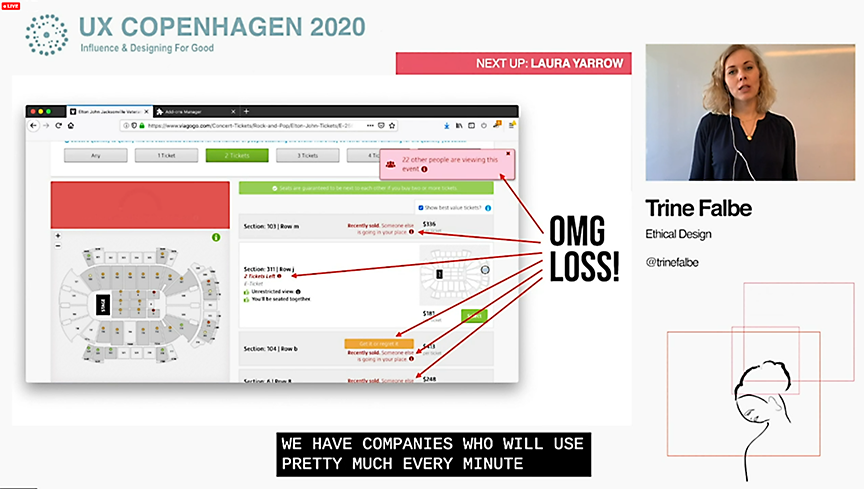
The planned launch party at UX Copenhagen was scrapped when the conference moved online. Falbe still presented "Ethical Design Beyond the 'Feel Good'" virtually, raffled off copies, and took audience questions. Attendees responded warmly, with one noting the book's clear business case for kindness and another praising the message that compassion during crisis is what users will remember.
Ethics as Professional Standard
Engineers, doctors, and teachers all have codes of ethics that guide professional behavior, often more stringent than the law itself. Business has similar codes. Yet dark patterns, weak privacy protections, and a lack of transparency in many digital services suggest that the tech industry has largely operated without such a framework.
The Handbook makes a case for why that needs to change. Companies that build with ethics in mind find themselves better positioned when legislation like GDPR and CCPA arrives. And during a pandemic, the stakes are even higher. As usage of online services, delivery apps, and teleconferencing surges, users are making rapid decisions about which tools to trust — and which to abandon.
Zoom illustrates the complexity. The platform has been praised for its accessibility and for offering free service to schools, yet it has also faced scrutiny for sending user data to Facebook and other ethical shortcomings. Falbe suggests that companies which protect privacy and communicate transparently during this crisis will earn lasting loyalty.
"If I was running a company that actually protects people's privacy (like join.me for online meetings) I would make sure to surface that in my communication. Another important element is transparency. People are in a state of crisis, and the last thing we need is to feel tricked. If we find a product or service that treats us well, doesn't hide costs, doesn't violate our privacy, and does their best to be honest about it, we will stick with them. After all of this is over, we'll remember the companies and people that did good."
— Trine Falbe
A Business Case for Doing Right
Designers facing ethical dilemmas in their work now have a starting point. The Ethical Design Handbook offers more than abstract principles — it provides a concrete business case for making ethical choices and the tools to implement them. As the world navigates unprecedented uncertainty, that foundation matters more than ever.
For those interested in exploring the topic further, Smashing Magazine has published related content on ethics and privacy, including Trine Falbe's article on designing for kids, a Smashing Podcast interview with Falbe and Frederiksen, and the printed magazine focused on ethics and privacy. Heather Burns' talk on building privacy-conscious projects from SmashingConf Freiburg is also worth watching. For those with extra time at home, Falbe curates a daily list of conference talks via #CoronaConf.
What ethically-made digital products are you recommending to friends and family right now? Which services earn your trust — and your loyalty?