Design as a growth lever, not a department
When Brian Chesky talks about Airbnb’s trajectory, he consistently returns to one idea: design was not a stage in the company’s development, but a driver of it. In a conversation recorded after Airbnb’s IPO, the co-founder and CEO described how the discipline moved from an internal function to the engine of the company’s next chapter.
Chesky’s framing is direct. He argues that design’s value is underestimated when it is treated as a finishing touch. Instead, he positions it as a tool for understanding what people actually need and translating that into business decisions. For Airbnb, that meant revisiting core assumptions about how hosts and guests interact, and letting those insights shape product strategy rather than simply polishing a finished concept.
The post-IPO reset
The period following Airbnb’s public listing presented a particular challenge. With growth expectations high, Chesky said the company had to resist the temptation to default to familiar playbooks—more features, more markets, more acquisition channels. Instead, the leadership team treated design as a lens for identifying where the real friction and opportunity sat.
That approach led to a re-examination of the guest experience from the ground up. The goal was not incremental improvement but a fundamental rethink of what Airbnb could offer beyond accommodation. Design, in Chesky’s telling, became a way to conduct that rethink rigorously, by forcing the company to articulate problems clearly before inventing solutions.
He also acknowledged a practical tension: design-led processes can look slower in the short term, especially in a public-company environment where quarterly numbers dominate. The antidote, he suggested, is to connect design work to business metrics early and explicitly, so that the connection between user experience and commercial outcomes is evident to investors and employees alike.
From craft to company-wide capability
A central theme of the conversation was scale—of a design organization itself. As Airbnb grew, Chesky said he realized that keeping design excellence meant more than hiring strong individual talent. It required building systems and rituals that let non-designers contribute to experience quality, and that let designers operate with the same rigor as engineers or finance teams.
That shift changed how Chesky thought about his own role. He described design as inseparable from leadership, asking the same questions of a product roadmap that a designer would ask of a screen—what is the job to be done, what does success look like, and for whom are we building this? He framed this not as a stylistic choice but as a competitive necessity in a market where differentiation rests less on features than on how people feel about the product.
Chesky offered a practical caution as well: design-led decision-making can become insular if it is practiced only by credentialed designers. He emphasized the importance of exposure to real user behavior and a willingness to kill ideas that do not solve a demonstrated problem, no matter how polished they are.
The business case for aesthetics and utility
One of the more pointed exchanges in the conversation concerned the relationship between beautiful design and functional design. Chesky argued that treating these as opposites is a false binary. Perceived quality, he said, influences trust, and trust is a currency in marketplaces like Airbnb. A well-executed interface is not decoration; it is a signal that the company will handle transactions and disputes responsibly.
That logic extends to the broader product. Chesky said Airbnb’s design work in the years after going public was aimed at making the service feel cohesive across trips, not just at the point of booking. The ambition was to treat the entire arc—search, book, stay, communicate, return—as one experience that design could own end-to-end.
The measurable payoff, in his account, came in retention and word-of-mouth: travelers who had a designed experience returned more often and brought others with them. This, he argued, is the real business case for design investment. It compounds, unlike marketing spend, because it improves the product itself with every interaction.
Hard-won lessons for other leaders
Chesky closed with observations aimed at executives who want to replicate Airbnb’s approach. His advice distilled to three points. First, put designers in positions where they see real business constraints; don’t shelter them. Second, expect design leaders to speak the language of metrics and strategy, not just aesthetics. Third, recognize that design is a discipline of trade-offs, and strong design organizations are those that make those trade-offs explicit and debatable.
The underlying message was that design’s role in a company is not predetermined. It can be confined to a specialized function, or it can be treated as a way of thinking that influences strategy, operations, and culture. Airbnb’s post-IPO history, as Chesky tells it, is a test case for the latter—and an argument that the gap between the two approaches is a business decision, not a creative one.
Figma’s Dylan Field sits down with Brian Chesky on why design-led companies need to organize around the product, not the process
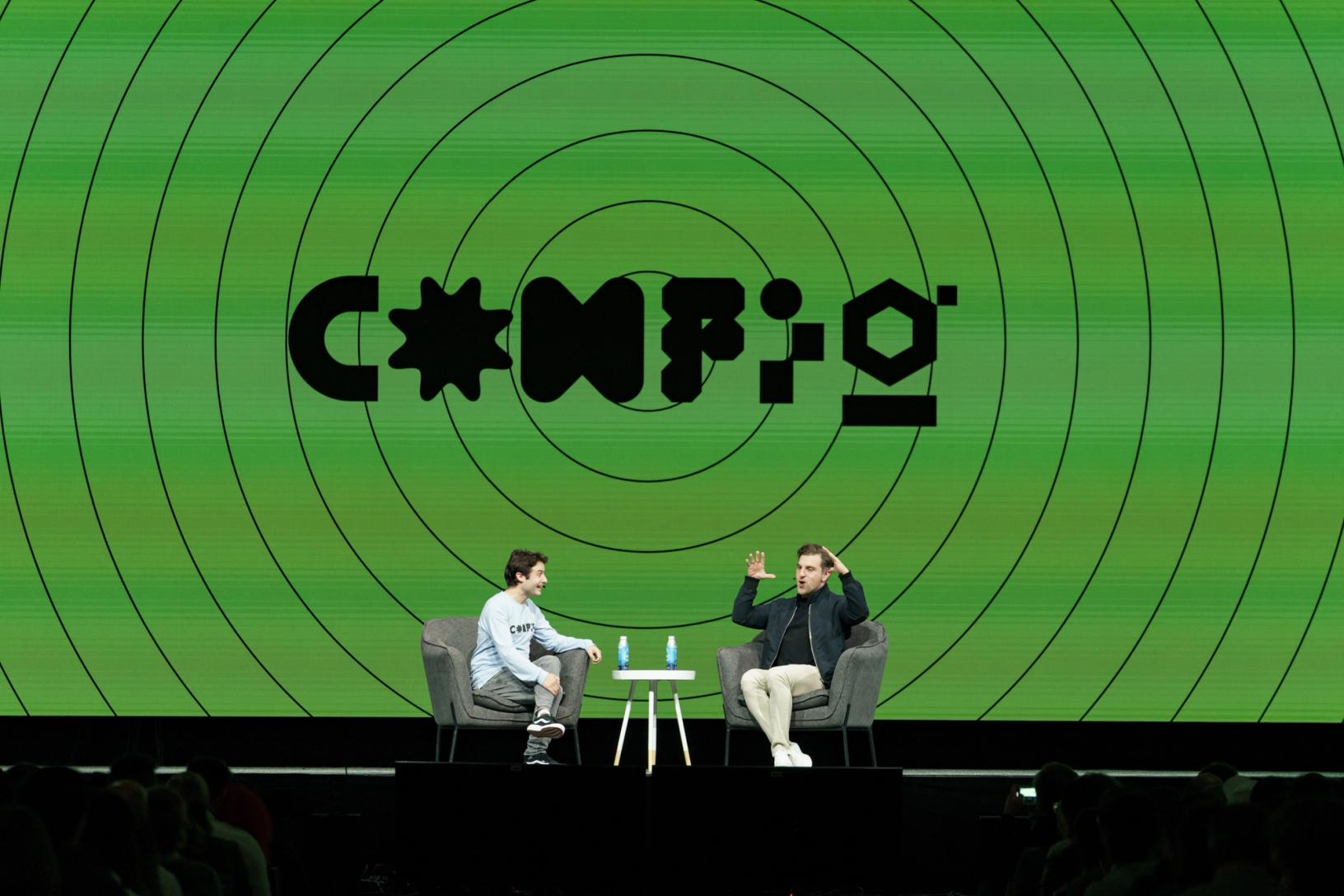
For a CEO who has spent most of the last year telling audiences that design isn’t decoration — it’s a way of running a company — Brian Chesky’s conversation with Figma’s Dylan Field at this year’s Config conference was something of a mission statement. Asked whether he is indeed the only designer running a Fortune 500 company, Chesky confirmed with a smile: “If there’s another one, I’d love to meet them.”
The conversation swung between Chesky’s near-death experience with Airbnb during Covid, how he rebuilt around functional teams instead of siloed business units, and why he believes designers should stop apologizing for their seat at the table. “Why does design need to be in the boardroom when it can occasionally run the boardroom?”
A crucible moment at the end of 2019
Chesky traces the turning point to late 2019, when he sensed the company’s original magic was fading. Ten years after co-founding Airbnb with Joe Gebbia and Nate Blecharczyk, that founding ethos — two designers and one engineer with a startup no one believed in because “designers don’t start companies” — had swollen into something unrecognizable.
As Chesky tells it, the company had fragmented into 10 divisions, each with another 10 subdivisions. Product managers made the calls. A/B tests were everywhere. The company delivered more projects while the app barely changed — and costs kept climbing.
One met with a raw early 2020 when Airbnb’s business in China dropped 80%. Within eight weeks, the business lost 80% overall, and Airbnb went from IPO hype to headlines questioning its survival. Chesky describes the moment as “your life flashes before your eyes” — for a company, the same clarity arrived. “If Airbnb’s like a burning house, and I can only take half the things out of the house, what do I take with me?”
For ten years, he says, he had been apologizing for how he wanted to run the company. The crisis gave him permission to stop.
From business units to functional teams — with a single roadmap
What followed was a restructure from business units back to a functional organization: one design department, one marketing department, one engineering team. Every project was consolidated onto a single roadmap, and then the hard reckoning came: “We can only do 10% of the things on the roadmap.” The company would focus on a few big bets, with its best people attached to each.
Chesky draws a direct line here to Apple, the company he studied as he rebuilt Airbnb. He cites two encounters that changed his thinking: Hiroki Asai, one of Apple’s creative directors, and Jony Ive, head of design under Steve Jobs. “Everything I was taught about how you run a company was opposite of what Steve Jobs and Jony Ive and Hiroki did at Apple,” Chesky says. After the restructure, he adopted their model more explicitly: he would become the chief editor of all work, reviewing everything across the top 30–40 people in the company.
- No more classic product management function — leadership combined product management with product marketing, on the reasoning that “you can’t develop products unless you know how to talk about the products.”
80%of product releases ship on a twice-yearly cycle — but the remaining20%remains live code, shipping hourly, reserved for optimizations.- A/B tests were not abolished so much as constrained, if you have a hypothesis — and you have to be able to say why the B treatment outperformed A.
Design roles were built while classic product management went away; Chesky describes designers less as surface polishers than as architects who must stay integrated with the full system and user flows the way Apple did. He points to the earnings streak since the crisis as a result: “We went from a company that was breakeven to, last year, we did nearly $4 billion in free cash flow,” more per dollar earned, he claims, than Apple or Google.
Airbnb’s design principles in practice
Field asked specifically how a design-driven strategy works for teams that aren’t founder-led. Chesky’s advice is a set of operating principles he says he repeats internally:
- Make experimentation hypothesis-driven — you should know why it worked, not just that it worked.
- Bound your focus to user flows rather than isolated surfaces.
- Ship only what you’re proud of — if you wouldn’t put your name on it, it doesn’t ship.
- Lead with intuition: make something that delights you first; don’t test until you’re happy with the work.
- Treat simplification as distillation, not removal. You have to understand something deeply before you can edit it down.
- Obsess over craft in every detail.
- Speak the business’s language: explain why the designer’s role helps them grow.
- Challenge “growth” as a goal — growth is a direction, not a strategy.
Underpinning that list is Chesky’s core contention that the creative process has ceded too much ground. Designers justify their jobs in ways CFOs and lawyers don’t have to, and that’s partly a historical accident. It is a habit he wants to break.
The Airbnb blueprint and the product roadmap
On alignment, Chesky returns to the financial roadmap — a three-year horizon with near-term clarity. He updates it every week; the near-term stays stable, the long-term tilts as conditions change. Product development often starts not with design but with marketing (a team he believes should be treated less like a front-of-house service and work “in the kitchen” with engineering).
Airbnb’s recent Rooms launch offers a concrete example. To revive host growth, they started with a user insight: guests were nervous staying in someone else’s home, especially when they’d share common spaces. Airbnb had optimized for the home photo — not the person behind it. So the company zeroed in on the Airbnb profile, applying historical reference: what is a profile with travel? A passport — and for every host, that meant building that equivalent they described as a “passport” from scratch.
The challenge then was the execution. The room product tied into operations — they spent on a shoot to take headshots for 40,000 hosts. All of what Chesky calls the “share of attention” — given the integrated structure — finally allowed Airbnb to take the leap from reviewing how the core product was constructed and where friction was happening, then map it to marketing execution.
Part of the problem is that “talking to customers” reads as a generic tactic. At Airbnb, Chesky approaches this with a systematic, almost industrial process — what he calls “wrapping your arms around the company.” Inspired by Walt Disney’s storyboarding for Snow White, he set out to build an Airbnb Blueprint: an end-to-end storyboard of every guest and host journey. It came to 150 screens. Nearly 70 user policies. He had teams map “every operational touchpoint,” went through nearly 20 million customer service calls, and reread “hundreds of thousands” of social posts.
The point is to hold a bird’s-eye view of the whole system, prioritized and sequenced: “We can’t do new things unless people love our core service.” The output isn’t anecdote; it’s judgment. Intuition, in Chesky’s telling, is holding 5,000 ideas at once — data, research, user interviews, personal experience — and then making something bet that “the best of it” in a single product.
The third path that designers bring
Field left Chesky to close the loop with founding advice. Chesky of a designer’s edge: “Do you ever see two bad options… the third path requires creativity.” He believes that the compounding run of metrics and optimization has gutted imagination in business, and designers are the force best positioned to bring it back: “Who knows what people want as well as designers? Not many other people.”
Design as a business function
Chesky’s view of design is not limited to pixels or prototypes. He frames it as a fundamental business process. “Design is not just about how a product looks,” he says. “It’s about how the entire company communicates, solves problems and makes decisions.” In this sense, design thinking becomes a leadership discipline that touches strategy, operations and customer experience.
Airbnb’s approach has been to embed designers early in the product cycle. They don’t polish at the end; they participate in defining the problem. For Chesky, this close coupling between design lead and business function creates the tension that produces strong products. He distinguishes between design as styling and design as definition — the latter shapes what the product is in the first place.
Building tools for collaboration
The operational reality of this philosophy is that cross-functional teams need shared artifacts. That’s where design tools such as Figma enter. They move design out of static handoffs and into a living, shared workspace. In the same way that docs became the medium for writing culture, a design file can become the medium for product decisions.
Chesky points to the value of design systems that let engineers, product managers and executives react to design directly, which reduces distance between idea and implementation. Team members can comment, suggest and modify without losing a version of the truth. This supports the “open” ethos: fewer walls means faster alignment and fewer miscommunications between disciplines.
Creating outside of a vacuum
One recurring theme in the conversation is the danger of internalized viewpoints. With a cross-functional tool, designers can expose their work to stakeholders more often. That constant exposure forces clarity and encourages a mindset where people build with an awareness of the market, user needs and constraints.
The lesson for the broader industry is that collaboration tools are not about convenience. They change the conversation patterns during the entire product life cycle, giving teams a tangible interface for one of normally the most abstract parts of the workflow. Both the practical aspect of handing off files and the higher-level practice of aligning strategy get stronger when the tool is shared.