Retrospectives that include everyone
Retrospectives are a core part of team growth, but most retrospective tools are built around drag-and-drop, color coding, and free-form canvases that lack headings and navigational anchors. For teams that include people with disabilities, that can mean excluding the very people whose perspectives matter most. The GitHub Accessibility leadership team — which includes members with blindness and hearing impairments — runs its retrospectives entirely with tools that support full participation from every teammate.
Because GitHub is remote-first, all collaboration happens virtually. The team’s retrospective stack is:
- GitHub Issues
- GitHub Discussions
- Zoom
- Slack
Screen reader users on the team specifically prefer GitHub Discussions over typical web-based document tools. Discussions natively support threaded conversations and allow voting on individual threads within a discussion. To keep everything findable, the team links all related discussions into a single GitHub Issue using a tasklist.
Setting up the retrospective
The process starts with a GitHub Issue that houses the retrospective. That issue includes a description of the format, a tasklist of discussions, and the shared agreements the team operates under. The team uses the Starfish retrospective format, with Norm Kerth’s “Prime Directive” as the guiding agreement. Proper Markdown headings in the issue and discussions are important so screen reader users can navigate the content by heading and understand how the retrospective will run.
Next, a discussion post is created for each Starfish category:
- Keep doing — what is working and we should continue?
- Less of — what do we want less of?
- More of — what do we want to see more of?
- Stop doing — what’s not working and we should stop?
- Start doing — what new things should we try out?
Each discussion is linked from the tasklist in the original issue. A dedicated “Retro” discussion category makes it easy to search past retrospectives later.
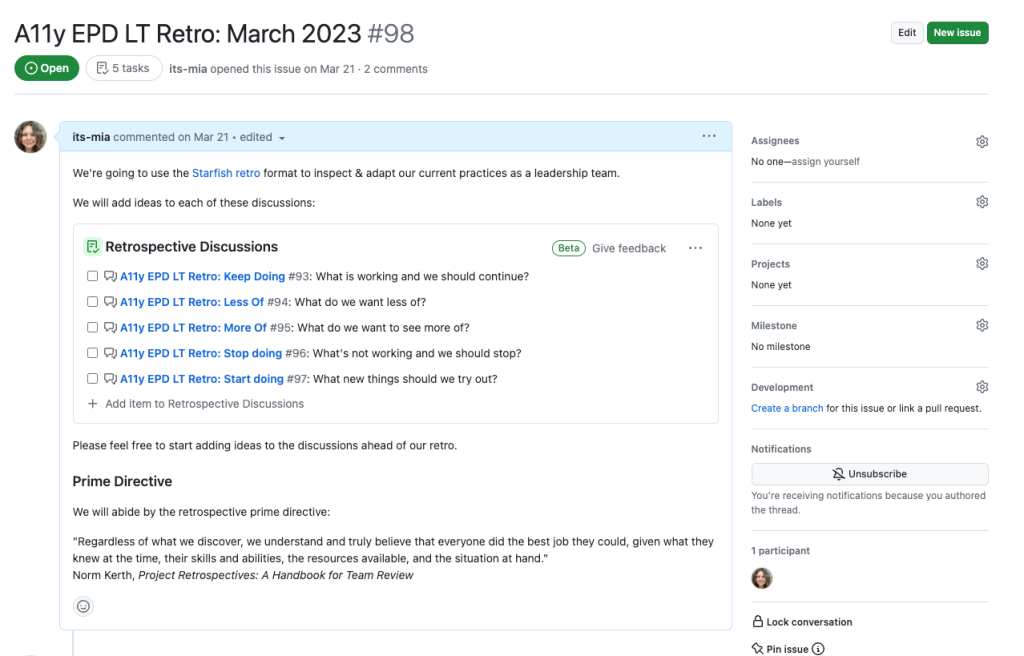
Participants are invited to contribute before the meeting so they have time to read, reflect, and prepare. That advance runway helps neurodivergent teammates in particular, and it is simply better facilitation practice overall.
Guiding the conversation
Running an accessible retrospective turns out to be straightforward. The key is to give people multiple ways to participate and to be explicit about what is happening at all times:
- Start by letting participants review, comment on, and vote within each discussion. The voting results help prioritize what gets talked about, and threaded replies in GitHub Discussions can carry the conversation.
- Ask each participant whether they prefer Slack or the video call’s own chat for non-verbal communication during the session.
- Turn on live captions in the video platform (Teams, Zoom, WebEx, Google Meet all support them) so anyone can glance back at the transcript if they miss something.
- Send a detailed meeting description and links in advance so everyone arrives with the context they need.
- If you use a timer, announce prompts both verbally and in chat.
- When sharing a screen, describe what is on it.
- If teammates have not worked together before, have everyone introduce themselves verbally first so voices are recognizable.
- Ask speakers to say their name before they start talking, and encourage keeping cameras on so participants who read lips and facial expressions can follow along.
- Tell people openly that fidgets and toys are welcome if they help with focus.
- Ask participants to verbalize expressive hand signals and reactions as they happen.
- As action items surface, summarize next steps and ownership aloud to confirm shared understanding.
Closing the loop
After the retrospective, post a summary of the key discussion points and agreed next steps on the issue. That gives everyone a stable place to check back and hold each other accountable.
The GitHub Accessibility team’s goal is to empower developers with disabilities to create and contribute — and that starts internally, with its own processes. The team intentionally hires people with diverse lived experiences and continually adapts how it works so every member can participate fully.