

Why Streaks Work
A streak is, at its core, a count of consecutive days a user completes a specific activity. But the mechanics of a streak are less important than the psychology that makes it so compelling. When Duolingo introduced an iOS widget displaying streaks, user commitment increased by 60%. That is not a small bump; it is a fundamental shift in behavior, and it shows how a simple consecutive-day counter can drive serious engagement.
Streaks tap into three well-documented psychological principles: loss aversion, the Fogg Behaviour Model, and the Zeigarnik effect. Each one explains a different piece of why streaks are so hard to break — and why they can be so effective when designed thoughtfully.
Loss Aversion
Loss aversion is probably the strongest force behind streaks. The emotional weight of losing something is roughly twice that of gaining something of equal value. A friend gives you $100 and you feel good. You lose $100 from your wallet and it hurts much more. Given a 50% chance to win another $100 or lose the original $100, most people would decline the gamble. That asymmetry is loss aversion, and it is deeply human.
Streaks exploit this directly. A user with a three-day streak closing their Apple Watch "Move Rings" is motivated by achievement. A user with a 219-day streak is motivated by the fear of losing it. The effort invested over months creates a psychological anchor, and the streak becomes something to protect rather than something to build. Duolingo has noted this bias explicitly, explaining how loss aversion contributes to a user's reluctance to break a long streak, even on their laziest days. At that point, a streak stops being a goal and starts being a habit.
The Fogg Behaviour Model (B = MAP)
Loss aversion explains why we protect long streaks, but what gets us to start — and keep going — before the streak feels valuable? The Fogg Behaviour Model offers an answer. It states that a behavior (B) occurs only when three factors align at the same moment: Motivation (M), Ability (A), and Prompt (P). Thus, B=MAP. If any one of these is missing, the behavior doesn't happen.
Motivation is fragile. Some days you are excited to learn Spanish; other days you feel no willpower at all. Relying on motivation alone is a losing battle.
Ability compensates for that by making the action so easy that it's almost impossible not to do it. Apple Fitness requires just one minute of standing in an hour to earn a tick toward your Stand goal. Duolingo requires just one completed lesson. The barrier is low enough that even on your worst days, the task is doable. The effort of maintaining the streak is where the psychology kicks in.
Prompt completes the equation. Humans are forgetful, and streaks are persistent by design, so users need reminders. A prompt can be remarkably powerful: Duolingo ran an A/B test adding a little red badge to the app icon and saw a 6% increase in daily active users — from just a red badge.
There is a limitation to the Fogg model, however. Modern research suggests that designs relying too heavily on prompts, like aggressive notifications, risk creating mental fatigue. Constant notification pressure can eventually cause users to churn.
The Zeigarnik Effect
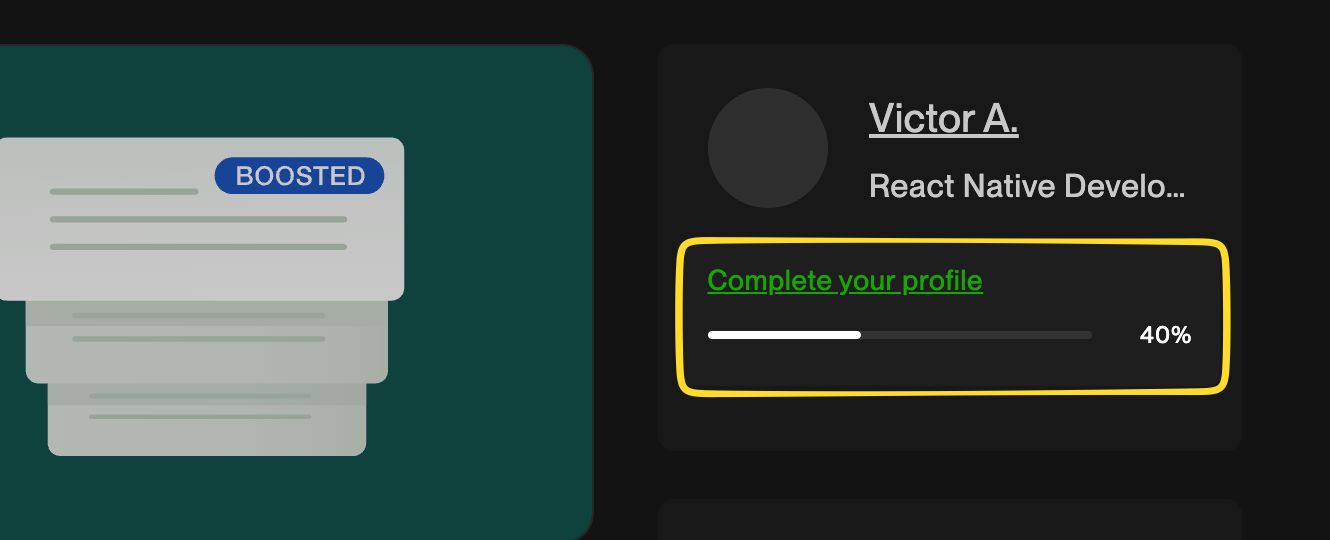
Unfinished tasks occupy more mental space than completed ones. This is the Zeigarnik effect, demonstrated by psychologist Bluma Zeigarnik, who found that incomplete tasks stay active in memory longer than those we finish. Digital products exploit this with artificial progress indicators, such as Upwork's profile completion bar showing a profile is only 60% complete.
Consider a to-do list app: five tasks, you complete four. Many people feel unaccomplished because of the one unfinished item. That is the Zeigarnik effect in action. A streak pattern taps into this naturally. On day 63 of a learning streak, you are in an ongoing state of unfinished business. The streak sits in the back of your mind, and your brain essentially starts sending you its own notifications.
The Goal and the Dark Side
Put together, these psychological forces explain why streaks are capable of reshaping behavior. But somewhere along the line — the exact point varies per person — a streak shifts from fun to something you feel you cannot afford to lose. You don't want 58 days of effort to go to waste.
Done right, streaks help users build habits that accomplish a goal, whether that's reading daily or hitting the gym consistently. These repeated actions compound over time and become visible in daily life. But there is a dark side to streaks as well, which any designer building one must keep in mind.
Where Streaks Turn Into Compulsion
There is a subtle but critical difference between habit formation and compulsion. A habit is consistency toward a repeated goal; compulsion is consistency on a goal that no longer serves a purpose, maintained out of fear or pressure. The line is thin. Brushing your teeth each morning is automatic and useful, with a clear outcome. An ethical streak system mirrors that: it allows imperfection. If you miss the morning, you can brush at noon without losing a long record.
Compulsion inverts this dynamic. The streak produces anxiety, guilt, even exhaustion. Users act not because they want to, but because the thought of watching progress reset to zero is unbearable. This can escalate until a user ties self-worth to an arbitrary metric rather than the reason the streak started in the first place. One description captures the extreme: "I felt that I was cheating, but simply did not care. I am nothing without my streak." That is a sign the metric has displaced the goal.
An ethical streak system should read as encouragement, not pressure. Extrinsic motivation — rewards, punishments — can get users started, but intrinsic motivation sustains engagement. A user learning Spanish to speak with a loved one has a far stronger long-term driver than a user fearing their fire emoji disappears. Design should lean on intrinsic motivation and use extrinsic elements sparingly, reminding users how far they’ve come rather than threatening what they might lose.
A useful check: Does your product make money selling solutions to the anxiety your product created? If so, there is a high chance you are exploiting users.
Good Streak UX: How To Keep It Ethical
Designing a streak that genuinely helps users achieve their goals requires intentional decisions. These are the core UX principles to follow.
Make The Action Tiny
Effortless actions form habits. The first rule of any streak design should be making the required action as small as humanly possible while still achieving progress. Daily actions that require willpower rarely survive more than a few days — nobody sustains motivation five days in a row.
A meditation app, for example, should not demand a 20-minute session to maintain the streak. A minute, or even thirty seconds, is enough. Small efforts compile into substantial achievements over time. The goal is to remove friction, especially during difficult moments. When users are stressed, make it clear that simply showing up counts.
Show, Don't Just Track
Humans are visual. Effort needs to be seen to be believed, which is why streak systems lean on graphs, checkmarks, progress rings, and grids. GitHub's contribution graph makes consistency visible, and users respond strongly to it.
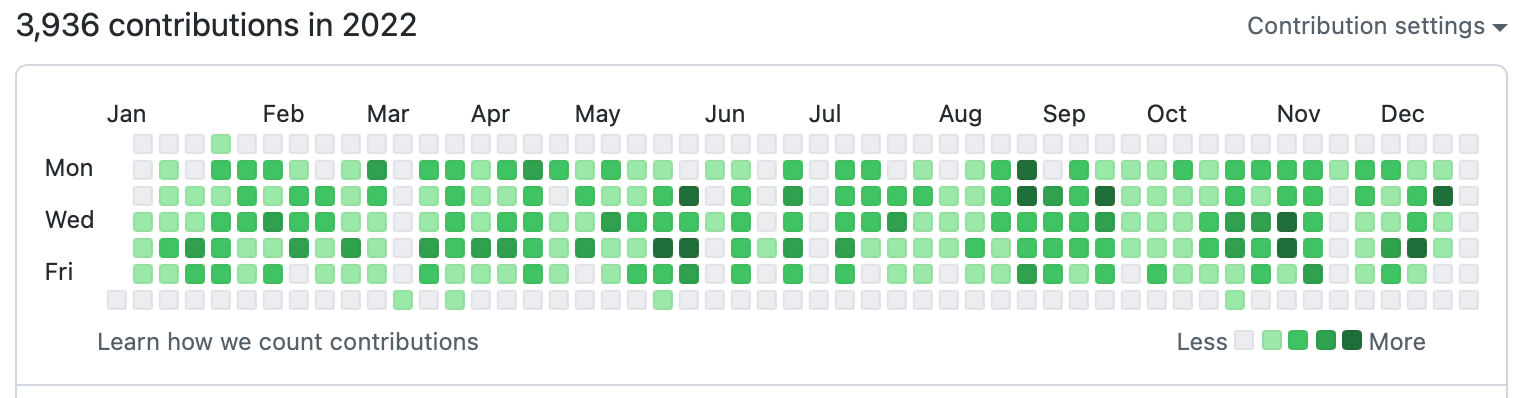
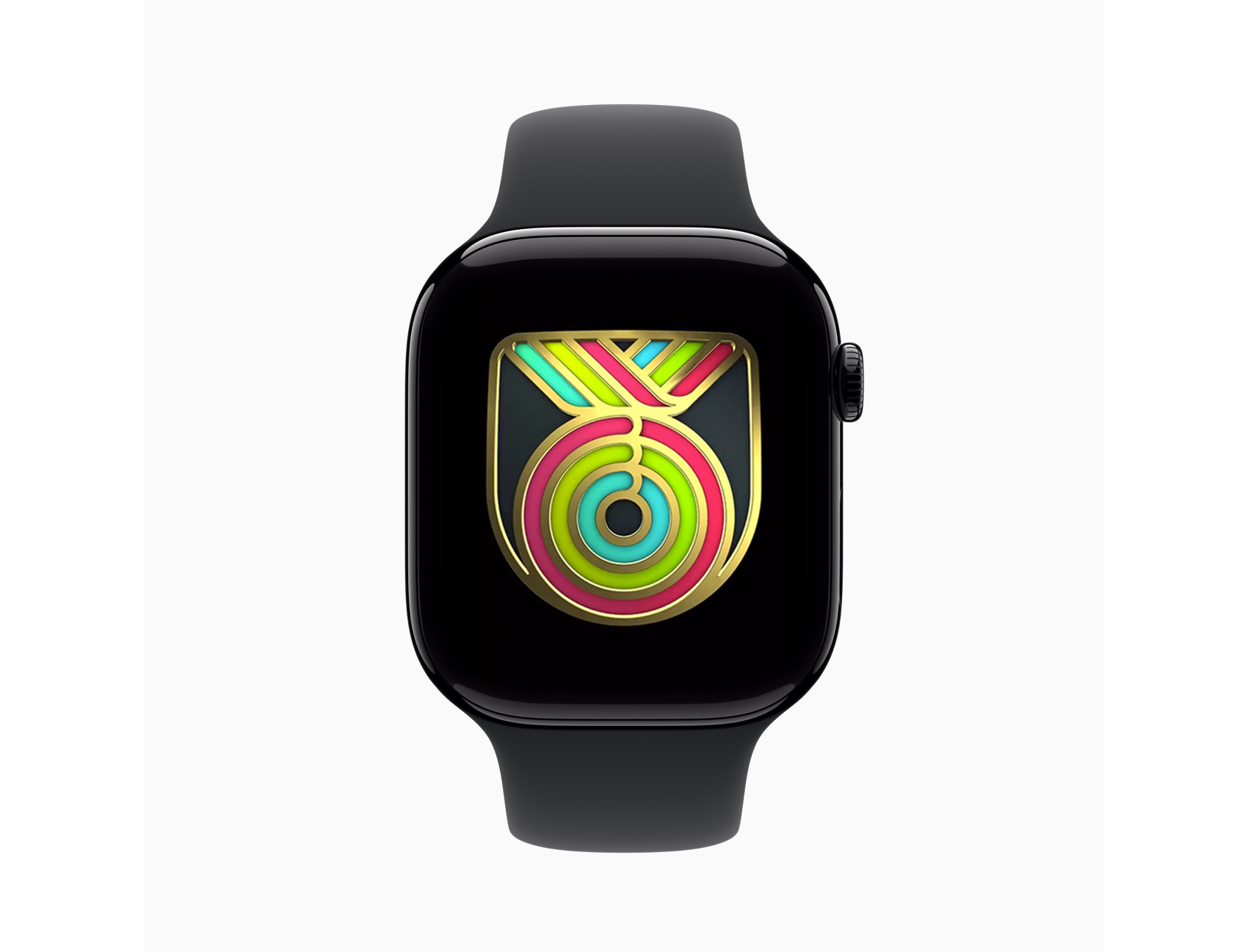
A streak system must not feel abstract. Duolingo's confetti animations and Apple's activity rings celebrate completed streaks with clean visuals, while GitHub presents a history of consistency. The effort should feel real and earned.
Prompt At The Right Moment
People are forgetful, especially new users. Life gets busy and motivation goes missing, so reminders become important. Even committed users can accidentally miss a day. Push notifications are the most common prompt, and timing matters by category — a 9 a.m. "you haven't practiced" notification is reasonable for a fitness app but odd for a language app, since most users haven't thought about a lesson yet.
Fitness apps often see higher engagement with early morning notifications around 7–8 AM, while productivity apps may perform better near noon. There is no one-size-fits-all answer, so A/B test based on how your users behave. Other subtle prompts include red dots on icons and widgets. Since the average person unlocks a device 50–150 times daily, a visible indicator can reinforce commitment with each glance. The prompt should remind, never nag.
Milestones Matter
Milestones reignite the emotional pull of a streak, particularly for long-time users. Reaching Day 7, Day 30, Day 50, Day 100, or Day 365 deserves to be a big deal.
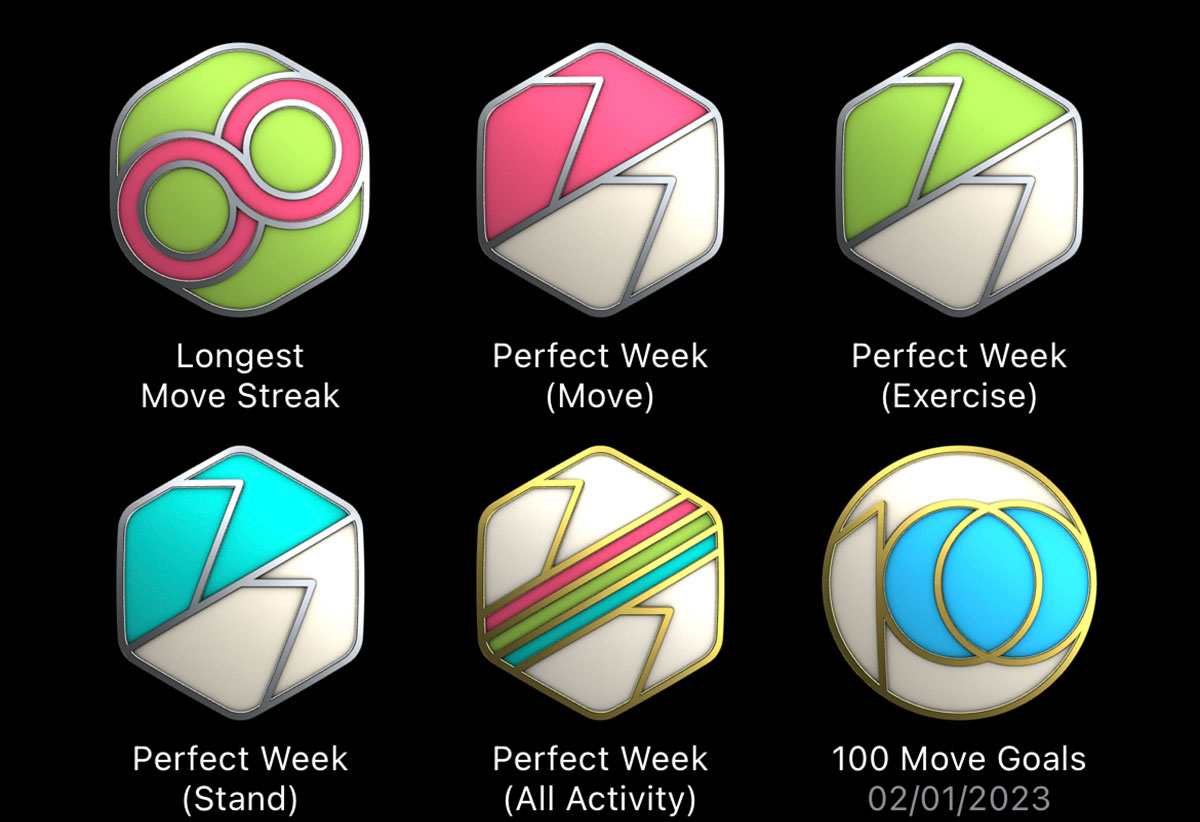
Publicly acknowledged achievements create a secondary benefit: users share them. Beyond that, anticipating a coming milestone gives users something to look forward to besides the streak itself.
Grace: The Mental Safety Valve
One missed day turning a 90-day effort into zero constitutes a genuine psychological threat. A user traveling without a charger loses nearly three months of work on no fault of their own. That kind of reset can lead to abandonment — the effort of rebuilding feels more painful than simply quitting.
A considerate streak design should build in slack:
- Streak Freeze — Let users intentionally skip a day without penalty.
- Extra Time — Allow a few extra hours past the usual cutoff before reset triggers.
- Decay Models — Reduce the streak by a set amount per missed day instead of eliminating it entirely, such as subtracting 10 days.
Choose The Right Words
When a streak inevitably breaks, the message carries as much weight as the reset itself. Compare "You lost your 42-day streak. Start over." with "You showed up for 42 days straight. That's incredible progress! Wanna give it another try?" One demoralizes; the other validates completed effort and invites re-engagement. Both are truthful. Only one respects the work the user has already done.
Engineering a Fair Streak System
Building a streak system means confronting a handful of design problems that, left unchecked, will quietly undermine trust in the product. The most visible of these problems is timezone handling, followed closely by edge cases around missed days and users who try to game the system.
Defining “A Day” for Each User
What counts as a day? The answer varies by timezone and includes complications like Daylight Saving Time. If you reset streaks at midnight UTC for everyone, you disadvantage users in earlier timezones — someone in London has fewer waking hours to complete an action than someone in California. That is an unfair design flaw that punishes users based on geography, not intent.
The practical solution is to ask users for their timezone explicitly during onboarding, ideally right after first authentication. Add a clear note that this information is only used to track progress accurately, and make it a setting they can change later. For implementation, rely on established date libraries such as Moment.js or pytz; timezone logic is too error-prone to write from scratch.
Handling Missed Actions and Edge Cases
Life happens. Users oversleep, servers go down, networks drop. Grace mechanisms — short windows of extra time — give both sides room to breathe. A small grace period is enough to absorb common failures without making the streak feel meaningless. Above all, never trust the client. Always validate on the server, which must be the single source of truth for streak state.
Preventing Cheating
Users will exploit loopholes if they find them. Server-side validation is the first and most important defense. Two techniques work well together:
- Utc timestamps for all actions. The client sends its local time, and the server converts that to UTC and compares against its own clock. Suspiciously inconsistent timestamps are rejected as errors, and the UI responds accordingly.
- Event-based tracking. Log each action with metadata — user ID, action type, timestamp, and timezone. This audit trail makes validation straightforward.
Anatomy of a Streak Engine
A streak engine is less about clever algorithms and more about clean architecture and disciplined flow. The server handles all logic; the client only presents data and sends events.
Core Architecture
On the server:
- Store each user's streak data in a database.
- Keep the current streak as an integer, defaulting to 0.
- Store the user's IANA timezone string, such as
"America/New_York", either derived from their local timestamp or set explicitly. - Run all streak-continuation logic against the user's local timezone.
On the client:
- Display the current streak, typically fetched from the server.
- Send qualifying actions as metadata to the server for validation.
- Show visual feedback that reflects the server's response.
The server is the brain; the client is the face. That split keeps bugs manageable and makes future updates far easier to ship.
The Logical Flow
When a user completes a qualifying action, the system executes the following sequence:
- User completes the streak action.
- Client sends an event to the server as metadata, e.g., “User X completed action Y at timestamp Z”.
- Server performs basic validation: Is the user real, authenticated, and the action valid? Is the timezone consistent?
- Server retrieves the user's current streak data from the database.
- Server converts the action's timestamp to the user's local timezone.
- Server compares calendar dates in that local timezone:
- Same day: the action is redundant, no streak change.
- Next day: the streak increments by 1.
- Gap of more than one day: the streak breaks, unless a grace mechanism applies.
- If grace is exhausted: reset the streak to 1.
- If you track milestones, update fields like “longest streak” or “total active days”.
- Server updates the database and returns a response to the client.
{
  "current_streak": 48,
  "longest_streak": 50,
  "total_active_days": 120,
  "streak_extended": true,
}
If anything fails during this process, the server must either retry or reject and notify the client. There is no silent success.
Building for Resilience
Users will not accept losing a streak because of a server bug or downtime. Build safeguards into the design from the start. If the server goes down for maintenance, consider adding a temporary window of extra hours so users can submit actions late and still be counted. If the outage could affect live streaks, notify affected users proactively.
Also establish an internal backdoor to restore streak data manually. Bugs are a when, not an if. When a user contacts support about a streak broken through no fault of their own, you need a process to investigate and restore the data if they are right.