
PostgreSQL is more than a piece of software; it is a community of people. Jan Karremans once remarked that the software is a side effect of the community — an exaggeration, perhaps, but every free open source project depends on people who dedicate effort to it. Tomas Vondra's opening keynote at Swiss PGDay 2024 made a related observation: many key contributors feel more loyalty to PostgreSQL than to their own employer.
That loyalty is easy to underestimate if you assume open source is written by hobbyists with spare time. In practice most contributors are paid to work on the code: companies that need the software to fit their own requirements, and companies that sell services, products and training and therefore need the expertise that only contribution brings.
What the community actually is
Contributors are not only the hackers of the PostgreSQL Global Development Group. Infrastructure such as the project's servers is maintained by people like Stefan Kaltenbrunner. Users running regression tests against the latest beta and reporting bugs are part of it. So are the organisers of local user groups and large conferences, many of whom invest more unpaid personal time than many code contributors.
PostgreSQL belongs to no single company, which puts the businesses built on it in an unusual position: they compete for the same customers while cooperating on development and community work. It works, and growth helps — when the cake is getting bigger, there is less need to fight over a share of it. Many of the people one looks forward to meeting at a PostgreSQL conference are direct competitors.
Conferences, and why they matter
Conferences are central to the motivation of the community, and my own history illustrates it. My involvement began at the City of Vienna, where the search for an open source database for strategic reasons led to an evaluation of several options. PostgreSQL stood out for its advanced features and, initially at least, for the quality of its documentation.
It deepened when I started writing code, adding the missing enterprise features that made life easier for DBAs and developers, and finding that the mailing list culture allowed direct exchange with the people who wrote PostgreSQL.
In 2010 I was at home caring for my eldest child. Childcare consumes your time but starves you intellectually, at least until the children can talk. So I took a few days off at my own expense for PGDay Europe 2010. The talks were inspiring, but the mingling was what did it: names from the mailing list acquired faces, and people who wanted to learn mixed with people who wanted to sell. There were no elitist circles, and no one pushed advertising in your face — sponsors were available but stayed in the background. I have worked with PostgreSQL ever since and have not missed a European PostgreSQL conference since.
Today attending is part of my job at a company selling PostgreSQL services, products and training, and the attraction has survived both that and the growth of the events. Conferences now also function as a family reunion, bringing together colleagues from other parts of the world and competitors who have become friends. They remain more than that: talks supply ideas, and conversations with customers met for the first time and with newcomers show what moves PostgreSQL users at the moment.
There is also the feedback. Open source developers usually hear from people only when something breaks; customers likewise get in touch when databases perform badly or worse. It is easy to conclude that your software is a collection of bugs, that PostgreSQL performance is poor and autovacuum is a nightmare. At a conference people say the opposite — the software is working like a charm, they enjoy the blogs, the talk was great. One returns exhausted and short on sleep, but with positive energy.
Who pays, and who profits
Asked what lies behind an event, the revealing questions are who pays and who profits. PostgreSQL conferences draw money from three sources:
- Participants pay a moderate fee that covers food and usually the social event.
- The organiser is often a non-profit association whose membership fees help finance the event — the Swiss PostgreSQL User Group for the Swiss PGDay, PostgreSQL Europe for PGConf EU. PostgreSQL Europe also provides free infrastructure to organisers of community events.
- Sponsors contribute a large share, in exchange for prominent logos and a booth.
Sponsors want customers and visibility, but many also want to give back to the community that let them prosper. Booths carry advertising and speakers do not hide their affiliations, yet the advertising is never aggressive — the companies know the audience would not appreciate it.
The Swiss event
The Swiss conference has a long tradition, and two things set it apart. The venue is not a big hotel where everyone spends the day indoors in interchangeable surroundings, but the University of Applied Sciences in Rapperswil — a more sober academic setting that involves walking between buildings and occasionally getting lost, on a peninsula in Lake Zürich rather than in the middle of nowhere.
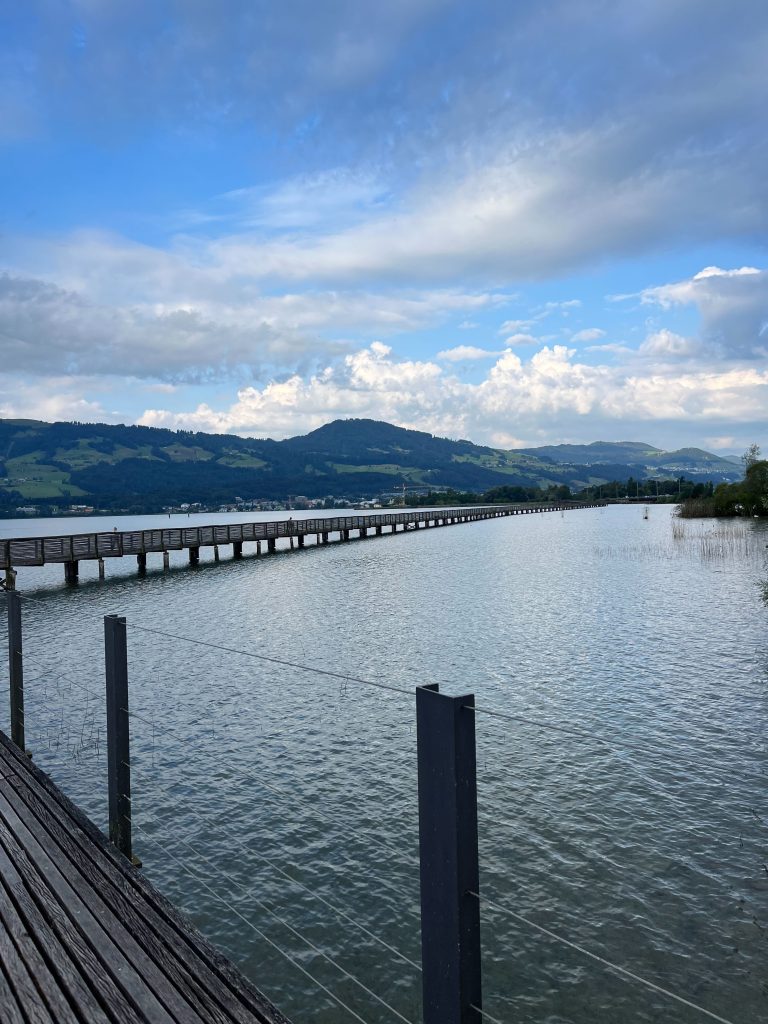
Steps away is the old town of Rapperswil. Lunch is taken in the university canteen under the trees by the lake; slightly underdone potatoes in that setting beat perfect hors d'oeuvres in a hotel lobby.
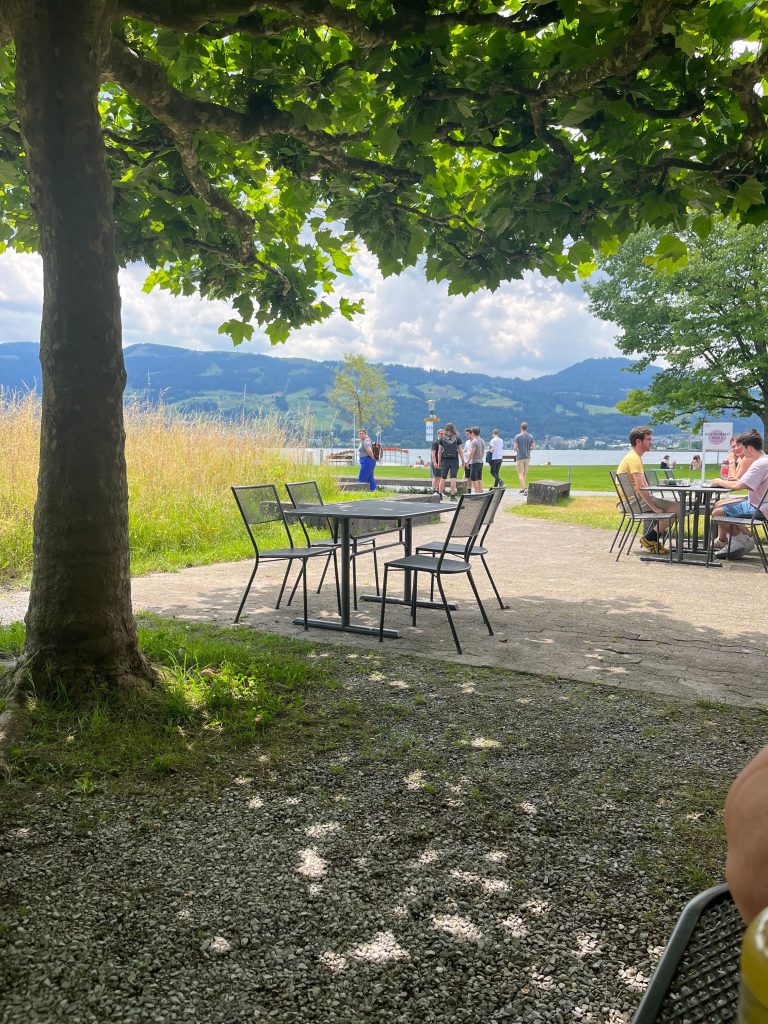
The moderate size helps too — around 110 people this year. Seven hundred attendees is impressive and fun, but at this scale conversations are longer and more relaxed, and at the social event you do not have to shout at your neighbour.
Talks and the social side
A PostgreSQL conference is not only talks and lobby networking; there is usually at least one evening social event, with drinks for those who want them, where you can talk at length. The one at the Bottéga club in Rapperswil had good food, friendly service and a large outdoor area. Such events forge the bonds of the community and make newcomers feel they belong — most of the in-jokes and legends originate at social events and hotel bars.
Swiss PGDay 2024 ran two days with two tracks, so nearly a quarter of the participants were also speakers, blurring the line between speakers and audience; it is not unheard of for a talk to end in a good discussion. My own talk got the first slot of the first day. The projection system could not be connected at the front, so participants climbed over a partition wall to switch the projector on by hand; my laptop was hooked up directly and my room host Daniel Westermann stayed at the back changing slides. The talk went well, and since everyone roots for a performer in trouble, the feedback was better than usual. The problems were fixed for later talks.
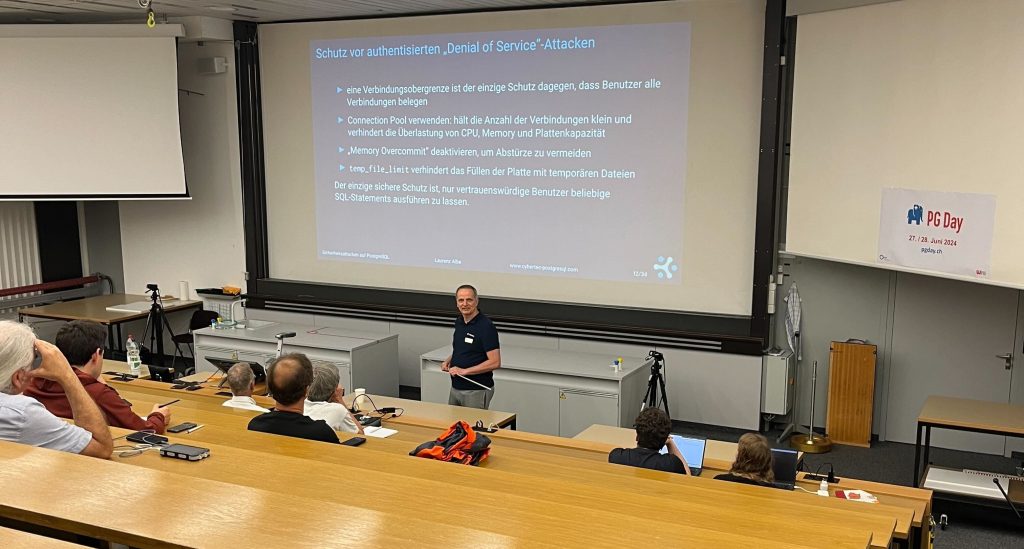
I will not rank the talks — the schedule is public, singling some out would be unfair to the rest, and with two tracks you can attend at most half of them in any case.
Many people I expected to see were there, among them Tobias Bussmann, treasurer of the Swiss PostgreSQL User Group. As organiser he did most of the thankless work, in his spare time rather than as part of a paid job. Others had drifted into the side eddies of the PostgreSQL stream but still came out of interest, which says something about the community's pull — as does the distance some travelled, with participants from Portugal, the Netherlands and the Czech Republic.
Anyone who has taken everything courses and documentation can offer and wants to go further, or simply wants to meet the people behind PostgreSQL, should go to a community event. The only risk is getting hooked and spending a professional career on PostgreSQL — not the worst of fates. See you at the next one.


