The Security Lesson From 50 Open Source Projects
AI is reshaping open source development at a pace that outstrips traditional security review processes. Maintainers now contend with unfamiliar contributions, new attack surfaces, and vulnerability reports while juggling limited time and resources. The GitHub Secure Open Source Fund's Session 4 put this to the test: it invested over $500,000 across 50 projects, pairing maintainers with GitHub Security Lab experts, security tooling, AI-assisted workflows, and a peer community.
The program's takeaway was consistent across the cohort: AI helps maintainers investigate, prioritize, and respond faster, but human judgment remains the deciding factor. "Maintainers still provide the context, judgement, and accountability required to decide what ships," the report notes. AI accelerates triage and remediation; it does not replace the maintainer's role.
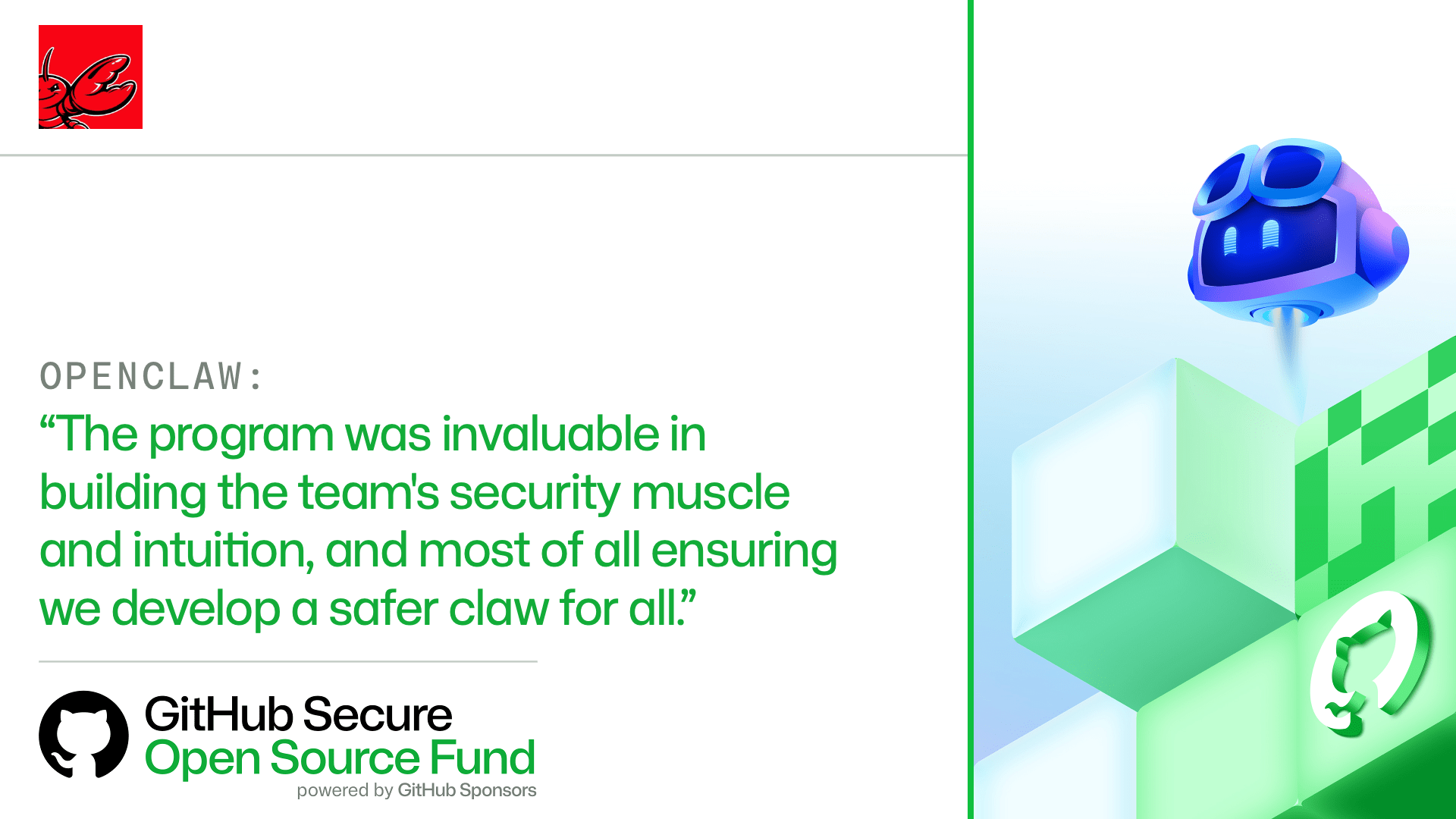
OpenClaw, GitHub's fastest-growing open source project, participated in Session 4 to strengthen its security posture. By the session's end, the maintainers had an incident response plan, expanded use of GitHub security tooling, audited GitHub Actions workflows, and hardened processes for identifying and responding to security issues.
How the Fund Works
The program ties funding directly to measurable security outcomes. Each session runs as a three-week sprint plus a 12-month engagement. Funding and participation depend on outcome-driven goals and verified security improvements, not just attendance.
The sprint is curated by the GitHub Security Lab and delivered by security experts from GitHub and partner organizations. Training is divided into weekly focus areas:
- Foundations of open source security
- Threat modeling and secure coding
- AI security and vulnerability management
Each project receives $10,000 USD via GitHub Sponsors, distributed as $6,000 during the sprint and $2,000 at both the six- and 12-month security check-ins. Participants also gain access to a security-focused community, office hours with GitHub Security Lab, security resources for immediate implementation, and Azure credits for cloud infrastructure.
Where the Security Work Happened
Session 4 concentrated on the systems developers rely on daily, grouped by their ecosystem role.
AI, Machine Learning, and Intelligent Systems
The projects in this category—ranging from LangChain to ONNX, DocsGPT to OpenClaw—sit at the intersection of AI, automation, data infrastructure, and machine learning. They increasingly underpin modern AI workflows and production deployments. As AI adoption accelerates, security fixes here create a more stable foundation for emerging AI ecosystems.
Build Systems, Supply Chain, and Release Tooling
Projects like CycloneDX Python Library, JReleaser, and Task cover testing, validation, packaging, and release across varied environments. This group influences software bills of materials, release pipelines, code quality, and testing automation. Securing them protects the distribution chain itself.
Core Languages, Runtimes, and Foundational Libraries
From core-js to htmx, Pyodide to Gleam, these projects define how software is written, configured, and executed. Security improvements at this layer flow downstream to thousands of applications and developer ecosystems, amplifying the impact of each fix.
Developer Tools and Productivity Platforms
This group shapes the everyday experience of building, testing, and using software. Widely adopted utilities like Pillow, Yjs, Vuetify, and ToolJet appear throughout developer environments and application stacks. Improvements support API development, low-code platforms, collaborative applications, and software delivery workflows.
Web, Networking, APIs, and Infrastructure Services
These projects—actix-web, FastAPI, Apache ZooKeeper, etcd, and others—form part of the internet's operational backbone. They handle APIs, networking, search, messaging, and service coordination for organizations worldwide, often sitting on the critical path of modern cloud applications.
AI Security as a Shared Frontier
AI-related security concerns surfaced across all project categories in Session 4, not just within machine learning infrastructure and agent frameworks. Developer tools and internet infrastructure faced the same questions. Yet established responsibilities persisted: maintainers still manage vulnerabilities, secure dependencies, protect release workflows, and prepare for incidents.
What changed is speed and scope. AI introduces new risks while increasing the pace at which maintainers must understand and respond to threats. The session's clear lesson: AI security is not evolving in isolation. It is becoming part of the broader practice of building secure software. Supporting that shift requires practical education, trusted communities, and expert guidance that evolves alongside the technology.
The benefits of this work extend beyond individual repositories. When maintainers strengthen widely used open source software, they reinforce the resilience of every project and organization that depends on it.