The Expanding Definition of Product Work
Product development has never been a siloed discipline, but recent data suggests the boundaries between roles are dissolving faster than ever. Figma's latest research, conducted with independent firms Factworks and Fusion Hill, draws on 51 qualitative interviews and a survey of 1,199 product builders—designers, PMs, developers, researchers, data specialists, and marketers—to quantify this shift.
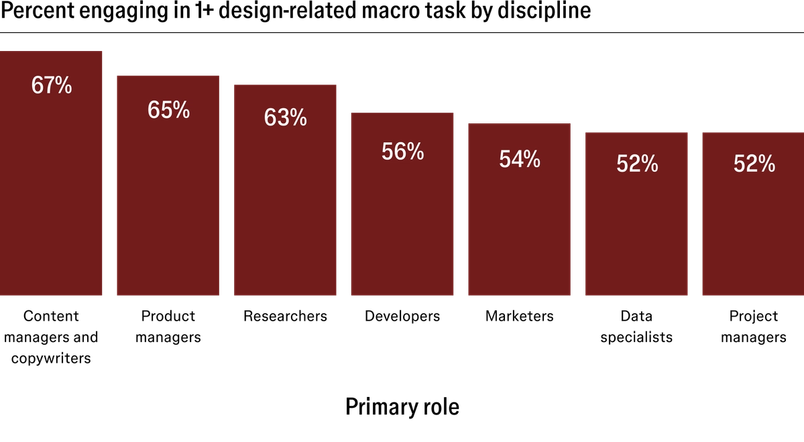
The headline numbers are striking. A full 56% of non-designers report engaging deeply in at least one design-centric task. Meanwhile, 64% of all respondents identify with multiple roles, and more than a third say their responsibilities span three or more. This isn't just about job titles blurring; it reflects a fundamental change in how work gets distributed across teams.
Non-Designers Are Designing More
Non-designer participation in tasks like mockup creation and brand exploration has climbed 10% over the past year. Concretely, that means 70% of PMs say they're creating low-fidelity mockups or wireframing, and 59% report taking on interactive prototyping. Marketers are producing quick visual assets for social channels, and developers are jumping into design files earlier to flag feasibility issues before implementation begins.
The adoption of design tooling outside traditional design roles underscores the trend. One in four respondents recently adopted a new design tool, and 42% of those who haven't yet say they plan to within the year. For designers with years of specialized training, this might feel like an encroachment on their craft. But the underlying driver is rarely a desire to replace design expertise—it's a need to communicate ideas visually, explain a pain point, or work around a technical barrier sooner rather than later.
The payoff for teams that embrace this overlap is tangible. When a PM sketches out an early concept, designers can iterate on a shared vision without endless back-and-forth. When engineers review mockups pre-implementation, they catch issues before they become costly. The time saved can then go back into research, strategy, design system maintenance, and honing the craft that machines still can't replicate.
Tool Proliferation Creates New Friction
Ironically, the same technology that enables broader participation is also creating bottlenecks. Among survey respondents, 72% cite AI tools as the primary force behind role changes. Solutions like Figma Make, Claude Code, and GitHub Copilot make prototyping and coding faster, while platforms like Notion, Figma Buzz, and Airtable streamline project management and marketing asset creation.
Yet more tools don't automatically mean better work. Seventy-one percent of respondents say they now use more software as a direct result of role shifts, with teams juggling tools from an average of 7.6 different categories out of 16—ranging from spreadsheets and AI chat tools to coding assistants and designer-developer handoff platforms. The effectiveness of any single tool, respondents report, is being diluted by the sheer volume.

There's also organizational inertia to contend with. Workers say they face resistance when trying to consolidate or switch platforms, since other teams are reluctant to abandon familiar tools. As one design expert put it, "I'm constantly having to learn these new tools. I end up wasting time trying to figure out how to put text into the tool that I don't have time to work on the actual text."
Projects often now begin in one platform, move to a second for the PRD, a third for brainstorming, a fourth for tracking, and a fifth for prototyping. Despite those frustrations, product builders express strong interest in mastering new tools—both to hit project targets and to build their own skills. The answer, many suggest, isn't fewer capabilities but more deliberate curation. "Streamlining the tools rather than coming up with so many new ones would be great," said one marketer at a design agency. "There doesn't need to be 8,000 [tools]. There should just be one."

More Tasks, But Higher-Value Work
The research identified 19 distinct "macro tasks" in the product development journey—from strategic planning, user research, and project management to content strategy, visual exploration, prototyping, coding, testing, and data analysis. Product builders report engaging with an average of 7.3 of those tasks per project, up 17.5% from a year prior. More than half (55%) say they've taken on tasks that previously belonged to someone else.
Intuition suggests that taking on more tasks would mean more grunt work. But the data tells a more nuanced story. Only 19% of respondents say they now spend more time on executional tasks. Meanwhile, 57% report dedicating more time to high-value work, and 68% say they feel more productive and efficient overall. Faster timelines and wider scopes are real, but so is the sense that automation is carving out space for deeper contributions.

As one product manager at a retail company noted, "I'm not expecting everything to be automated from end-to-end, but if there are 20 different tasks across the product lifecycle, I think a lot of those tasks will get easier. I'm hoping product managers can then spend a lot more time on the tasks that create value."
The central question for teams now isn't whether roles should blur—that horse has left the barn. The real challenge is determining which tasks deserve the acceleration of AI and which require the nuance of human judgment, then building the collaborative habits that let both exist on the same project without tripping over each other.

Craft and Human Judgment Are the New Core Competencies
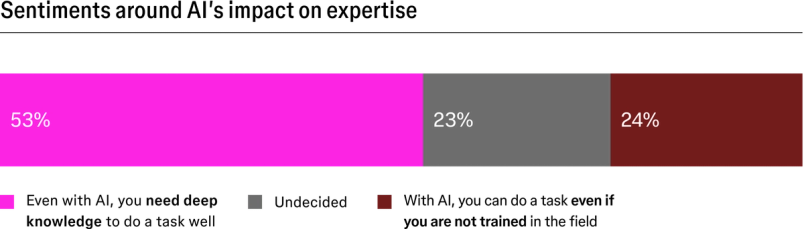
Automation may be expanding what teams can produce, but the research indicates that the fundamentals of great product work haven't changed. A significant majority of product builders—63%—agree that their role requires a human touch, and 53% believe that deep domain knowledge is still necessary to execute tasks well, even with AI in the workflow. The technology is an accelerator, not a substitute for expertise.
This reality manifests differently across disciplines, but the pattern is consistent. Developers apply their expertise to validate and refine AI-generated code, ensuring it scales reliably. Designers leverage their taste to elevate AI-produced assets from generic to polished. Writers must step in to assess context, cultural nuance, and tone in AI-generated copy—elements the models simply cannot grasp. As one UX writer at a SaaS company noted, AI does not recognize nuance, cultural references, or depth; those are inherently human sensitivities that cannot be replicated.
Looking ahead, the value of craft, taste, and discernment will only intensify as AI capabilities grow. The implication for individual product builders is clear: treat these skills as a perpetual work in progress. Actively seek mentorship from seasoned experts, pursue continued education to broaden your knowledge, and treat every project as an opportunity to raise the bar for quality and care in the work.
AI does not recognize nuance, cultural references, perspective, or depth. Those are human capabilities that cannot be replicated.“AI does not recognize nuance, cultural references, perspective, or depth. Those are human capabilities that cannot be replicated.”
While the research captured a mix of anxiety about broader responsibilities and top-down pressure, it also found genuine enthusiasm for the new capabilities that modern tooling unlocks. What remains certain is that craft and human judgment are not being phased out—they are becoming the defining elements of the product development cycle. As teams adapt, roles are still evolving, and the full report explores these shifts to map what the future of building actually looks like.