
Backends without the boilerplate
Vercel is extending its zero-configuration approach to backend frameworks. The platform now detects popular Python and TypeScript backend frameworks and automatically provisions the infrastructure needed to run them. Developers can deploy FastAPI, Flask, Express, Hono, NestJS, or Nitro without configuration files or Docker images.
This move reflects how AI applications have evolved over the past year. Instead of simple prompt-response patterns, modern AI workloads orchestrate multi-step workflows, spawn sub-agents, and run processes that stretch across hours or days. These applications need backends capable of data processing, inference, and real-time event handling.
Framework-Defined Infrastructure for backends
The same Framework Defined Infrastructure (FDI) model that powers Next.js deployments now applies to backends. Vercel reads your framework's conventions for routing, concurrency, and execution, then uses that context to determine how code should scale and how requests should be routed. Your framework defines the infrastructure; Vercel handles the rest.


The result is automatic scaling per endpoint, per function, and per request. Observability — logs, traces, and metrics — lives in the same dashboard as your frontend. The platform continuously adjusts compute allocation based on workload behavior, eliminating the gap between writing backend code and running it in production.
A native Python SDK
Alongside the zero-config framework support, Vercel is launching a native Python SDK, available in beta via pip install vercel. The SDK provides API abstractions for Vercel services: Sandboxes for running untrusted code, a Runtime Cache for storing and retrieving data across functions, and Blob storage for frequently read resources.
Pricing that matches real execution
For workloads that run intermittently — agents paused for input, or processes waiting on external APIs — Fluid compute introduces Active CPU Pricing. Instead of billing by wall time, this model charges only for the time your code is actively executing. Idle waiting costs nothing. AI workloads on Fluid compute also get on-demand scalability and reduced costs for long-running LLM calls.


Durability for long-running processes
For backends that need persistence or reliability over time, the Workflow Development Kit (WDK) adds durability and observability directly into code. It handles orchestration of multi-step processes such as AI agent loops, data pipelines, and scheduled automations. Vercel detects when a function is durable and dynamically provisions the appropriate infrastructure in real time.


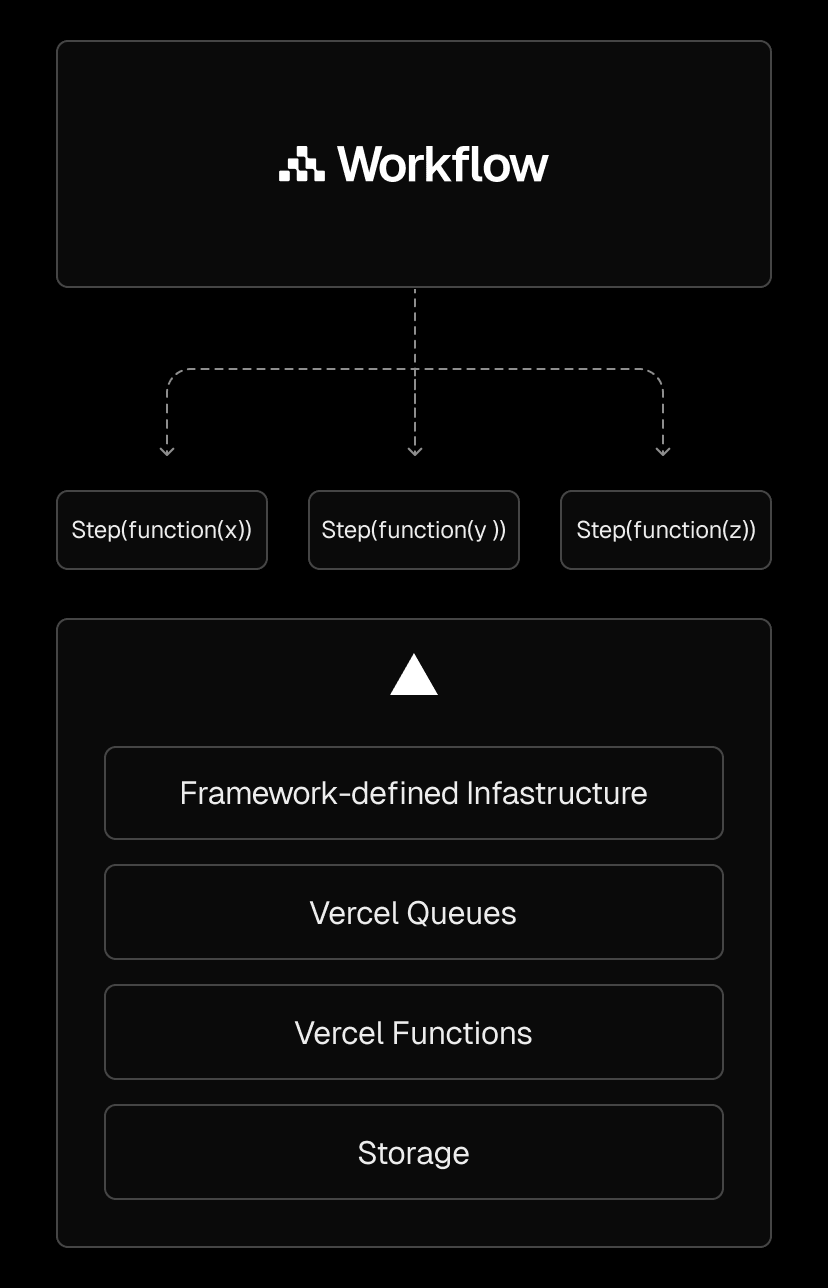
New backend templates demonstrate these patterns in production-ready form. RAG pipelines that handle ingestion, embedding, and retrieval at scale are available as a starting point.
One platform, full stack
Every backend deployed on Vercel runs on the same orchestration, compute, and storage layers used across the AI Cloud. From real-time APIs to long-running background agents, the full stack now shares one deployment, scaling, and observability surface.


