
Facebook's recommendation systems have historically relied on implicit engagement signals. That approach scales, but it adapts slowly and captures little nuance. Your algorithm is an end-to-end system built to address both limitations: a suite of AI-powered tools that lets people state in their own words what they want to see in Feed and Reels. A collection of large language models interprets, stores and tracks those stated preferences alongside user behavior, and the resulting system adjusts what each person is shown.
Anatomy of the preferences page
The interface is organized into three parts:
- A one-sentence Lately Summary at the top, describing recent viewing activity.
- An Interested In list, prefilled with interests inferred from past activity.
- A Not Interested In list, capturing topics explicitly marked as not interested or hidden on Facebook.
People can add interests in natural language, move them between lists, or remove them. Each change applies to both Feed and Reels, and continues to update as the person gives feedback on individual posts.

System components
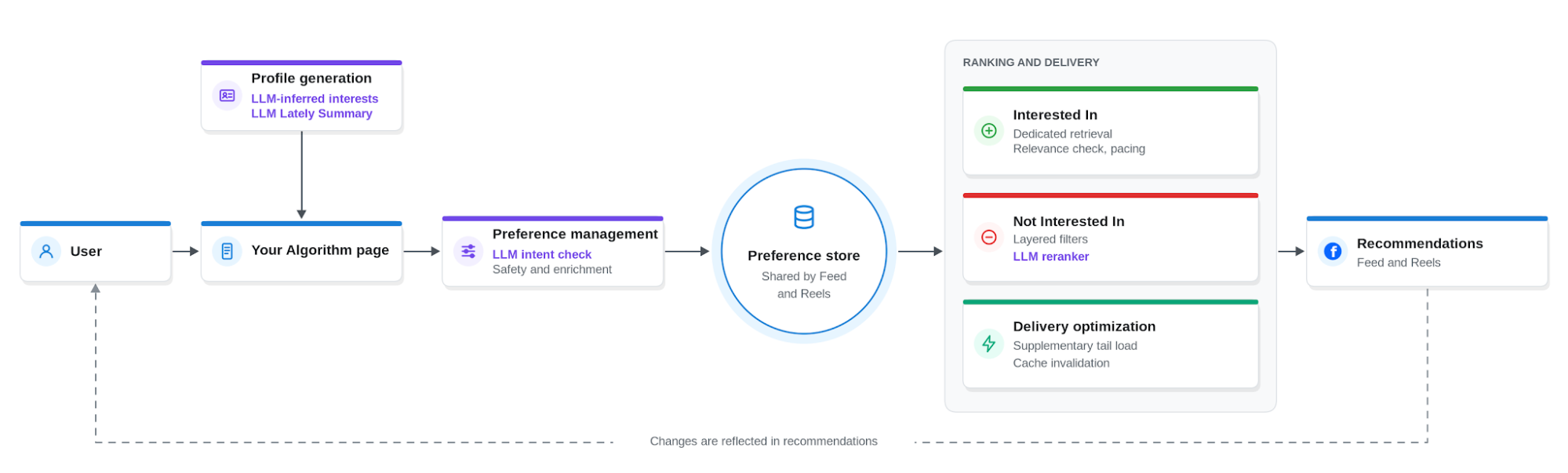
Four components cover the lifecycle of a preference, from inference to delivery:
- Profile generation builds the initial interest profile.
- Preference management validates each change, enriches it with the signals ranking requires, and writes it to a single store read by both Feed and Reels — so the preferences displayed on the page are the same ones used in ranking.
- Ranking applies the Interested In and Not Interested In lists throughout the funnel.
- Delivery optimization makes changes take effect more responsively.
Turning stated preferences into ranked content
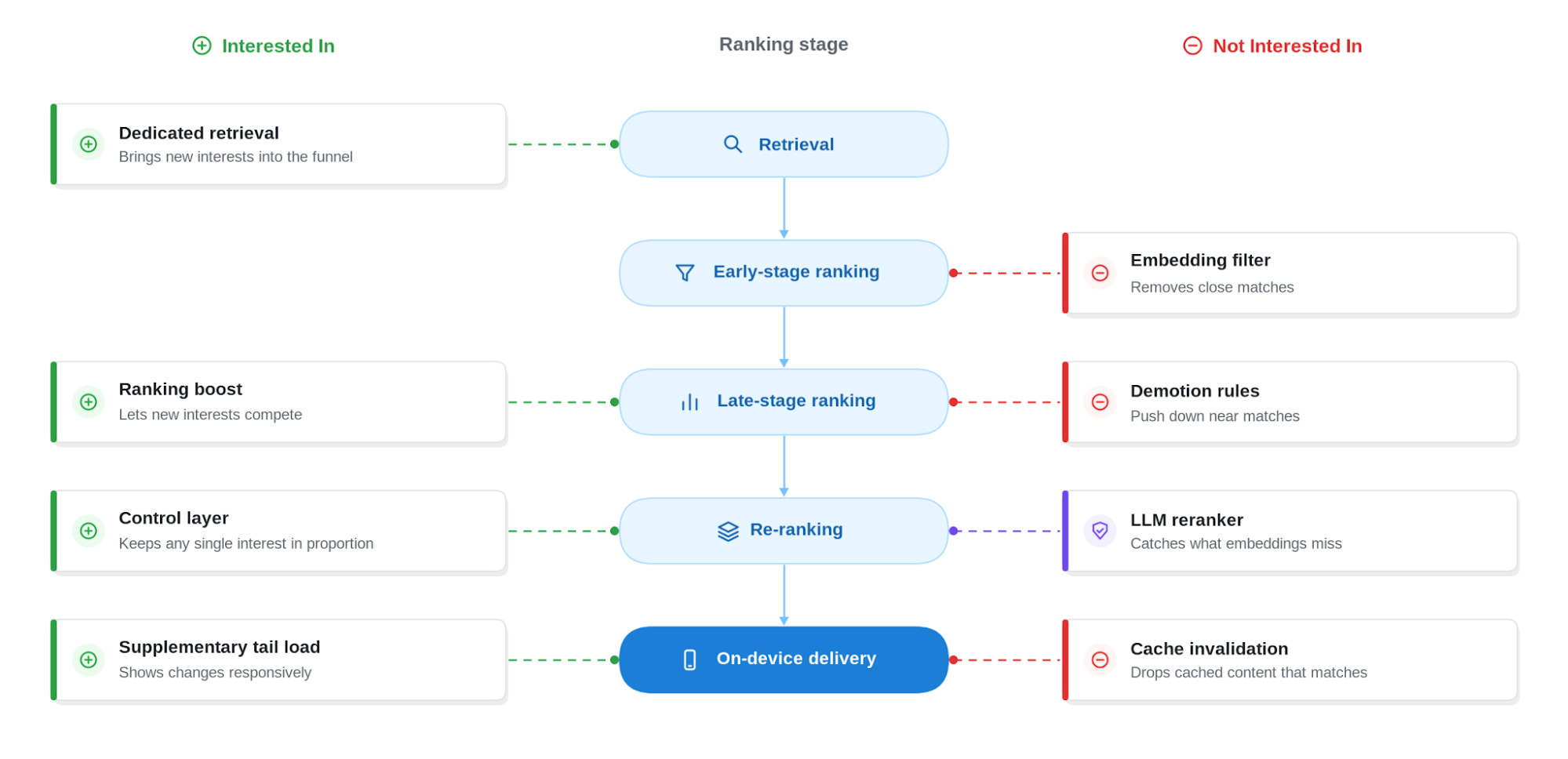
Three distinct problems arise when converting a preference into recommendations. An interest in Interested In must surface relevant content quickly without crowding out everything else. An interest in Not Interested In must hold reliably, despite fuzzy topic boundaries and the gaps of any single filter. And both must take effect promptly, even when the next recommendations were cached before the change. Dedicated logic across the funnel — retrieval, reranking and the device itself — handles each case.
Interested In: visibility with limits
Every interest in Interested In drives four dedicated retrieval sources. Two locate matching content directly, via search and via clusters of closely related topics; two extend reach through the content graph and item-to-item similarity. Retrieving for each interest explicitly guarantees enough relevant candidates downstream — without it, content about a brand-new interest might never enter the ranking pipeline. Candidates that pass a relevance check, comparing the meaning of the interest with each candidate, are promoted in late-stage ranking so they can compete with other content, and a control layer in reranking decides where they appear.
The design targets balance rather than volume: a new interest should show up, not take over. The control layer spaces out recommendations for the same interest and caps that interest's daily contribution. Retrieval fetches candidates for only one interest per request, so every interest gets a turn, and new interests receive extra weight for a limited period. After that, the system learns from how people engage with the content.
Not Interested In: filtering at every stage
Entries in Not Interested In are enforced at multiple stages, using different signals to achieve high precision and recall. During ranking, the same embedding-based comparison used in the relevance check strips out candidates too close to a listed interest, and demotion rules push down near matches. After ranking, the LLM reranker reviews the final list. On the device, cache invalidation removes matching candidates already queued for display.
Not every entry is a topic. Quality-related requests, such as reducing AI-generated or sexually suggestive content, map to dedicated demotion signals rather than topic matching. When a request names a creator, that creator's content is filtered out directly.
Closing the delivery gap
Ranking tuned to preferences still leaves latency: content for a new preference is not picked up until the next fetch request, and content already cached on the device was ranked before the preference was set. Two delivery mechanisms close these gaps. Adding a new interest to Interested In triggers an extra fetch outside the normal cycle, called a supplementary tail load, so matching content appears quickly. Adding an interest to Not Interested In triggers cache invalidation: the client obtains the new interest's clusters and drops any cached content that matches them before it is displayed.
Where the LLMs fit
LLMs participate at several points in a preference's life: generating the initial profile, validating each edit as it is made, and giving final recommendations a last check. Each use carries its own constraints around latency, serving capacity and safety — and evaluating them demanded a new approach.
Profile generation. An LLM turns regularly refreshed interest signals into a set of inferred interests with clear, readable topic names, prefilled into Interested In and drawn from past viewing across Facebook Feed and Reels. It also writes the Lately Summary highlighting ongoing interests. The result is a recognizable starting point that is easy to review and correct.
Preference management. Every edit passes through an LLM that checks whether a phrase is a coherent topic, detects duplicates, and maps it to a clean topic name; this runs on a smaller model that is efficient to serve at scale. The validated interest is then enriched with the signals ranking needs, such as an embedding and search keywords, and saved to the shared preference store. The LLM is only one validation layer — a dedicated component also performs integrity and safety checks.
LLM reranking. Embedding matching in the funnel is fast but coarse. To catch what it misses, a fine-tuned LLM reviews the ranked list and removes content it judges related to an interest recently added to Not Interested In. The key finding: a small model fine-tuned to return only the items to remove proved faster and more reliable than a general-purpose model judging each item individually.
Evaluation. Standard offline metrics cannot say whether a Lately Summary is accurate or whether the reranker removed the right candidates. A separate LLM acts as a judge, grading each call's output against expected behavior — an objective, repeatable way to compare prompts and models before launch.
Open ground
Your algorithm makes recommendations more transparent and more personal by combining behavior with stated intent. Remaining opportunities include better interpretation of ambiguous input and recommendations that respond even more precisely to each request; the team is also exploring additional entry points where preferences can be shaped.


