Why multimodal search is hard
Modern teams produce and store an enormous range of content—text, images, audio, video—spread across many different tools. That variety makes it difficult to retrieve specific answers quickly. Dropbox Dash was built to address this by using context-aware AI to connect content and tools, giving teams a single assistant that understands their work and their search intent.
One of the harder parts of that problem is handling media files. A one-hour video may contain scene changes, multiple speakers, on-screen text, objects, actions, and audio cues that all need to be understood together. A photo collection might require recognizing people, activities, locations, and timing. These modalities don't operate neatly in parallel: transcripts, shots, and sound each have their own timelines and semantic boundaries. Understanding the content means not just processing each modality separately, but also capturing how they relate to one another to create meaning. Doing that reliably across exabytes of stored content is also expensive from a compute standpoint.
How Aana handles rich media
To strengthen Dash's multimodal capabilities, Dropbox has brought on Mobius Labs and its family of models called Aana. Aana processes media files together rather than treating text, images, audio, and video as separate streams. It can trace how objects move and actions unfold over time, and can connect insights across modalities—for example, finding the exact moment in a video when someone walks to a whiteboard to explain a diagram.
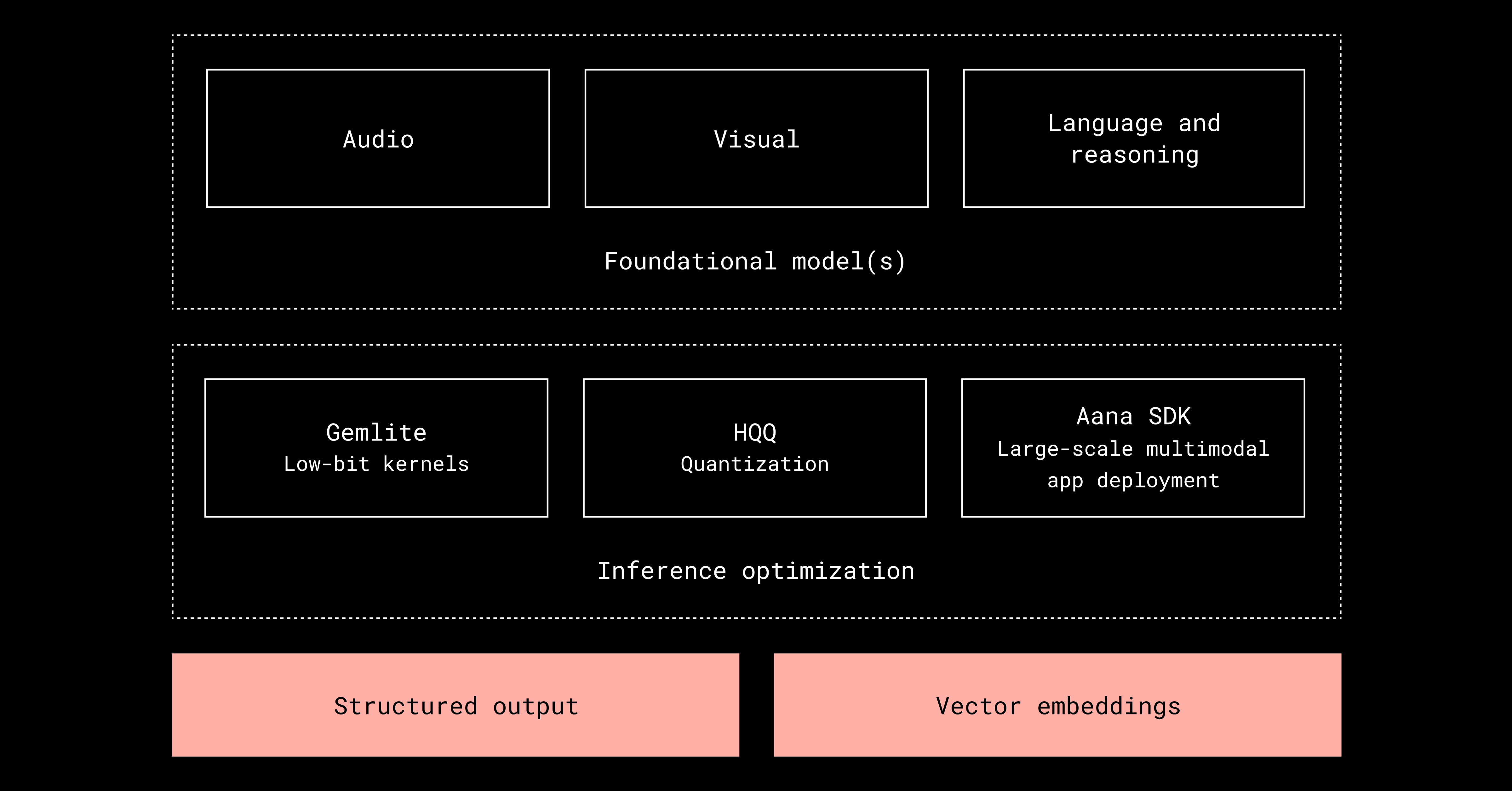
The system combines open-source, fine-tuned foundation models for speech, vision, and language, with continuous evaluation as new models are released. For audio, Aana uses inference-optimized Whisper-like models developed with open-source collaborators, including faster-whisper-large-v3-turbo. Its vision and language components rely on transformer-based and mixture-of-experts architectures optimized for fast inference on standard GPUs. The mod team benchmarks and integrates advances from the open-source community to maintain an optimal balance between quality and computational cost.
All extracted information is distilled into a shared vector space, enabling fast multimodal search. That allows queries like "the part where the presenter explains the API flow" instead of scrubbing through timestamps or relying on basic metadata.
Aana's efficiency comes from several layers of optimization. Its HQQ system supports low-bit (8-bit and 4-bit) inference to reduce compute and memory demands. Gemlite provides custom GPU kernels that accelerate core operations such as matrix multiplication and attention layers. The Aana SDK orchestrates everything, handling batching, coordination across models, and GPU utilization—and it doubles as a framework for building and deploying multimodal applications, letting teams compose different model setups and processing pipelines.
Together, these components let Aana analyze large volumes of media with only a fraction of the compute footprint of traditional architectures. That opens up workflows like surfacing a specific visual motif across a creative archive or condensing years of client meetings into searchable highlights.
What Aana brings to Dash
Dash was designed to keep teams organized and projects secure from a single place, and now it's coming to Dropbox proper. Adding Aana goes beyond making audio and visual content more searchable: it provides a foundation for agentic workflows that can analyze multimedia data, surface insights automatically, and act on behalf of teams. For marketing, creative, and technical organizations working with large media collections, that turns scattered files into connected, searchable knowledge that supports faster answers and better ideas.