
Concrete’s carbon problem gets an AI solver
Concrete production is responsible for roughly 8% of global CO2 emissions, according to the World Economic Forum, making it a prime target for decarbonization efforts. Meta has been working on this problem with an open-source AI tool designed to formulate concrete mixes that cure faster, meet structural requirements, and carry a smaller carbon footprint. The tool, built on Meta’s BoTorch and Ax frameworks for Bayesian optimization, was developed in partnership with cement manufacturer Amrize and the University of Illinois Urbana-Champaign (U of I). It has already been used to design and deploy a concrete mix at Meta’s data center construction site in Rosemount, MN.
Traditional concrete mix design optimizes primarily for 28-day compressive strength and cost. Data center construction, however, demands more: concrete must also cure quickly, remain workable, finish smoothly, and minimize embodied carbon. Low-carbon mixes have historically struggled on several of these fronts, including slower curing, surface quality issues, and supply chain complications tied to novel materials.
Why sustainable mix design is hard
Formulating concrete is a multi-objective problem with a large decision space. Designers must balance the types and proportions of cement, supplementary cementitious materials (SCMs), water-to-binder ratios, aggregates, and admixtures. The performance of SCMs varies based on source location and seasonality, and validating a new mix requires tests spanning days or even weeks. Several key ingredients are in play:
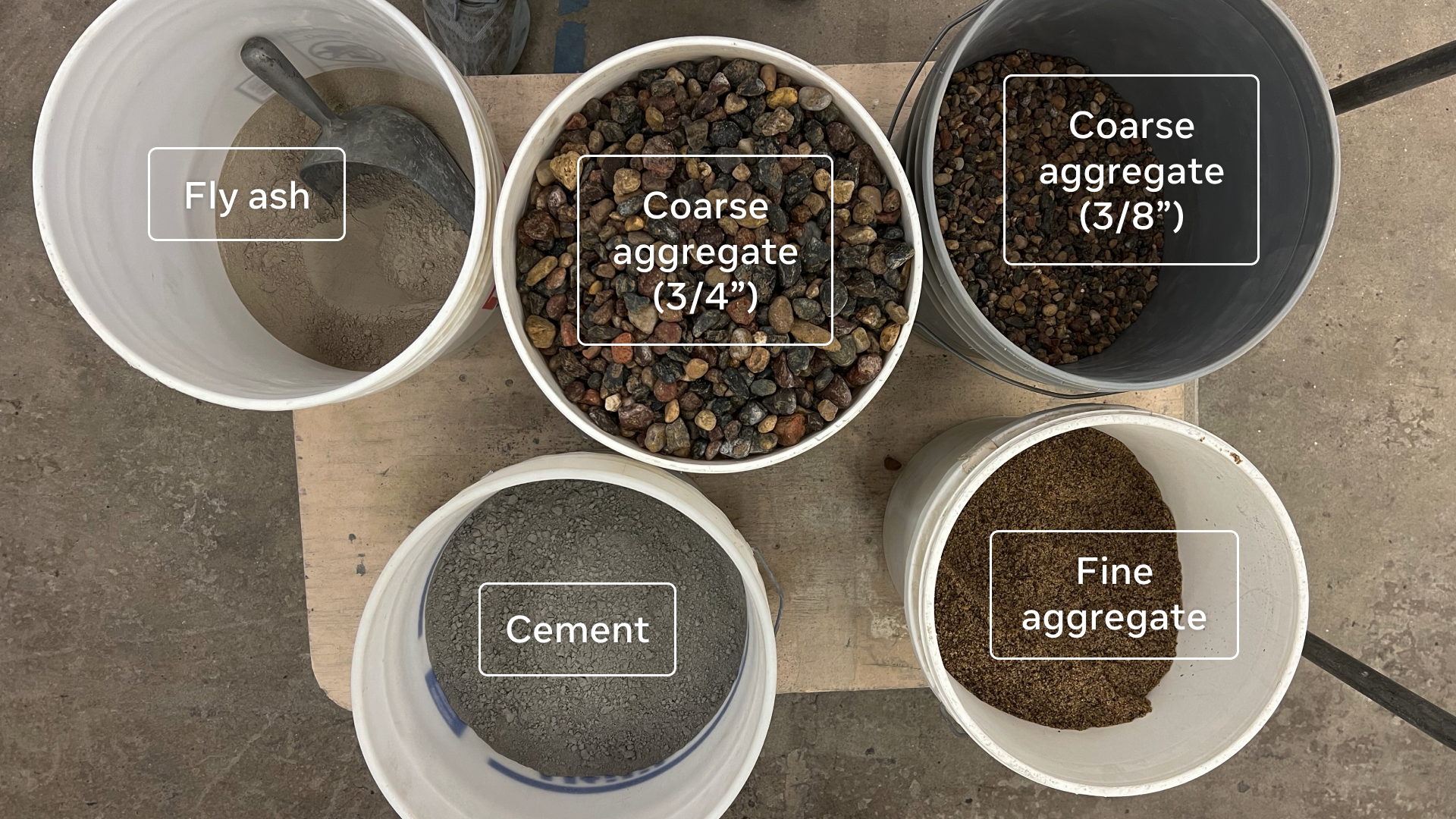
- Cement acts as the binding agent, produced by calcining limestone and clay at high temperatures—a process responsible for significant CO2 emissions.
- Slag is a steel production byproduct that can replace some cement, cutting embodied carbon while improving long-term strength and chemical resistance.
- Fly ash is a byproduct from coal-fired power plants that also substitutes for cement, reducing carbon impact and enhancing workability and durability.
- Fine aggregate (sand) fills gaps between larger particles, creating a smoother surface.
- Coarse aggregate (crushed stone or gravel) provides bulk volume and load-bearing capacity.
Ingredients vary by origin and manufacturing conditions, and some SCMs are declining in availability, pushing the industry toward novel materials with little performance data. The goal of Meta’s approach is to optimize the strength-sustainability trade-off efficiently.
Meta’s AI model uses multi-objective Bayesian optimization to learn and optimize concrete compositions. Rather than testing every possible mix, the model predicts compressive strength curves for candidate mixtures, enabling joint optimization of short- and long-term strength alongside sustainability metrics. The strength curve predictions allow the system to evaluate curing speed at early ages (one, three, and five days) as well as the standard 28-day strength.

Building the pipeline with real data
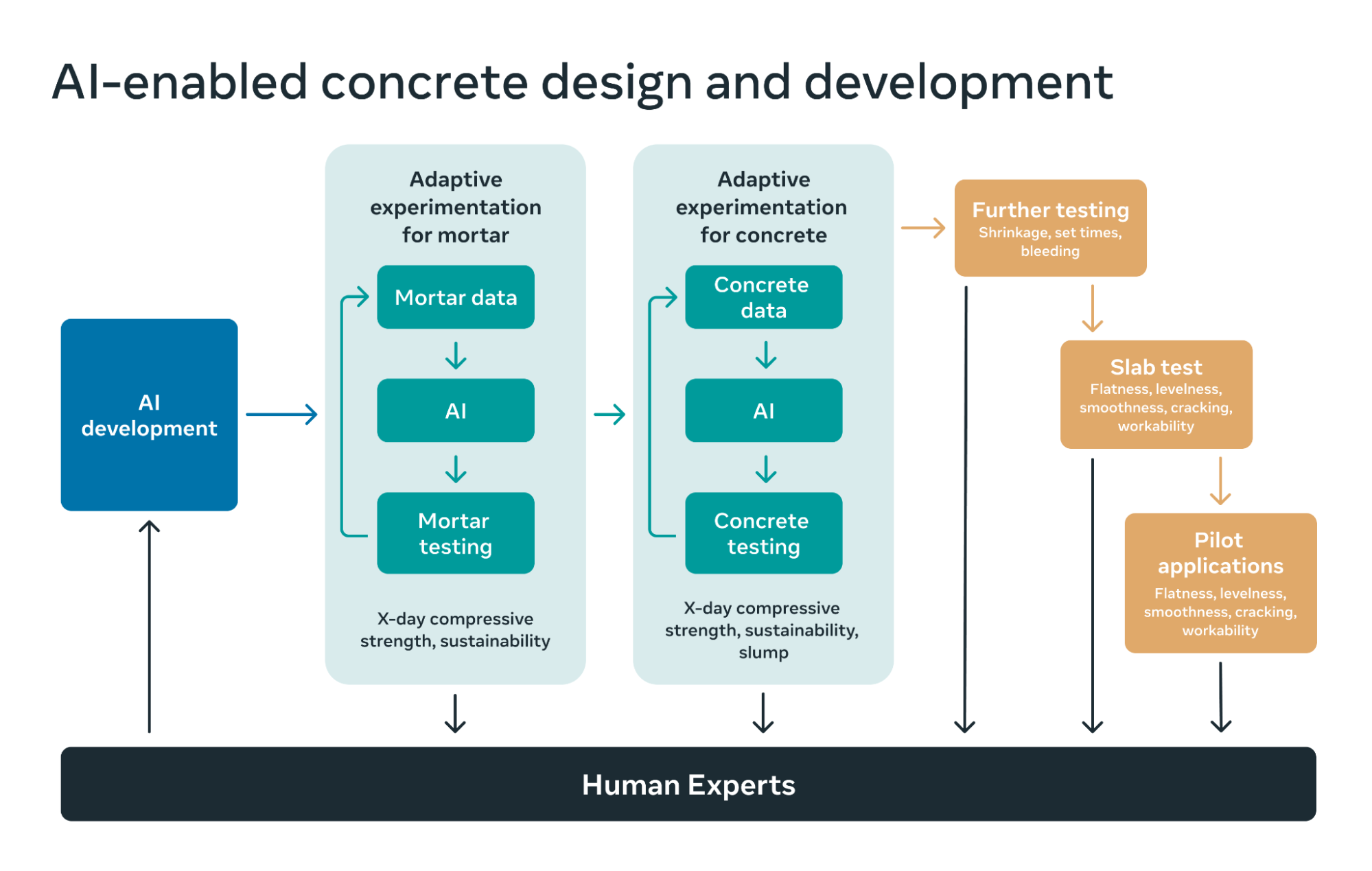
To train the model, Meta collaborated with Professor Nishant Garg’s research group at U of I. The workflow is iterative: the AI proposes new mixes based on performance predictions, lab testing validates those predictions, and the results refine the model for the next round. The pipeline covers baseline data generation, AI training, hypothesis development, and continuous improvement.
The first implementation focused on compressive strength, curing speed, slump, and sustainability—the latter quantified using a proxy for carbon footprint. These properties can be tested on concrete cylinders in the lab, enabling systematic data generation for AI training. Larger-scale tests come only after new formulas pass expert review. The full pipeline is shown below:
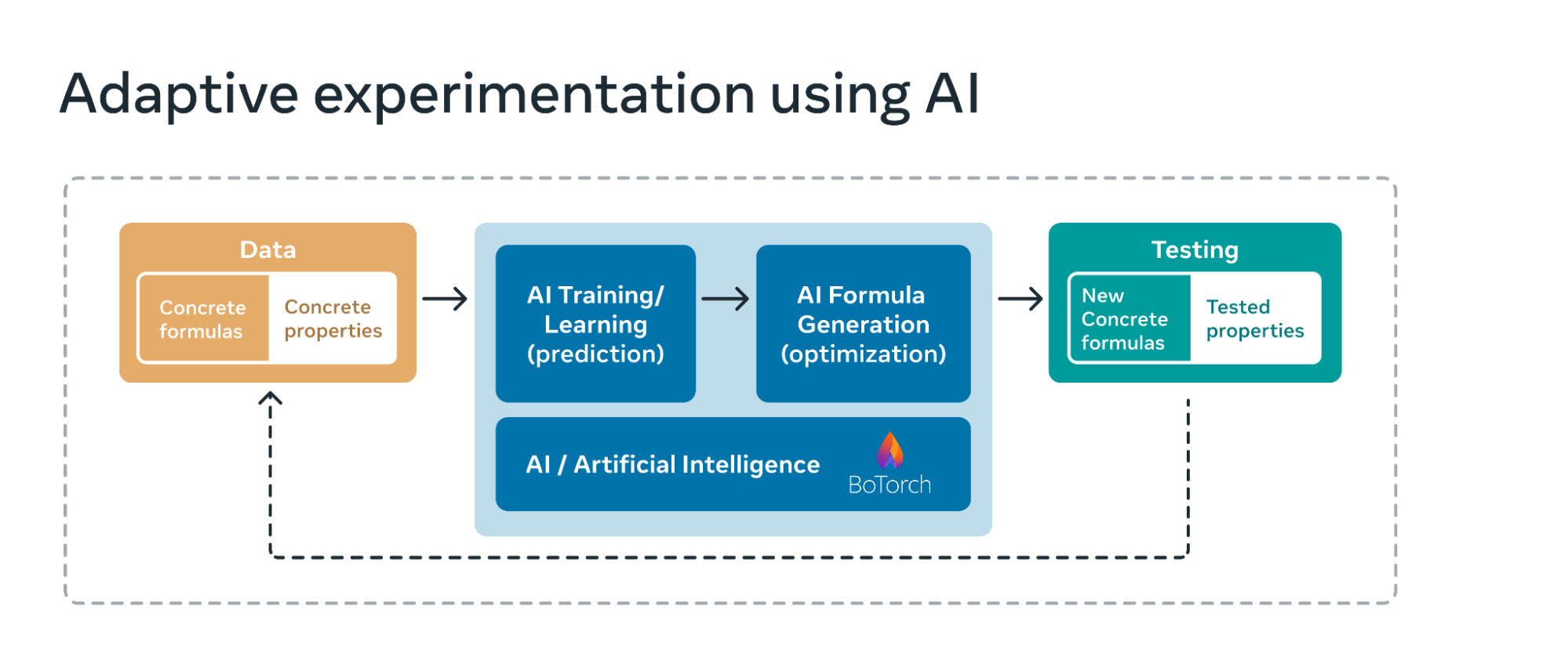
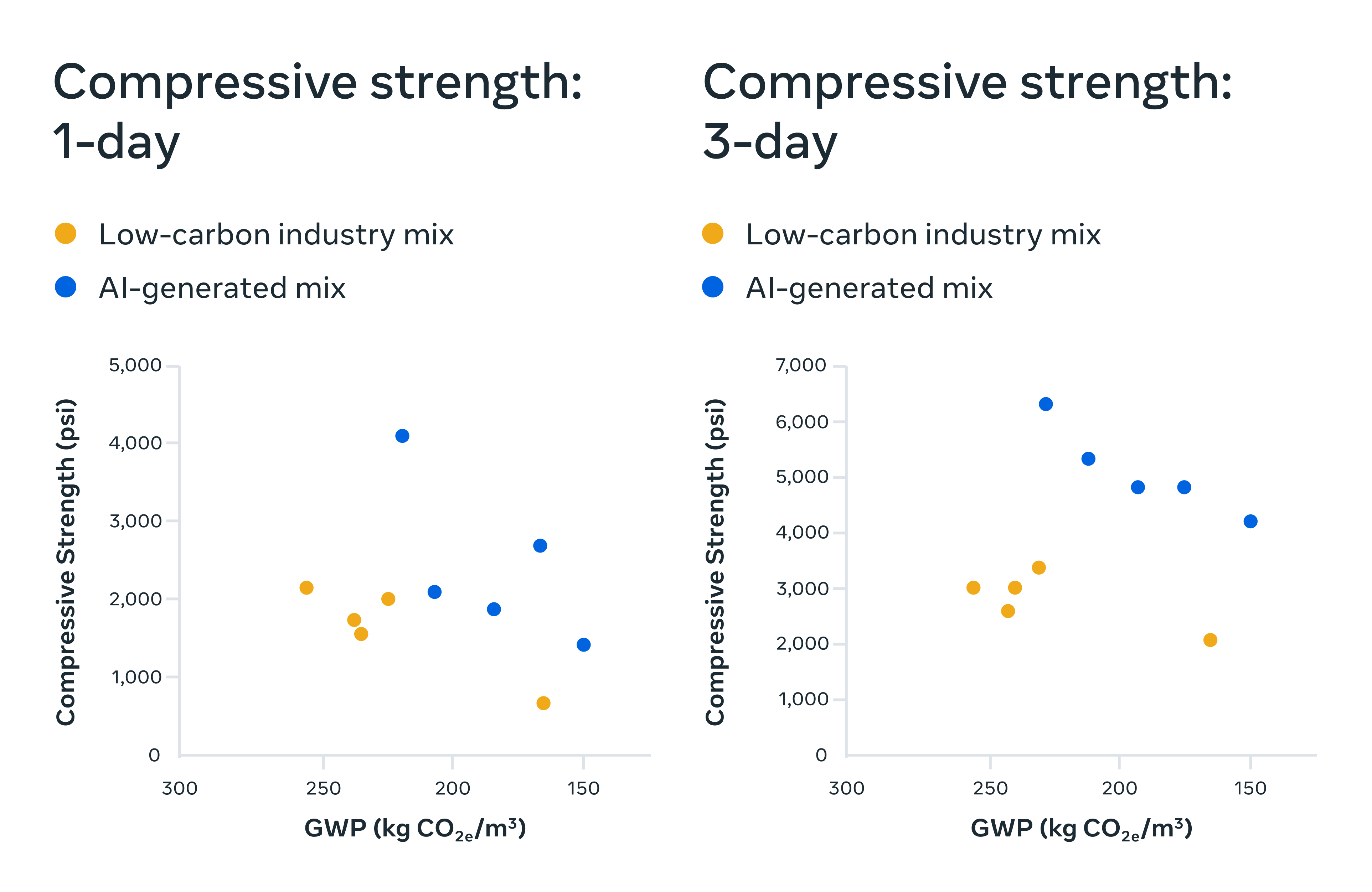
Over multiple iterations, the AI learned to exceed the performance of initial human-designed formulas, optimizing the x-day strength versus sustainability trade-off. The process generated a dataset of over a hundred unique concrete mixes with comprehensive compressive strength data and global warming potential (GWP) measurements in kilograms of CO2 per cubic meter.

Scaling up with Amrize
In 2024, Meta began working with Amrize to test whether the AI approach could work at industrial scale. Amrize shared performance data from its batch plant near St. Paul, MN, and developed an AI pipeline there, extending the discovery and testing process beyond the lab.
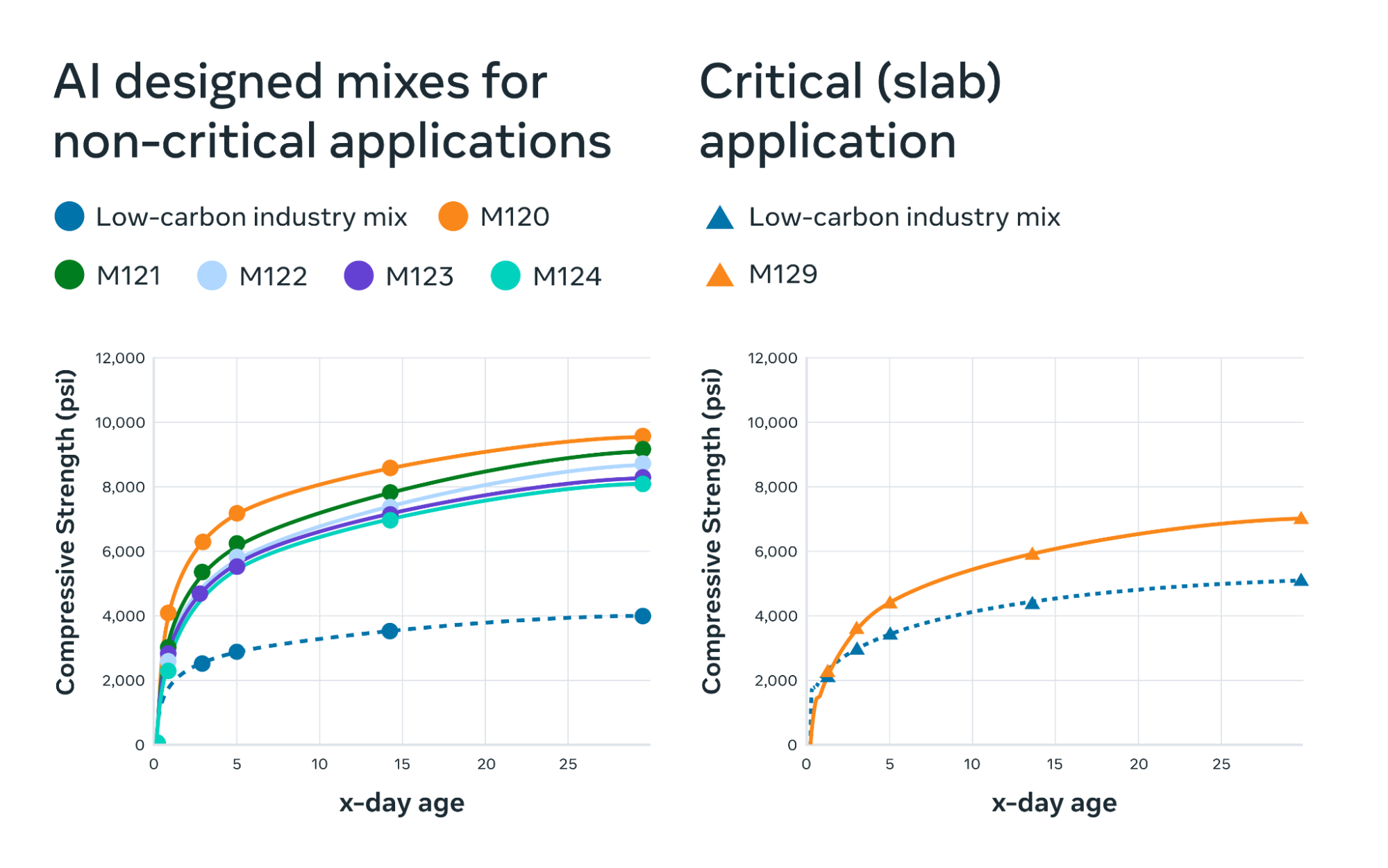
Data center concrete slabs have demanding requirements: they must be flat, level, smooth, and durable to support servers and cooling equipment. The AI algorithms incorporate water-to-binder ratios and volumetric material constraints to discover formulas that cure faster and achieve lower GWP while meeting these stricter finish standards. Within two iterations—and with only minor human adjustments—the pipeline found formulas that outperformed standard low-carbon industry mixes across strength, speed, and sustainability.
From lab to data center floor
Moving from AI-generated formulas to real-world application required additional testing stages. Amrize collaborated with Mortensen, the general contractor on Meta’s Rosemount data center, to test workability and finishability. After successful slab tests, the mix was applied at scale in a site support section of one of the building slabs.
Formal testing confirmed that the team met all technical requirements while achieving the necessary workability and finish performance.
Open source for broader adoption
The AI tool and its associated data and code are freely available in Meta’s SustainableConcrete repository. The basic solution will remain open source to support further commercial productization and R&D. Meta plans to continue its Amrize collaboration to scale AI use across the concrete industry, and will work with hyperscalers, iMasons, and the Open Compute Project to publish reference designs, AI-informed formulas, case studies, and best practices. The aim is to drive wider adoption of high-performance, low-carbon concrete through open standards and shared knowledge.
Putting the model to work
The practical workflow starts with a set of candidate mix designs and a target mean_28d_compressive_strength (in MPa). For each design, the model predicts the expected strength and the uncertainty around that prediction. If the upper confidence bound of a candidate exceeds the required minimum strength, it is accepted for further testing. From there, the model runs a Bayesian optimization loop with a budget of eight mix designs to propose a slate of candidates that trade off performance against embodied carbon, using the constrained MEGlobalImpact objective in BoTorch. Finally, those candidates are checked against a benchmark: only mixes with projected strength within 2 MPa of the incumbent design move forward.
Meta's case study worked on a design space of roughly 350,000 candidates, each described by 13 chemical and physical properties. The sensitivity analysis pointed to the type and dosage of cement replacement materials as the dominant lever on the carbon-to-strength trade-off. A key observation from that exercise was the sign of certain correlations — specifically, the inverse relationship between the Cement fraction and mean_28d_compressive_strength in the model's training data. The Bayesian optimization approach handled this correctly by concentrating on blended systems with low cement content and high replacement material dosage rather than abandoning cement entirely.
The report cautions that neural network models on this kind of data can exhibit unrealistic extrapolation in the low-cement and high-replacement region — for example, predicting 80 MPa for a mix with only 100 kg/m³ of cement. The authors attribute these artefacts to the correlation structure in the raw data and note that they are partially mitigated by lowering the prior mean on the extrapolation term in the GP model, which helps the surrogate avoid overestimating strength in under-sampled parts of the design space.
The resulting curves suggest that a meaningful reduction in embodied carbon per unit of strength is attainable — with projected improvements on the order of 20–30% relative to conventional mixes — while still keeping 28-day compressive strength in a range that is practical across the slate of candidate designs. The largest gains come from increasing the share of supplementary cementitious materials and making modest adjustments to admixture loadings, not from re-optimizing water-to-cement ratio alone.
Materials and resources
The trained model is open-sourced on GitHub under the SustainableConcrete repository. The supporting technical report, “Sustainable Concrete via Bayesian Optimization,” is available on arXiv (2310.18288), and the optimization pipeline itself builds on two existing open-source libraries: BoTorch for Bayesian optimization primitives and Ax for the higher-level API around search spaces and trials. For context on deployment, Meta has also published details on how low-carbon concrete is used in its data centers.


