

From Turing to Text-to-Image
The path from Alan Turing’s 1950 question—“Can machines think?”—to today’s generative tools has been long and non-linear. Early artificial intelligence research tried to encode human knowledge as declarative rules, but the implicit rules of daily life made that approach impractical.
That shifted in the 1990s. Scientists moved from knowledge-feeding to a data-driven approach, where programs learned directly from large datasets using neural network architectures modeled loosely on the human brain. The results started to follow: IBM’s Deep Blue defeated a world chess champion in 1997, and Google Brain’s deep neural network learned to discover and categorize objects.
A further inflection point came in 2014, when Ian Goodfellow created the first generative adversarial neural network. This allowed machines to generate entirely new data that matched the statistical properties of their training sets. That foundational work set the stage for 2022’s high-profile models—DALL·E 2, Stable Diffusion, and MidJourney—which capture the public’s imagination with seemingly original creations.
AI Finds Its Way Into the Workflow
For years, automation warnings focused on manual or repetitive “blue-collar” roles. Many in creative fields assumed their work was inherently immune. But AI has now appeared across the design spectrum, often augmenting rather than replacing human effort.
- Product design. Mattel is applying AI in its product design process.
- Interior design. Designers are generating mockups with AI that detects floors, walls, furniture, and swaps them out at will.
- Graphic design. Nestlé used an AI-retouched Vermeer painting to market a yogurt brand.
- Advertising. BBDO is already prototyping work with Stable Diffusion.
What about disciplines with a more defined medium—like web design? The same momentum applies. Modern AI capabilities are the result of fifty years of research accelerated by three compounding factors: more sophisticated neural network architectures, larger training datasets, and better hardware to run both. For web designers, the question is no longer whether AI will reach their field, but how they will work alongside it.
Mapping AI Against Today’s Design Process
Most website projects still move through the same five-step arc: forming, defining, ideating, socializing, and implementing. In each phase, the designer acts as researcher, strategist, creator, and advocate. To see what changes when AI enters the picture, it helps to break those stages into discrete activities and check what today’s models can actually do — and where they still fall short.
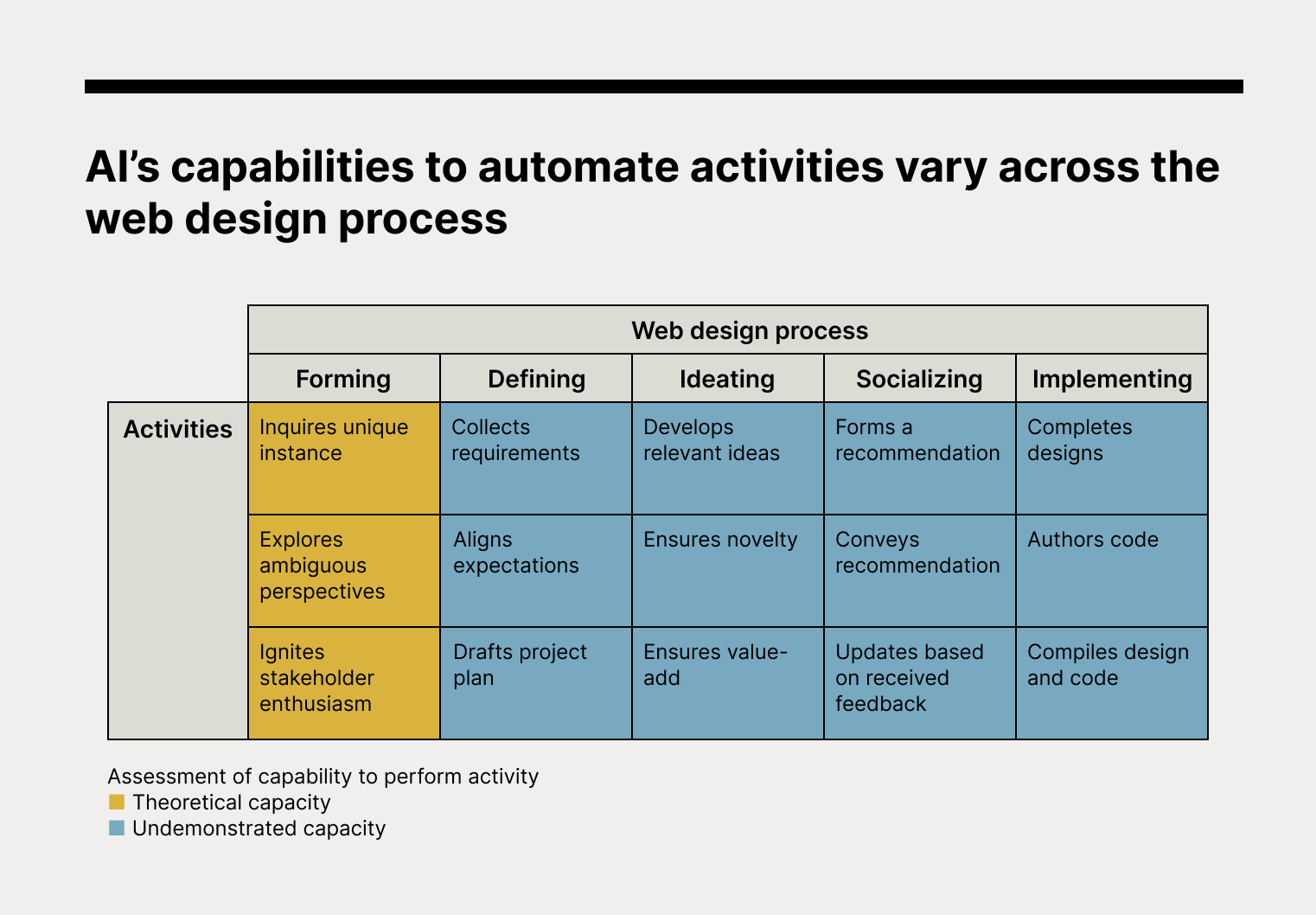
Forming
Early engagement is about context: understanding the client’s unique position, holding space for ambiguity, and building momentum. None of that comes easily to current AI models.
- Inquiring into the unique instance: Undemonstrated. A new client brings a distinct mix of goals and constraints. AI models trained on public data have little to say about cases outside that data. Without a way to interrogate a specific business context, they cannot yet ask the probing questions that shape a sound project brief.
- Exploring ambiguous perspectives: Undemonstrated. Designers often draw on emotional and cultural nuance — the story behind a brand, for example. Some research prototypes show early promise in abstract reasoning and emotion recognition, but empathy remains a missing layer in production systems.
- Igniting stakeholder enthusiasm: Undemonstrated. AI can craft persuasive marketing copy, but sustaining the long-term motivation a redesign demands is another matter. There is no evidence yet that models can galvanize a client team for the duration of an engagement.
The AI Experiment: Forming
The design team prepping a product launch landed on a landing page concept built around nostalgia, and worked with product managers to build excitement. When they tried the same with AI, general conversational models gave generic advice and failed to diagnose whether a website was even the right move. Generated directions leaned heavily on functional differentiation and missed the emotional triggers that made the human-driven concept click.
Defining
Defining is where requirements get written down, expectations get aligned, and timelines get set. Here, the capabilities of AI are more concrete.
- Collecting requirements: Theoretical capacity. Natural language processing and understanding let models parse and respond to human input. ChatGPT, for instance, can ask clarifying questions and push back on bad requests. Early deployments in customer service already show positive effects on trust and satisfaction.
- Aligning expectations: Theoretical capacity. Negotiation is a solvable problem for AI. Meta has demonstrated autonomous deal-making through simulation and prediction, and companies like Pactum use proprietary models to negotiate B2B terms with global retailers.
- Drafting project plans: Theoretical capacity. Timelines, task dependencies, and work breakdown structures are all pattern-based. Research has used Support Vector Machines for timeline forecasting and Artificial Neural Networks for defining task relationships and generating WBS charts.
The AI Experiment: Defining
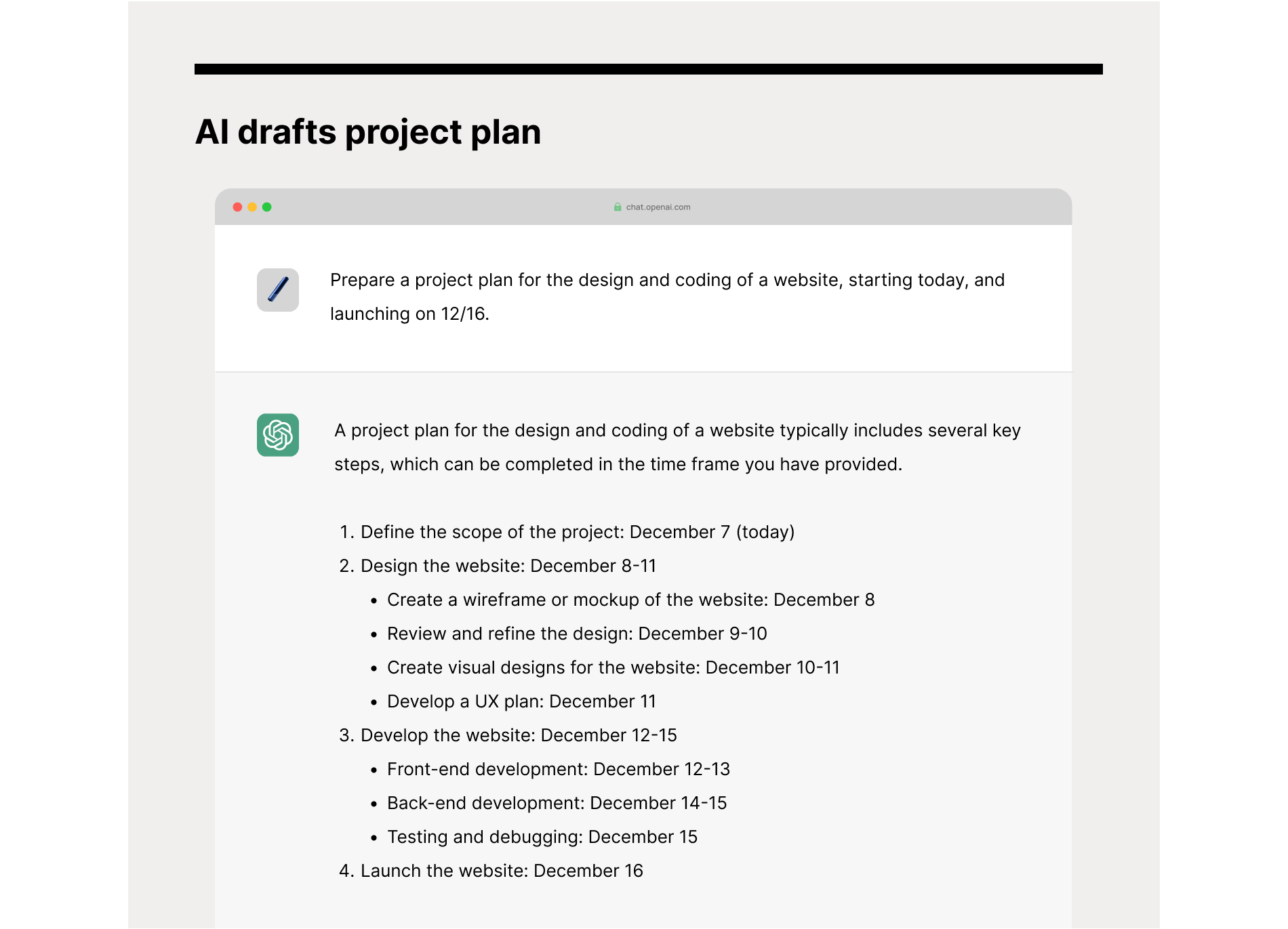
The designers started with their usual questionnaire and hashed out scope with the product team — a process that involved some friction before landing on a plan. With AI, they had ChatGPT role-play as the design team to collect requirements. It performed well enough to suggest new questions. Asked to produce a project plan from the product team’s responses, it delivered something reasonable, even if the team would not use it as-is given gaps like current workload.
Ideating
Ideation turns requirements into directions — relevant, novel, and valuable. That mix of constraints makes this a promising area for generative models.
- Developing relevant ideas: Theoretical capacity. Models like DALL·E 2 learn the relationship between prompts and outputs, so they can produce design concepts that track stated criteria — including UI-level explorations.
- Ensuring novelty: Theoretical capacity. Diffusion-based approaches scramble and reassemble learned data, creating new combinations the way humans mix known concepts. Google’s Imagen Video, Meta’s Make-a-Video, MidJourney, and Stable Diffusion all demonstrate this kind of synthesis.
- Ensuring value-add: Theoretical capacity. When value comes from spotting patterns across large datasets, AI can match or exceed human capability — making it a useful engine for generating and supercharging ideas.
The AI Experiment: Ideating
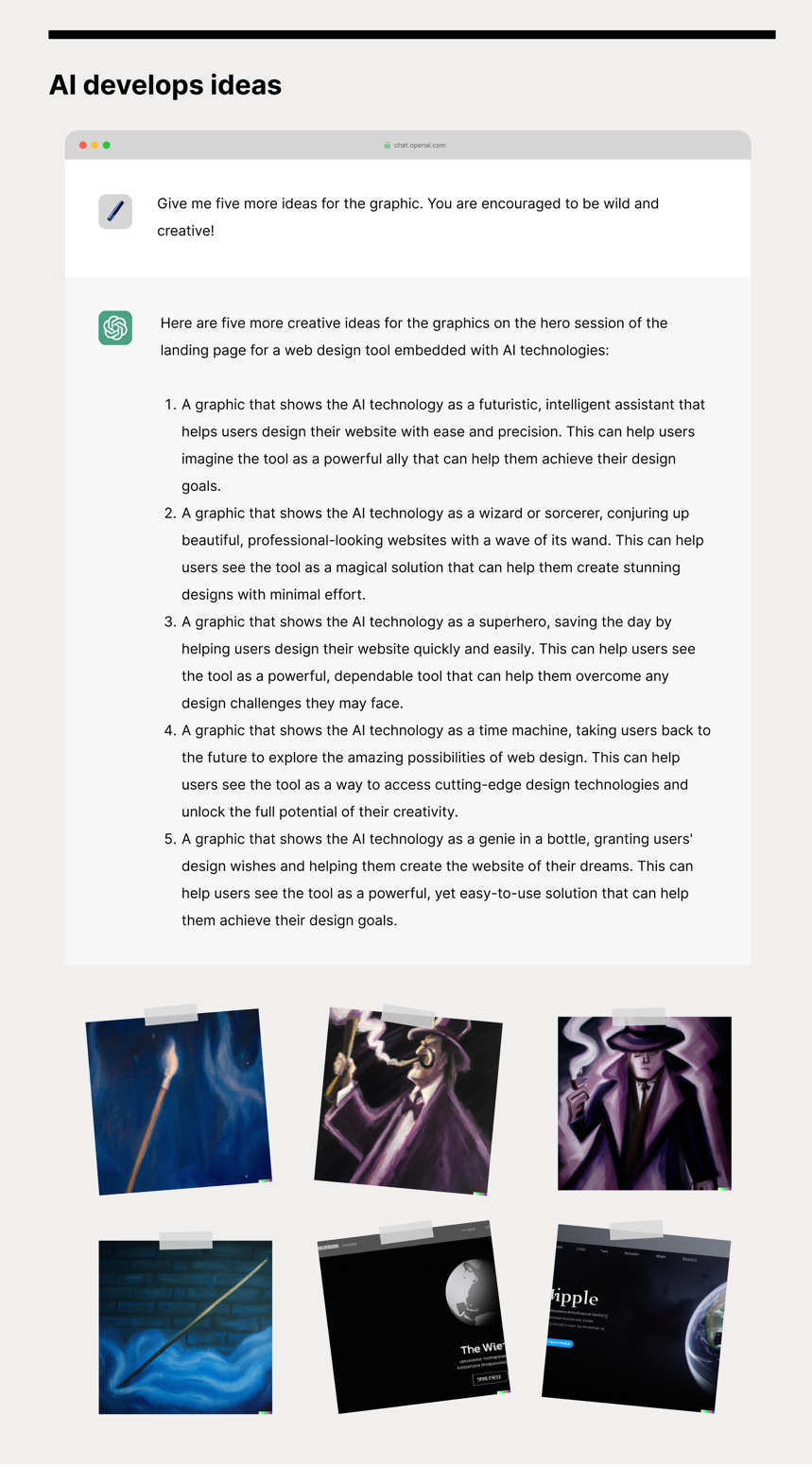
The designers brainstormed hero concepts around the nostalgia theme. ChatGPT suggested “wizard” and “time machine” angles that genuinely surprised them. DALL·E 2 produced visual directions, though the output still needed cleanup in UI tools to be presentable.
Socializing
Socializing is where the designer advocates for a direction and responds to pushback. AI’s role here is promising but still partial.
- Forming a recommendation: Theoretical capacity. Trained on design and attention datasets, models can score and rank options by likely impact on conversions. What they cannot yet do is weigh softer, more subjective objectives.
- Conveying the recommendation: Theoretical capacity. IBM’s Project Debater shows AI can generate coherent, persuasive arguments aligned with a position. The finer balance between confident and overbearing remains an open research question.
- Updating based on feedback: Theoretical capacity. Models like DALL·E 2 and ChatGPT iterate quickly when prompts reflect new input. For unrecognized concepts, textual inversion techniques let models learn and incorporate them.
The AI Experiment: Socializing
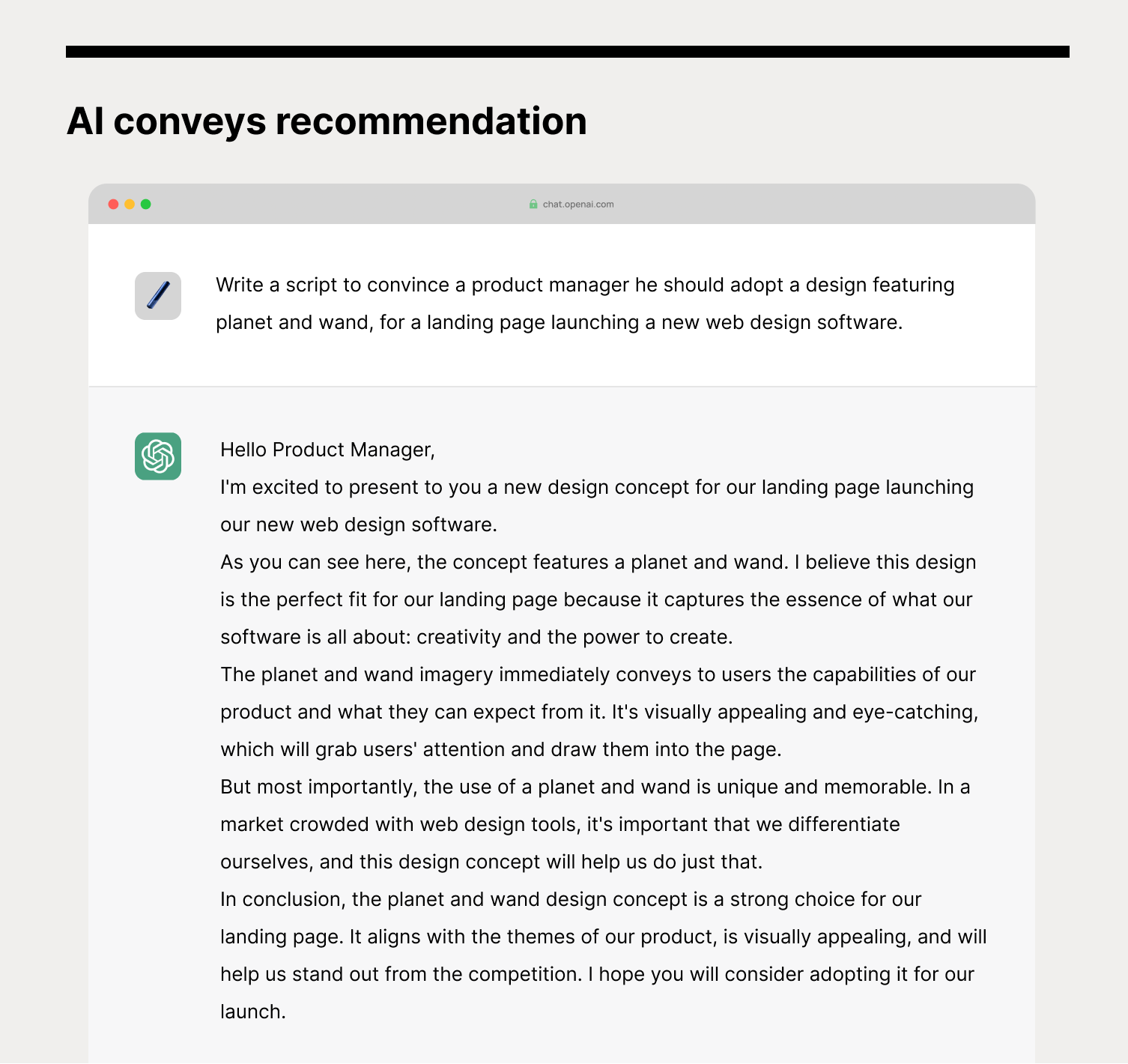
The team ranked DALL·E 2 outputs using models trained on attention data, which gave a simulated gaze path and confidence in one option — pending a real usability test. ChatGPT then wrote a pitch script to sell the idea. As feedback came in, the designers updated prompts and regenerated. The speed of iteration felt productive, even if the team wanted more validation before committing.
Implementing
Implementation — finishing the design, writing the code, and shipping the result — is the stage where AI assistance is closest to production-ready.
- Completing designs: Theoretical capacity. Models can fill in and extend existing designs. Outpainting from OpenAI extrapolates beyond an original canvas, and research shows low-fidelity sketches can be upgraded to medium-fidelity mockups by detecting and refining UI elements.
- Authoring code: Theoretical capacity. Trained on large code-description pairs, models generate HTML, CSS, and JavaScript from functionality descriptions. Microsoft’s PowerApps already turns natural language into queries, and GitHub Next’s leadership predicts a near future where the developer sketches architecture and the AI fills in the details. Human review remains necessary, but feedback loops should drive steady quality gains.
- Compiling design and code: Theoretical capacity. With design and code generation both advancing, automatic alignment is not far off. OpenAI engineers have demonstrated prototypes that build simple apps from plain-language requests, such as “Make me a personal website with PayPal embedded for payments.”
The AI Experiment: Implementing
Developers joined the designers to test code-generation services. Both sides were surprised by the syntactically complete output and called the experience futuristic. Still, they did not feel comfortable shipping the generated code without further checks for compatibility with the existing codebase.
Automation in Three Waves
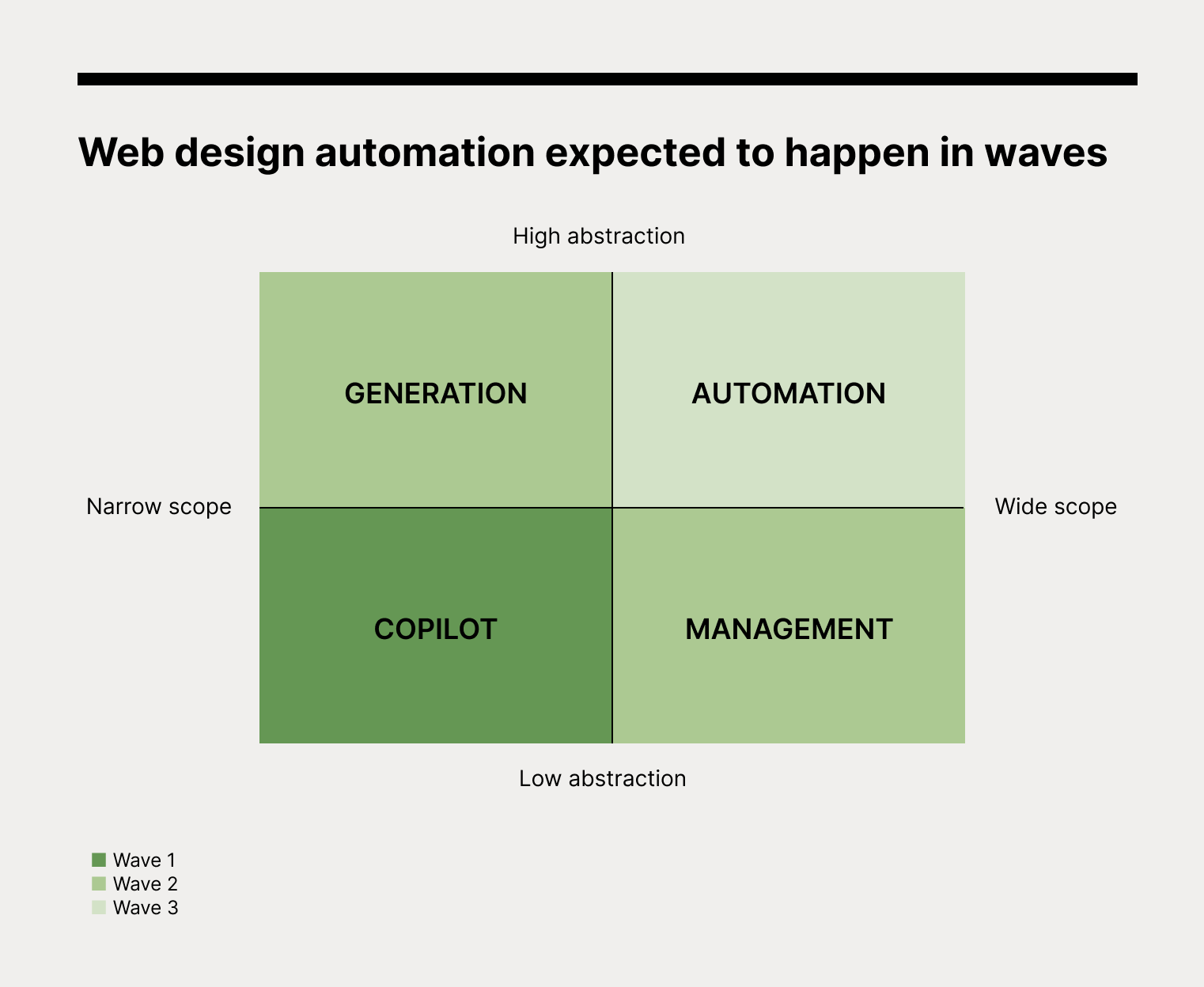
The shift toward AI-assisted design will not be instantaneous. Rather, it should unfold in three recognizable waves, each defined by the abstraction level and scope of the tasks being automated. The more specific and narrow the task, the sooner models can be trained to handle it reliably. More abstract or broad responsibilities will require larger, industry-specific datasets and longer refinement cycles.
Wave 1: Design Copilot
The first wave covers low-abstraction, narrow-scope tasks that are manual and time-consuming. These are well-suited to automation because the controlled output domain lets models meet expectations consistently with relatively little training data. We are at the beginning of this wave, with technology previews from Adobe and startups like Studio Design. Near-term tools might automatically adapt one design to different screen sizes, apply suggested animations for interactivity, or handle complex format adjustments from descriptive prompts.
Wave 2: Generation and Management
The second wave splits into two fronts. On the generation side, models will produce semi-completed web designs from prompts, covering the Ideating and Implementing output ideas. This involves higher abstraction but a narrow scope. ChatGPT and DALL·E 2 already generate design suggestions and image outputs, yet they need training on web-design-specific datasets to improve variation and quality. Copyright and ethics concerns remain open questions.
On the management side sit the Defining and Socializing ideas, which are lower in abstraction but broader in scope. Adjacent industries have shown some success here, but everyday account management will need further oversight. One particular challenge is monitoring the balance between persuasion and tactful communication during client interactions.
Wave 3: Automation
The final wave is end-to-end automation of the web design process, encompassing strategy and intent development in the Forming stage. Website builders with AI modules represent early leapfrog attempts, but significant hurdles persist. Chief among them is instilling uniquely human perspectives such as empathy into the process. Until that is resolved, AI cannot fully replace the designer’s contribution.
A Parallel to Previous Transitions
History suggests a pattern: the printing press redirected scribe artists in the late 15th century, textile machines shifted artisan work in the 19th century, and photo-editing software changed the work of darkroom artists more recently. AI in the 21st century is poised to trigger a similar redirection of creative focus.
Later stages of the web design process are most susceptible to automation. Productive designers will therefore concentrate their creative energy on earlier stages, where differentiation remains possible. Daily work moves from pixel-pushing and software operation toward strategizing and forming intents with clients. In short, the future of creativity is heading upstream.
Where Designers Fit
AI is already demonstrating theoretical and practical capabilities across multiple stages of web design. Yet it still lacks distinctly human qualities such as inquisitiveness and empathy. That gap leaves room for designers to collaborate with these tools rather than compete against them. Working together, designers and AI can push the craft beyond its current boundaries.


