
Accuracy isn’t everything in recommendations
Most recommendation systems are judged by how accurately they predict what a user will engage with next. But an exclusive focus on predictive accuracy can create a narrow, stagnant user experience over time. A better framework considers not just what users will click today, but how recommendations shape what they’ll be interested in tomorrow.
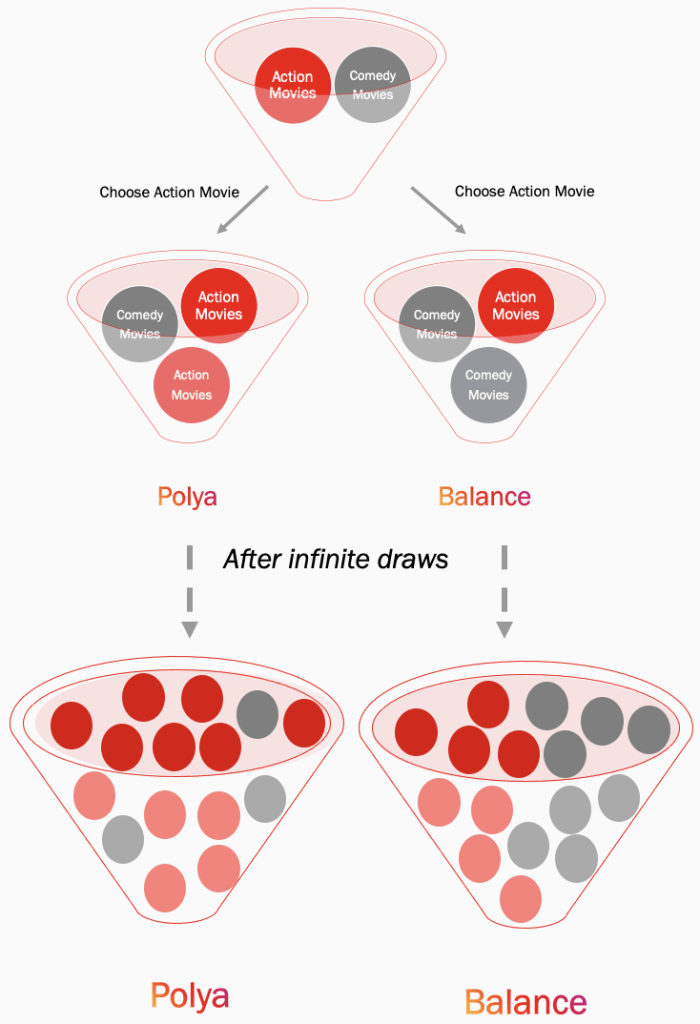
Two simple mathematical models illustrate the trade-off. In a Polya process, every choice is positively reinforced: drawing a red marble (action movies) adds another red marble to the urn. Over many iterations, the urn becomes dominated by a single color, locking the user into one genre. In a balancing process, each draw adds a marble of the opposite color, driving the system toward an even mix of everything—steady, but unlikely to produce strong engagement at any given moment. One over-personalizes; the other over-diversifies. Neither is right on its own.
Real preferences resist tidy models
Urn models are useful because they simplify. But real user preferences are messier:
- Multidimensional: A user may like a “dark comedy” for both its thriller and comedic elements, not just one genre.
- Soft: Affinity toward a genre is a matter of degree—say, 35% toward comedy and 99% toward sports.
- Contextual: Choices depend on prior selections, presentation order, trends, and other shifting variables.
- Dynamic: Interests evolve. A user who is absorbed in historical documentaries may lose that interest within a month.
This resembles the classic explore-exploit trade-off from reinforcement learning, with a complication: unlike games with fixed rules, human preferences can change after every interaction. A closed-form optimization is infeasible, so practical heuristics are the way forward.
Heuristics for diverse recommendations
Several pragmatic techniques can inject diversity into a recommendation pipeline without abandoning accuracy:
- Author-level diversity: If one author dominates a user’s session feed, simple stratification of ranking candidates by author can improve the overall experience.
- Media-type diversity: On platforms with multiple content types (photos, short and long videos, albums), interleave media formats in the sequence rather than clumping three videos followed by two photos—so long as quantitative and qualitative metrics don’t degrade.
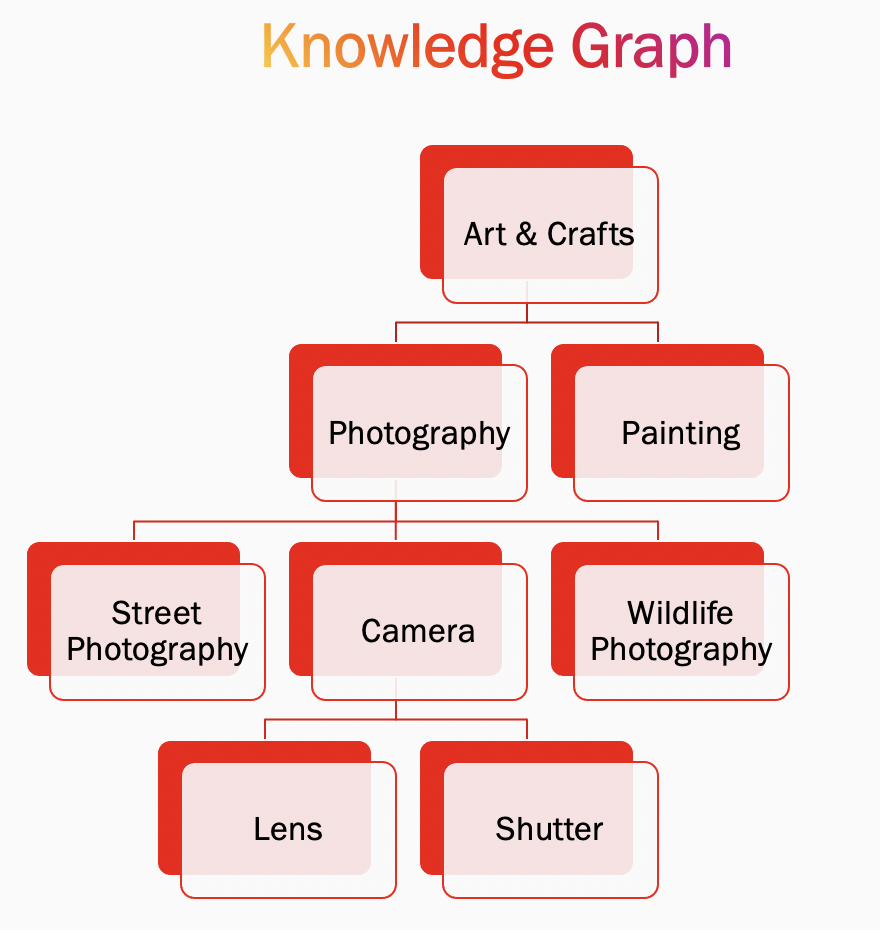
- Semantic diversity via content understanding: A robust content understanding system can label each item at multiple levels—birds, sunset, tiger—and at a higher level, wildlife photography. If a user’s tastes are represented as a weighted cloud of concepts, sampling across the cloud yields a richer mix of items.
- Explore semantically adjacent nodes: Many content understanding systems use knowledge graphs or trees. When a user shows interest in one concept, consider recommending related ones:
- Parents, siblings, and children of the concept (e.g., from wildlife photography to photography broadly, or to street photography).
- Niche “tail” concepts the user may not have encountered before.
- Items that span multiple concepts of interest, such as a blog post on machine learning applied to wildlife conservation.
Separating long-term and short-term tastes
Users have enduring interests and passing fascinations. Maintaining two distinct queues for long-term and short-term preferences lets the system mix the familiar with the novel, providing both comfort and discovery.
Borrowing from reinforcement learning
Classic explore-exploit strategies have practical value here:
- Epsilon-greedy: Recommend normally, but occasionally and deliberately expose the user to a random near-similar item. This is inexpensive and easy to implement.
- Upper confidence bound: For concepts where user interest is present but under-tested, show enough items to gather confidence before deciding whether to keep or drop the concept.
Quantitative and qualitative guardrails
Metrics like ROC-AUC and NDCG aren’t the whole story. User satisfaction studies, diary research, and surveys reveal tolerance for repetitiveness and appetite for content variety, informing deployment decisions. Likewise, negative signals—clicks on “not interested,” “show fewer videos like these” buttons—serve as explicit guardrails. Models that learn to minimize such feedback are tuned using both offline simulation and direct user research.
A bias toward long-term satisfaction
Optimizing purely for clicks, likes, or short-term engagement may maximize metrics on Monday while building boredom by Friday. The goal should be to balance immediate relevance with sustained interest, accepting small short-term trade-offs for a healthier, more diverse user experience in the long run.


