Python tops GitHub as AI remakes the global developer landscape
GitHub’s annual Octoverse report is out, and the headline is less about automation replacing programmers and more about how AI is pulling new people into software development. In 2024, Python overtook JavaScript as the most-used language on the platform, while Jupyter Notebook usage jumped 92% — both signals that data science, machine learning, and scientific computing are now driving the largest share of open source activity.
The platform also saw an unprecedented wave of new developers join, particularly in the global south. GitHub notes that the surge began around the time Copilot and similar AI tools went mainstream in early 2023, and while the company can’t fully explain the growth, it’s clear that AI is both lowering the barrier to entry and shifting what kinds of people are writing code.

Three trends shaping 2024’s data
1. Generative AI is spreading far beyond code completion. Contributions to generative AI projects on GitHub rose 59% year-over-year, and the number of such projects grew 98%. The United States still leads in raw contribution volume, but combined activity from the rest of the world now exceeds it. Notable contributors came from India, Germany, Japan, and Singapore, and first-time open source contributors are showing strong interest in AI projects — with no evidence that AI is degrading the quality of contributions.
2. Developer growth is accelerating worldwide. India is on track to have the largest developer population on GitHub by 2028, with significant gains also occurring across Africa, Latin America, and Brazil. Students are a major factor: GitHub Education has verified more than 7 million participants, and adoption of Copilot through the complimentary access program has doubled year-over-year among students, teachers, and open source maintainers. The implication is that AI isn’t just making existing developers faster — it’s helping more people become developers in the first place.
3. Python is now the platform’s most used language. For the first time, Python has overtaken JavaScript on GitHub, driven by its dominance in machine learning, data science, scientific computing, and even hobbyist and home automation projects. The shift reflects a broader change: open source is no longer the domain of traditional software developers alone. The STEM community — researchers, data analysts, and academics — is now a major contributor base. Meanwhile, systems languages like Rust continue to gain ground, even as Python, JavaScript, TypeScript, and Java hold the top spots overall.
That 92% spike in Jupyter Notebook usage is a clear sign that Jupyter is becoming a standard tool for people working in AI, data science, and academic research — populations that previously used GitHub less frequently. As these communities grow, the lines between software development, research, and data analysis are blurring further.
AI reshapes the global GitHub map

The GitHub community passed 100 million developers in early 2023 and has kept climbing. Across 2024, developers worldwide logged more than 5.2 billion contributions across 518 million public and private repositories, and the distribution of that activity is shifting as fast as the tools developers use.
As AI lowers the barrier between intent and code, growth is increasingly coming from regions where English is not the primary language. That shift is visible across the top 20 developer communities, where India is closing on the United States, and fast-growing communities in Brazil, India, and Nigeria are registering the sharpest increases.

Growth outside the United States has outpaced that inside the country every year since 2013, and the pace has accelerated recently. India is now projected to pass the US by 2028—an update over the prior projection of 2027.
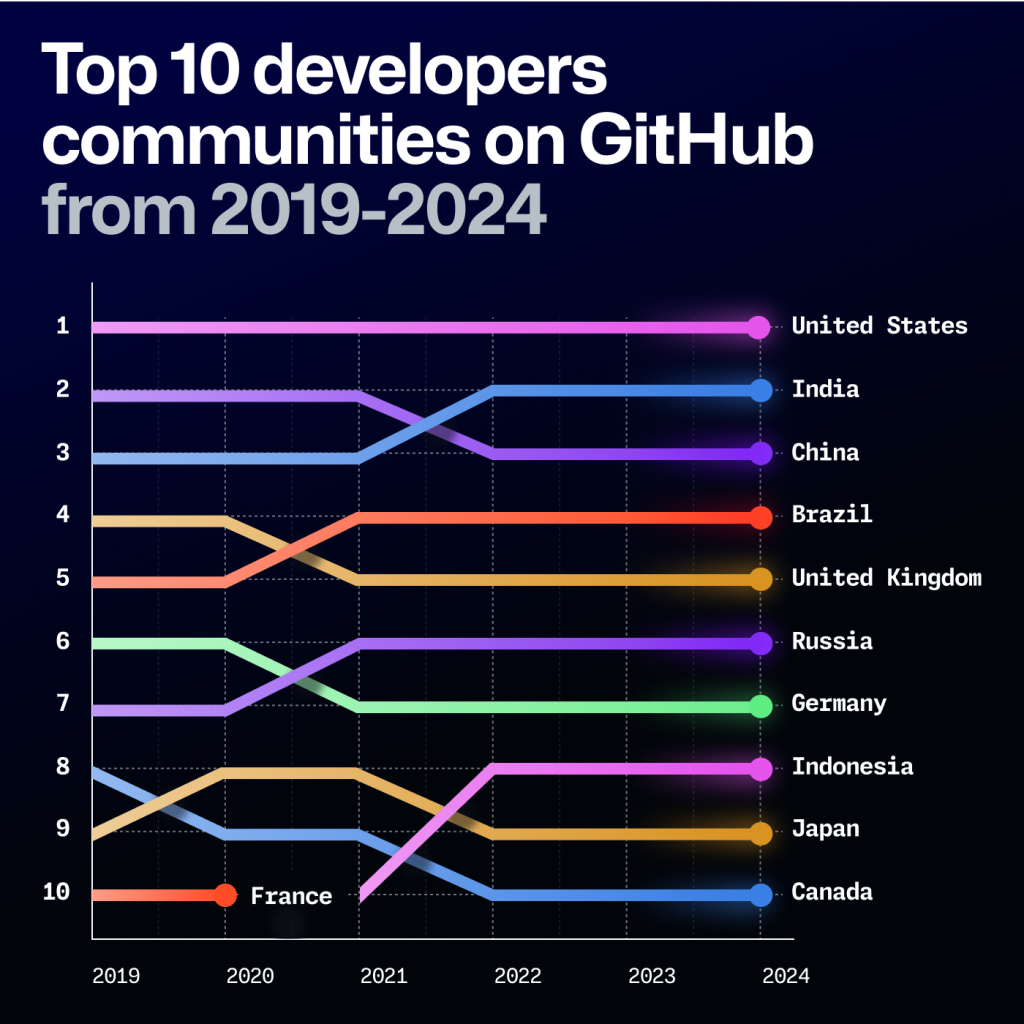
Most of the top 20 communities held their positions over the last year. The notable exceptions: the Philippines has pulled ahead of Australia, and Pakistan has passed Poland.

Regional snapshot: Latin America
The driver of growth in Latin America is the combination of an emerging workforce, government incentives for tech startups, and growth in open banking, cloud infrastructure, and AI.
| Country | Percentage growth | # of developers |
|---|---|---|
| Brazil | 27% YoY | >5.4M |
| Mexico | 21% YoY | >1.9M |
| Colombia | 25% YoY | >1M |
| Argentina | 22% YoY | >1.1M |
| Peru | 27.5% YoY | >583K |
- Peru: Fintech startups are multiplying, and foreign investment is helping the broader tech sector expand.
- Brazil: Real-time payments infrastructure Pix remains a core driver of its open banking ecosystem, fueled by open source tooling from the Central Bank of Brazil. Brazil also recently announced a $4 billion national AI investment plan.
- Mexico: Government efforts are aimed at building developer infrastructure and expanding coding and AI skills in the workforce.
“Students learn to collaborate and cooperate, they develop their soft skills. I did a survey at the end of the semester and more than 70% of the students indicated that working on projects through GitHub improved their technical and leadership skills.” – José Alfredo Román Cruz, Professor, Technological Institute of Tlaxiaco
Regional spotlight: Asia Pacific
Asia Pacific is home to some of the fastest-growing developer communities on GitHub, and AI is expected to keep fueling that momentum as more developers engage in their own languages.
India’s developer community is on track to overtake the US by 2028. That growth is supported by the National Education Policy of 2020, which requires schools to teach coding and AI from class 6 onward, and by India’s participation in the Digital Public Goods Alliance, which has produced projects like the Open Healthcare Network with support from GitHub Copilot.
| Country | Percentage growth | # of developers |
|---|---|---|
| India | 28% YoY | >17M |
| China | 10% YoY | >9M |
| Indonesia | 23% YoY | >3.5M |
| Japan | 23% YoY | >3.5M |
| Philippines | 29% YoY | >1.7M |
- Singapore: A high developer-to-population ratio, supported by its Smart Nation and National AI Strategy initiatives.
- Japan: Growth continues as the government takes a light-touch approach to AI regulation.
- South Korea: Investment in AI, quantum computing, and cybersecurity is expanding through plans like K-Network 2030.
“GitHub is like the air we breathe. It’s such a natural part of the way we work that sometimes we don’t even notice it. We cannot imagine living without GitHub.” – Ryuzo Yamamoto, Software Engineer, Souzoh
Regional echo: Europe and the Middle East
Europe and the Middle East are devising two opposite strategies for AI: heavy regulation in the EU, with acts like the AI Act and the Data Governance Act, versus a push for AI hubs in the Middle East. Both approaches are shaping developer growth.
| Country | Percentage growth | # of developers |
|---|---|---|
| United Kingdom | 19% YoY | >4M |
| Germany | 21% YoY | >3.5M |
| France | 20% YoY | >2.8M |
| Spain | 24% YoY | >1.8M |
| Turkey | 19% YoY | >1.7M |
- Netherlands: Its IT sector and digital infrastructure have been expanding for a decade; it hosts 1.3 million GitHub developers.
- Spain: Growing importance in the EU is tied to an AI plan that includes Spanish-language models, and it now ranks 15th globally.
- France: AI and startup efforts are supported by French Tech 2030, which complements its 2030 national plan for AI talent and upskilling.
- Switzerland: Mandates open source for federal software where possible, and The Economist ranks it as the world’s most innovative country based partly on its GitHub activity.
- Turkey: 5G rollout and local telecom advances are expanding its information and communication technology markets.
- United Arab Emirates: Recent push to be an AI and advanced tech leader coincided with a 32% year-over-year rise in GitHub developer numbers.
Regional snapshot: Africa
Africa’s growing talent pool is building on strong open source communities, with organizations like Open Source Community Africa and All In Africa creating visibility for the region’s creators.
| Country | Percentage growth | # of developers |
|---|---|---|
| Nigeria | 28% YoY | >1.1M |
| Egypt | 25% YoY | >990K |
| South Africa | 23% YoY | >664K |
| Morocco | 25% YoY | >556K |
| Kenya | 33% YoY | >393K |
Nigeria, Egypt, South Africa, and Kenya—Africa’s “big four”—are making a concentrated effort to build technical literacy and draw foreign investment, accounting for most of the continent’s startup funding in 2023.
- Egypt: Its “Our Future is Digital” initiative is expanding education for developer skills.
- Kenya: Founded its coding-in-schools education push in 2022, making it the first African country to require programming in schools.
- Nigeria: Its National Digital and Economy Policy and Strategy, launched in 2019, supports digital literacy as core economic policy.
- Morocco: Outsourcing is positioned as a key lever of digital transformation.
- South Africa: Training is focused on programming, AI, cloud, and robotics for its young workforce.
“I think it’s important to change the perception that Africans are merely consumers; we are creators as well. By helping people across Africa build projects and showcase their work globally, I hope to change this narrative.” – Ruth Ikegah, Community Lead, CHAOSS Africa
Open source at scale
In 2024, developers made nearly 1 billion contributions to open source and public repositories on GitHub, spanning community projects like home-assistant/core, generative AI tools such as ollama/ollama, and commercially backed efforts including vercel/next.js. Commercially backed projects and generative AI projects drew the most attention again this year, but activity from regions outside North America and Europe is growing quickly.

Open source consumption is also rising, with a 15% spike in JavaScript packages through the npm registry and net positive growth across the top 50 packages—a sign of a maturing JavaScript ecosystem. Meanwhile, first-time contributors are joining in larger numbers: 1.4 million new developers entered open source, mostly through commercially backed and generative AI projects. Notably, rejected pull requests did not increase, suggesting that the influx of newcomers has not lowered quality.

There are geographic shifts as well. Germany, for instance, is the third-largest contributor region to open source on GitHub, yet it ranks seventh by overall developer population. The most active projects reflect a mix of interests: home-assistant/core and flutter/flutter remain top contributors, while vercel/next.js stays firmly in the top 10 for web development.
Several new projects entered the top lists this year:
- firstcontributions/first-contributions, ultralytics/ultralytics, langchain-ai/langchain, and NixOS/nixpkgs appear consistently, pointing to interest in LLM application development and cloud-native practices alongside early-career skill building.
- ollama/ollama outranks projects like PyTorch by contributor count and is the third-fastest-growing project, indicating strong interest in running AI models locally.
- The IoT project koenkk/zigbee2mqtt emerged, likely tied to the popularity of home-assistant/core. With Ultimaker/Cura also present, the maker and hacking culture is evident.
- ProvableHQ/leo appears for the first time; the statically typed language is used for private applications on decentralized blockchain systems.

Open source is also driving societal impact. GitHub’s For Good First Issue lists Digital Public Goods (DPGs) needing contributors. Notably, 34% of contributors to the top 10 projects made their first contribution after signing up for GitHub Copilot. First-timers have worked on projects supporting youth in foster care, drug discovery in low- and middle-income countries, and whistleblowing platforms.
| Top 10 open source and public projects attracting the most first-time contributors in 2024 on GitHub | |
|---|---|
| 1. | microsoft/vscode |
| 2. | home-assistant/core |
| 3. | microsoft/PowerToys |
| 4. | Kas-tle/java2bedrock.sh |
| 5. | ultralytics/ultralytics |
| 6. | flutter/flutter |
| 7. | langchain-ai/langchain |
| 8. | Ultimaker/Cura |
| 9. | platformio/platformio-home |
| 10. | Koenkk/zigbee2mqtt |
The majority of work happens out of view: more than 82% of GitHub contributions are made to private repositories, totaling 4.3 billion contributions across over 181 million private repositories. In the public sphere, Jupyter Notebooks usage has surged over 170% since 2022 and jumped 92% in the past year, correlating with the boom in machine learning and AI research.
| Top 10 public projects by contributors on GitHub | |
|---|---|
| Project | Contributor count |
| home-assistant/core | >21K |
| microsoft/vscode | >20K |
| ProvableHQ/leo | >20K |
| firstcontributions/first-contributions | >13k |
| flutter/flutter | >10K |
| NixOS/nixpkgs | >9K |
| vercel/next.js | >9K |
| langchain-ai/langchain | >8K |
| godotengine/godot | >7K |
| ollama/ollama | >7K |
Generative AI matures
The hype phase of generative AI is over; 2024 data shows developers are focused on results. They created over 70,000 new public and open source generative AI projects and made almost 60% more total contributions to all generative AI projects.

AI models are shifting from code-generation assistants to foundational building blocks in application development. Several trends are clear:
- Demand is growing for smaller models that offer good performance at lower compute costs, particularly for embedded use in smartphones and other devices.
- ollama/ollama was the fastest-growing open source AI project by contributor count, pointing to further experimentation with locally run LLMs.
- The top public generative AI projects aim to lower the barrier to experimentation, from user-friendly interfaces for text-to-image generation to autonomous AI agents for task management.

Developer interest shows both consistency and evolution. Image generation via AUTOMATIC1111/stable-diffusion-webui and AI agents via Significant-Gravitas/AutoGPT remain steady, while other shifts are emerging:
- Work with Meta’s LLaMA models has risen, signaling interest in smaller, open source models.
- Projects like binary-husky/gpt_academic reflect a move toward specialized use cases such as academic research.
- AutoGPT-related projects persist, with developers focused on enhancing AI agent capabilities for automation.
GitHub’s free Copilot program now serves more than one million open source maintainers, verified students, and teachers, with usage up 100% in 2024. Over 450,000 GitHub Education users were first-time contributors in the last year. Developer activity also correlates with Copilot usage: regular GitHub users who leverage Copilot show 12–15% higher activity on a five-day-per-week basis and 8–15% higher activity for weekly users.
Generative AI contributions are growing globally, led by developers in the United States, Hong Kong SAR, India, Germany, and France. India saw a 95% year-over-year increase in contributions, while France grew 70%. Smaller communities posted the highest percentage growth in contributors to public generative AI projects, including Netherlands (291%), Ethiopia (242%), Costa Rica (171%), Serbia (175%), and Vietnam (143%). While their absolute numbers are smaller, the trajectory suggests continued global expansion as small language models reduce computational requirements and natural-language coding tools lower barriers for non-native English speakers.
| 💡 If you’re a student, teacher, or maintainer, you can apply to get complimentary access to GitHub Copilot. |

As regions with larger developer populations rise to the top, the overall picture is one of sustained global growth in both contributors and contributions to generative AI.

Security in 2024: Detection, AI-assisted fixes, and automation
GitHub’s secret scanning detected more than 39 million leaked secrets in 2024. At the same time, developers and open-source communities are responding to incidents faster, aided by generative AI security tools, automated alerts, and proactive measures. These are not just improving security posture—they are shortening the time between detection and remediation.
Injection was the most common vulnerability class found by GitHub’s CodeQL analysis engine across public and private repositories. Security Logging and Monitoring Failures appeared more frequently in private repositories.
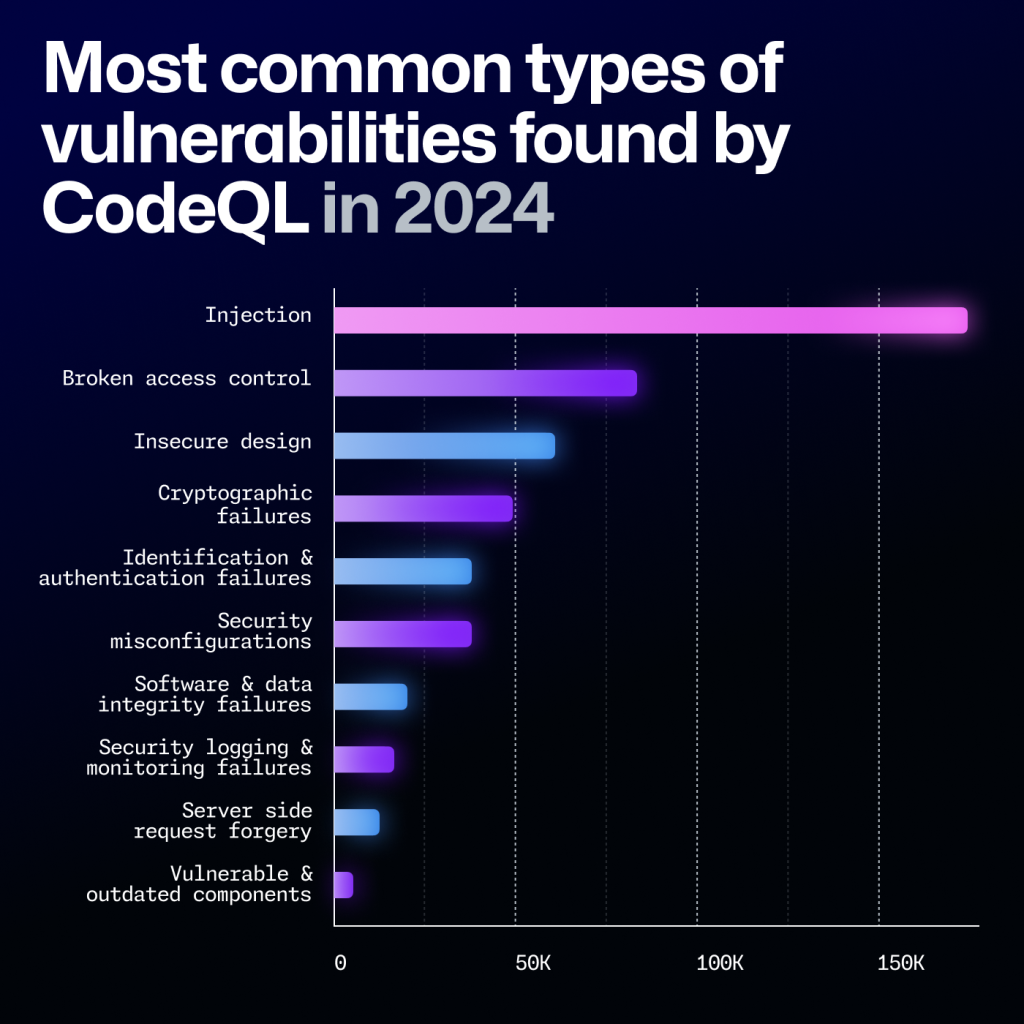
Developers are leaning on AI for code review and vulnerability remediation. The tools do not replace security experts but help address the global shortage of security professionals. Copilot Autofix, GitHub’s AI-powered security tool, automatically detects vulnerabilities, suggests fixes, and explains them in natural language. Early data shows meaningful time savings:
- Code vulnerabilities are fixed more than three times faster, reducing time-to-fix from 1.5 hours to 28 minutes for pull request-time alerts.
- Cross-site scripting vulnerabilities are fixed seven times faster, down to 22 minutes from nearly three hours.
- SQL injection vulnerabilities are fixed twelve times faster, with time-to-fix cut to 18 minutes from 3.7 hours.
Automation is also absorbing more security workload. Dependabot pull requests are being merged at a higher rate, and the gap between Dependabot-opened and developer-merged PRs keeps narrowing year over year.
Compliance is an area with room to grow. Government regulations increasingly require visibility into software supply chains, driving demand for automated governance tooling. The OpenSSF Scorecard is already widely adopted: 94% of the top 50 open-source projects use it to enforce security best practices. GitHub evaluated roughly 1 million repositories with OpenSSF Scorecards in place. The Scorecard action assesses repositories, runs security checks, and produces real-time feedback. For teams getting started, GitHub security features like code scanning and secret scanning (free for open-source developers) and artifact attestations for supply chain provenance are useful first steps. Enterprise developers can also route compliance work through OSPOs, which are becoming central to navigating regulations across open-source dependencies.
GitHub Actions usage hit a record 10.54 billion total CPU minutes in 2024 across public and open-source projects, up nearly 30% from 7.3 billion in 2023. Marketplace growth followed, and popular actions spanned security (Gosec Security Checker), linting (Super-Linter, PHPLint), and code quality metrics. AI use cases are emerging in the marketplace as well, with actions like OpenCommit (AI-generated commit messages) and Replexica (AI-powered code translation).
“We get everything we need from the GitHub Actions marketplace to build and support our tailored CI/CD pipeline.” – Bjoern Bengelsdorf, Senior Software Engineer, Otto Group
| Check out the GitHub Marketplace and make your own GitHub Actions. |
Python takes the top language spot
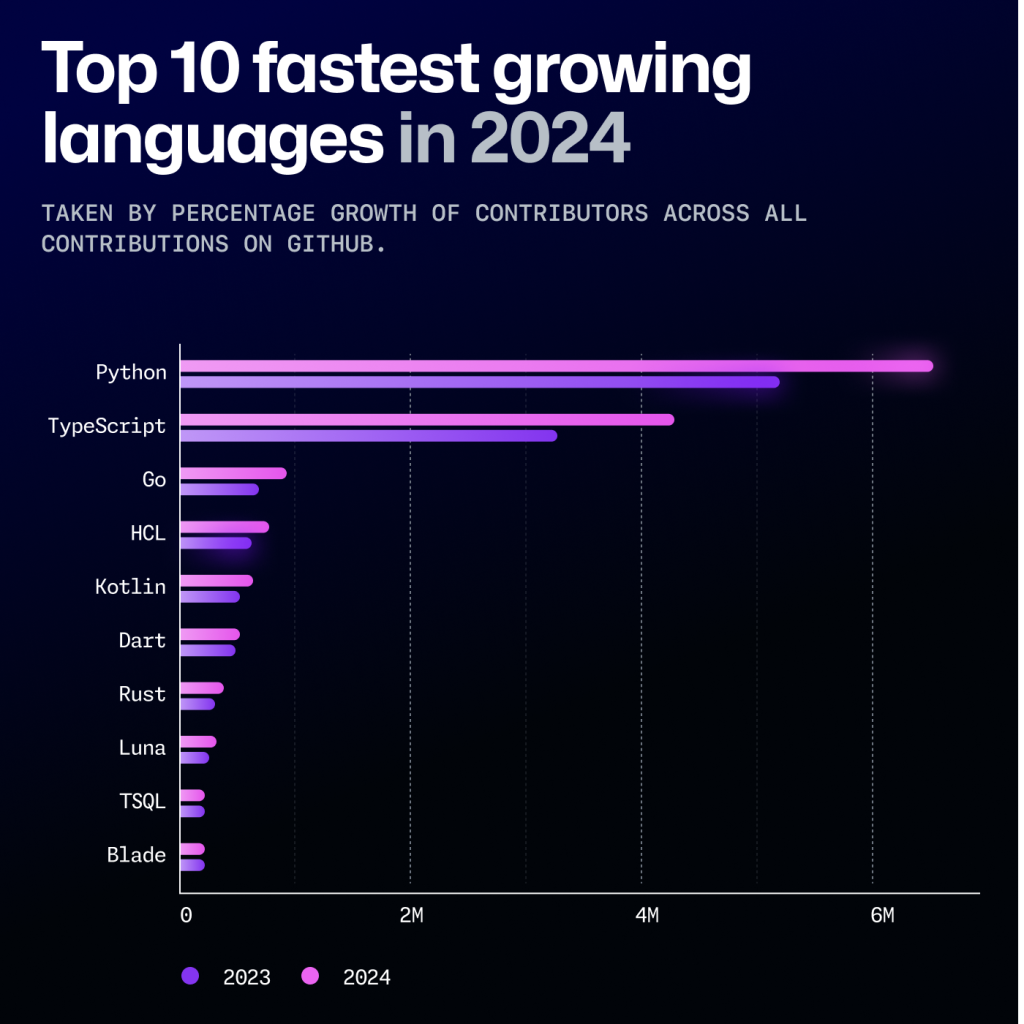
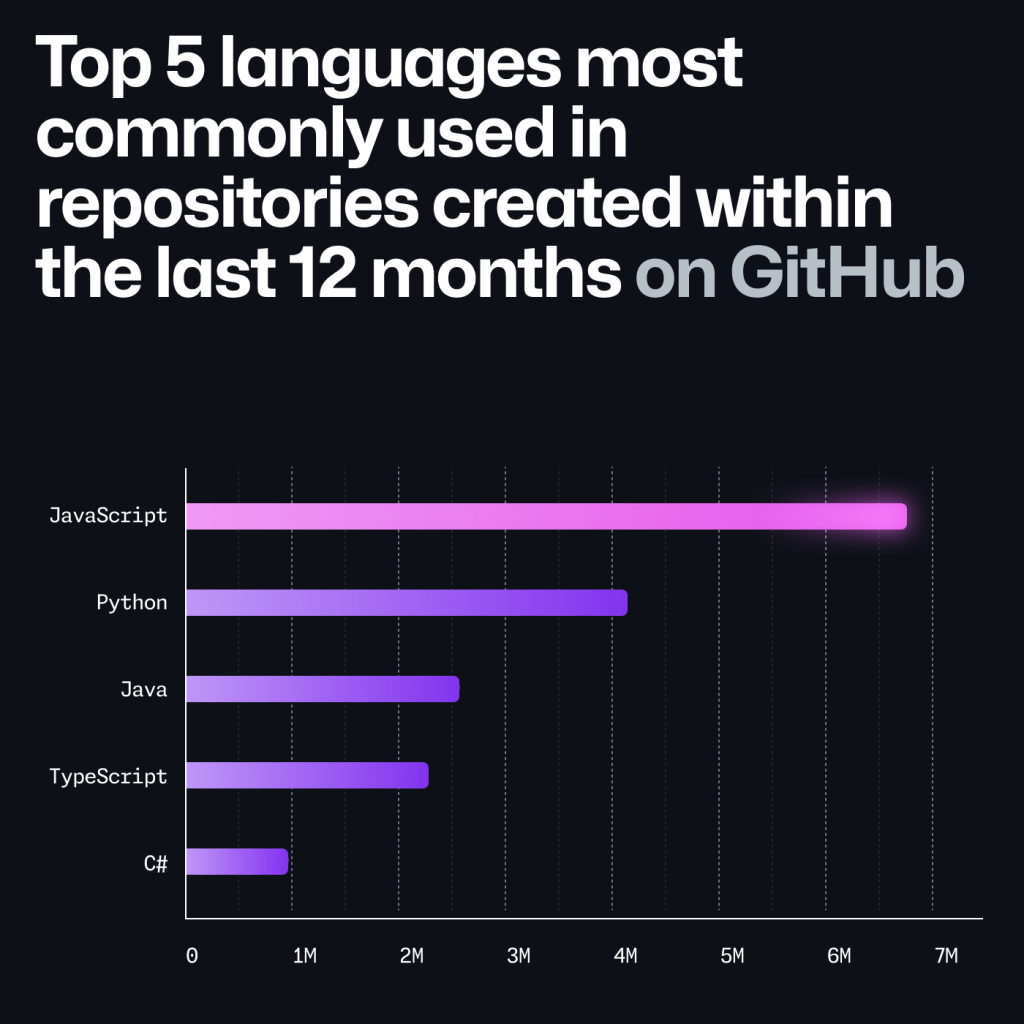
Python overtook JavaScript in 2024 to become the most used language on GitHub, ending JavaScript’s ten-year run at number one. It is the first change in the top two languages since 2019, driven by the generative AI boom of the past two years. The Python Software Foundation called the rise “especially coupled with the increased use of Jupyter Notebooks, data analysis, AI, and open source technology.” Shell also moved past C in 2024.

JavaScript still ranks first for code pushes alone. Python leads across all contribution types, aided by its role in data science and AI. The picture is more nuanced on the JavaScript side: TypeScript overtook Java last year to enter the top three, and its combined contributor growth with JavaScript outpaces Python’s. The data points to a gradual shift of the JavaScript community toward TypeScript as a superset and type checker, not a decline in activity. npm package consumption still grew 15% year over year.
- Python is the top language for data science and research, and its growth along with Jupyter Notebooks suggests GitHub activity extends beyond traditional software development into roles like data science and academia.
- T-SQL, a Microsoft SQL Server extension, also indicates significant activity from data scientists and database administrators.
- Rust continues to gain ground, adopted for safety and performance; Microsoft Windows uses it to rewrite core libraries in memory-safe code.

The rise of HCL and Go reflects growth in operations and infrastructure-as-code work around cloud-native systems. HCL grew 25% year over year, suggesting more developers use declarative languages to manage cloud deployments. Alongside increased Dockerfile usage, the trend shows teams bringing more standardization to cloud infrastructure.
| 🦀 Learn how Rust developers are making the web safer and why Rust is the most admired language among developers. |

What the 2024 data says about developers
The annual Octoverse report offers a broad look at how software development is evolving, and the 2024 edition covers October 1, 2023 through September 30, 2024. The headline: generative AI has moved from an experimental novelty to a standard part of the developer toolchain, and it is reshaping both who writes code and how they do it.
Three themes stand out from the data.
Generative AI is now a building block
Generative AI models have become core components in software development workflows. They power coding tools that explain vulnerabilities, suggest remediations, and generate code in response to natural language prompts. For developers at every experience level, these tools serve as both assistants and teachers.
More importantly, AI is altering how applications are architected. Developers increasingly need platforms that let them experiment with AI models as modular building blocks, without requiring separate infrastructure setups or incurring added costs. The shift suggests that familiarity with AI model APIs will be as fundamental to future development work as version control is today.
The developer community keeps expanding and diversifying
GitHub’s global contributor base is growing at a rapid pace, and newcomers are often starting their journey directly on the platform. That influx matters: a more diverse community brings a wider pool of perspectives and solutions to complex technical problems.
AI may be lowering the barriers to entry further. Simplified, personalized coding experiences backed by generative AI can make the learning curve less steep, encouraging participation from groups that were historically underrepresented. As access improves, expect the community itself to become more heterogeneous in background and skill.
The definition of “developer” is broadening
The rising prominence of languages such as Python, HCL (HashiCorp Configuration Language), and Jupyter Notebooks signals that coding is no longer the sole province of software engineers. Operations and IT professionals, machine learning researchers, and data scientists are all contributing code and collaborating on GitHub. The platform’s user base now reflects a broader technical workforce, not just traditional application developers.
How the numbers were compiled
This report draws on anonymized user and product data from GitHub collected from October 1, 2023 through September 30, 2024. Only public activity is included, and metrics for specific economies are only reported when at least 100 unique developers performed the relevant activity during the period.
For context on definitions used in the report:
- Contributions include commenting on commits, issues, pull requests, pull request diffs, or team discussions; creating gists, issues, pull requests, or team discussions; pushing commits to a repository; and reviewing pull requests.
- A contributor is a GitHub user who performed any of those activities.
- A developer is defined as anyone with a GitHub account, reflecting the increasingly wide range of people — from software developers to data analysts — who drive open source work.
- Generative AI projects were identified by searching for repositories tagged with topic strings sourced from a white paper authored by GitHub’s CEO with the firm Keystone.
- GitHub Classroom users are those who have logged into the classroom tool, a subset of the broader GitHub Education user group, which also includes students, teachers, and users affiliated with an educational organization.
More data is publicly available through the GitHub Innovation Graph, a research tool for those interested in the state of software development. A complete methodology is available on request from [email protected].


