
Rebuilding Groups Search Around Meaning, Not Just Keywords
Facebook Groups hosts an enormous volume of community-generated knowledge, but finding a specific answer inside those conversations has historically been hit-or-miss. The core problem: traditional lexical search only matches exact words, so a query like "small individual cakes with frosting" returns nothing when the community simply calls them "cupcakes." A person searching for an "Italian coffee drink" similarly misses relevant posts about cappuccinos because the word "coffee" never appears.
Meta has re-architected Group Scoped Search to close that gap. The new system, detailed in a technical paper, replaces pure keyword lookup with a hybrid retrieval architecture that runs sparse lexical and dense semantic pipelines in parallel, then ranks their combined results with a multi-objective model that targets three engagement signals at once. An automated LLM-based evaluation framework was added to validate relevance at scale without relying on slow human annotation.
Three Friction Points in Community Search
The redesign targets distinct failure modes people hit when searching Groups content: discovery, consumption, and validation.
Discovery failures are the most straightforward. Keyword systems cannot bridge the gap between natural language intent and community vocabulary. The result is zero returns for queries that clearly have good answers somewhere in the group.
Consumption is a second, subtler burden. Even when search surfaces the right thread, users face an "effort tax": scrolling through dozens of comments to piece together a consensus answer, such as assembling a watering schedule for snake plants from scattered advice.
Validation is the third issue. Before making a significant decision—say, buying a vintage Corvette on Marketplace—people want trusted community opinion about the product. That wisdom lives scattered across specialized group discussions, and manually digging through them to gather those signals is impractical.

The Hybrid Retrieval Stack
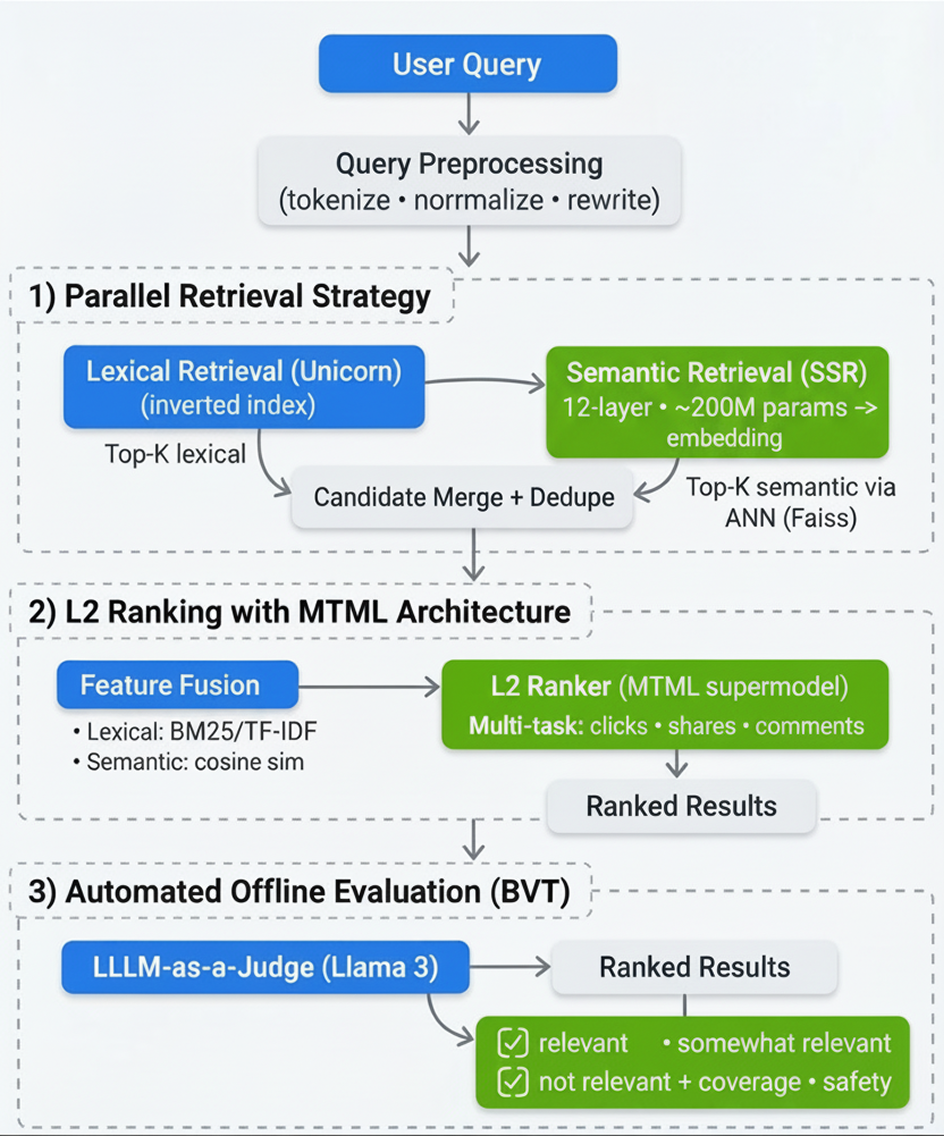
The modernized system, which powers a discussions module on Facebook Search, decouples query processing into two parallel retrieval pathways.
On the lexical side, queries are tokenized, normalized, and rewritten before hitting Facebook's Unicorn inverted index, which preserves high precision for proper nouns and exact phrases. In parallel, the same processed query goes to the search semantic retriever (SSR), a 12-layer, 200-million-parameter model that encodes natural language into a dense vector. An approximate nearest neighbor (ANN) search then runs over a precomputed Faiss index of group posts, pulling content by conceptual similarity even with zero keyword overlap. The two candidate sets are merged before ranking.
Ranking with a Multi-Task Model
Merging sparse lexical and dense semantic candidates requires a ranking stage that understands both. The L2 ranker ingests lexical features like TF-IDF and BM25 scores alongside semantic cosine similarity signals. Rather than a single-objective model, Meta adopted a multi-task multi-label (MTML) supermodel that jointly optimizes for clicks, shares, and comments. The design keeps objectives plug-and-play, letting the system weight these signals so surfaced results are not only relevant but likely to foster genuine community interaction.
Automated Offline Evaluation
High-dimensional similarity scores are hard for humans to validate intuitively, so Meta integrated automated evaluation into its build verification test (BVT) pipeline. Llama 3 with multimodal capabilities serves as an automated judge, grading search results against queries. The evaluation prompts avoid binary good/bad labels and instead recognize a "somewhat relevant" category: cases where query and result share a common domain even if they differ in specifics (different sports, for instance, still count as relevant in a general sports context). This lets the team measure improvements in conceptual matching and result diversity without a human labeling bottleneck.
Impact and the Road Ahead
Offline evaluations show the hybrid L2 Model + EBR system outperforming the keyword-only baseline on daily search engagement among Facebook users, with no increase in error rates. The combination of lexical precision and neural understanding is proving measurably superior to keyword-only retrieval.
That deployment is a milestone, but Meta's roadmap points deeper into LLM integration:
- LLMs in Ranking: Applying LLMs directly at the ranking stage to process post content during scoring, refining relevance beyond vector similarity.
- Adaptive Retrieval: Exploring LLM-driven strategies that adjust retrieval parameters dynamically based on query complexity.


