
Retrieval at Scale: The Problem Andromeda Tackles
Meta’s ads recommendation pipeline is a multi-stage system. Retrieval is the first gate: it must narrow tens of millions of eligible ad candidates down to a few thousand, which are then passed to larger ranking models that make the final ad selections. Two forces make this stage uniquely hard. First, the sheer volume: retrieval processes roughly a thousand times more ads than any downstream stage. That problem is compounded by automation tools — Advantage+ features like dynamic creative generation and audience expansion — which inflate the pool of eligible creatives. Second, retrieval operates under strict latency constraints. Ads must be selected fast enough to stay relevant for a live viewer, so near real-time updates to user interests and ad delivery require considerable model complexity that must still resolve quickly.
A Co-Designed System: New Hardware, New Model
Andromeda is Meta’s answer to these constraints: a retrieval engine built on the NVIDIA Grace Hopper Superchip and co-designed with the company’s own Meta Training and Inference Accelerator (MTIA) hardware. The goal was not a marginal gain but a step-function improvement in how many candidates the system can evaluate and how well it personalizes each request.
The underlying approach abandons the old architecture. Previous retrieval systems ran isolated model stages glued together with rule-based heuristics, which limited personalization and made global optimization difficult. The hardware profile was equally problematic: conventional retrieval models were memory bandwidth-intensive, had low hardware-level parallelism, and struggled to scale with the growing candidate volume.
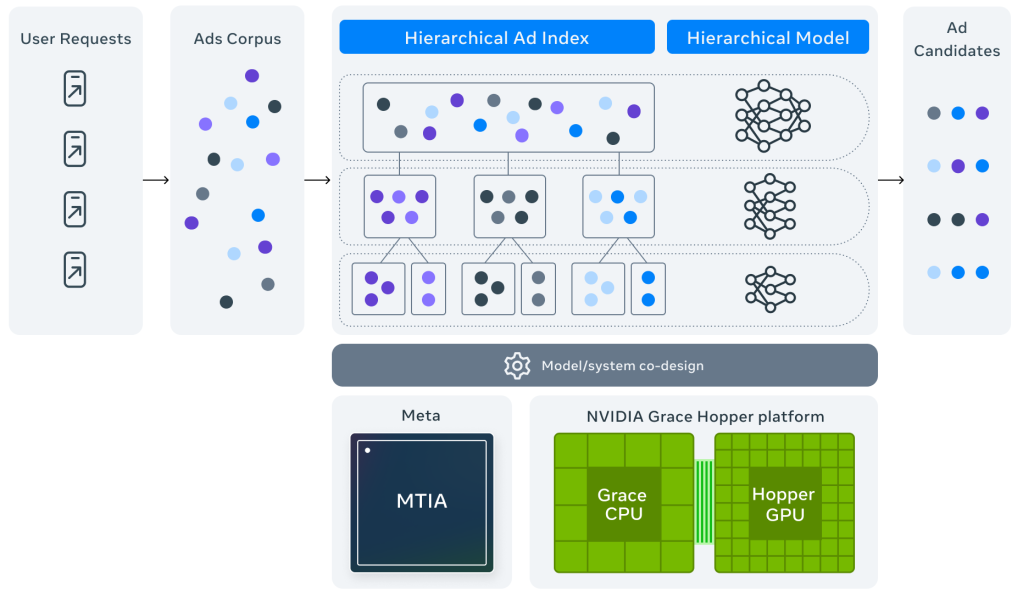
Andromeda replaces this with a custom deep neural network designed specifically for the Grace Hopper chip. The key breakthrough is a sublinear inference cost, allowing roughly a 10,000x increase in model capacity. The design eliminates the traditional bottleneck between CPU and GPU: feature extraction is handled with GPU preprocessing, and all precomputed ad embeddings live in the superchip’s local memory. This minimizes memory IO overhead and keeps the GPU well-utilized.
Hierarchical Indexing for Exploding Ad Volumes
A central innovation is how Andromeda organizes the ad corpus. Instead of scanning all candidates, it builds a multi-layer hierarchical index and jointly trains that index alongside the retrieval models. The network only focuses on the most relevant nodes at each layer, which cuts inference steps dramatically. The result is a system that can handle exponential growth in ad creatives — growth driven largely by adoption of generative AI tools within Advantage+.
The early numbers on that adoption trend are significant. Meta reports that more than a million advertisers used its GenAI tools to produce over 15 million ads in a single month. Andromeda’s hierarchy is built to absorb that scale, where a traditional two-tower neural network or approximate nearest neighbour search would come up short on both precision and recall.
Real-World Performance Gains
Andromeda is already live across Instagram and Facebook. The deployment shows a +6% recall improvement to the retrieval system and an +8% ads quality lift on selected segments. The overhauled inference path also delivers concrete efficiency wins:
- Feature extraction using the Hopper GPU’s massive parallelism reconstructs latent user-ad interaction signals on-the-fly. This yields over 100x improvement in both feature extraction latency and throughput against prior CPU-based components.
- Full end-to-end model inference queries per second (QPS) is up by over 3x.
- Model elasticity, which adjusts complexity in real-time based on segment value and available resources, contributes another 10x boost in inference efficiency.
Design Philosophy: Simplify, Then Optimize
Andromeda also reduces system overhead by minimizing the number of components and rule-based logic, enabling end-to-end optimization. This streamlines the path for future AI research and makes it easier to adjust capacity requirements. Higher-complexity models are reserved for high-value ad segments to protect return on infrastructure investment.
The GPU operators themselves are low-latency, high-throughput, and memory-IO aware. They use deep kernel fusion and advanced pipelining to cut down on kernel dispatch overhead and avoid repeated memory traffic between HBM and SRAM.
What Comes Next
Meta plans two near-term evolutions for the Andromeda architecture. First, a shift to an autoregressive loss function, which should enable faster inference and a more diverse set of ad candidates. Second, integration with MTIA and future commercial GPUs, which Meta expects to unlock another 1,000x increase in model complexity. Both are positioned to continue the push on retrieval scale while maintaining the latency and capacity budgets the ads system requires.


