
Adaptive Ranking: Meta’s Answer to the LLM-Scale Inference Trilemma
Meta’s push to scale its ads recommender models to LLM-level size and complexity has collided with what the engineering team describes as an “inference trilemma.” Juggling sub-second latency, global serving costs, and deep personalization creates a fundamental tension: more complex models typically demand more compute and memory, threatening both the user experience and the bottom line. The company’s solution, the Meta Adaptive Ranking Model, is a production system that bends the inference scaling curve by aligning model complexity with request context.
Rather than applying a monolithic model to every request, Adaptive Ranking uses intelligent routing to serve each ad call with the most efficient model that still meets quality targets. The result is a dynamic trade-off that keeps the platform’s strict latency constraints while delivering richer personalization. After launching on Instagram in Q4 2025, the system reports a +3% increase in ad conversions and a +5% lift in click-through rate for targeted users.
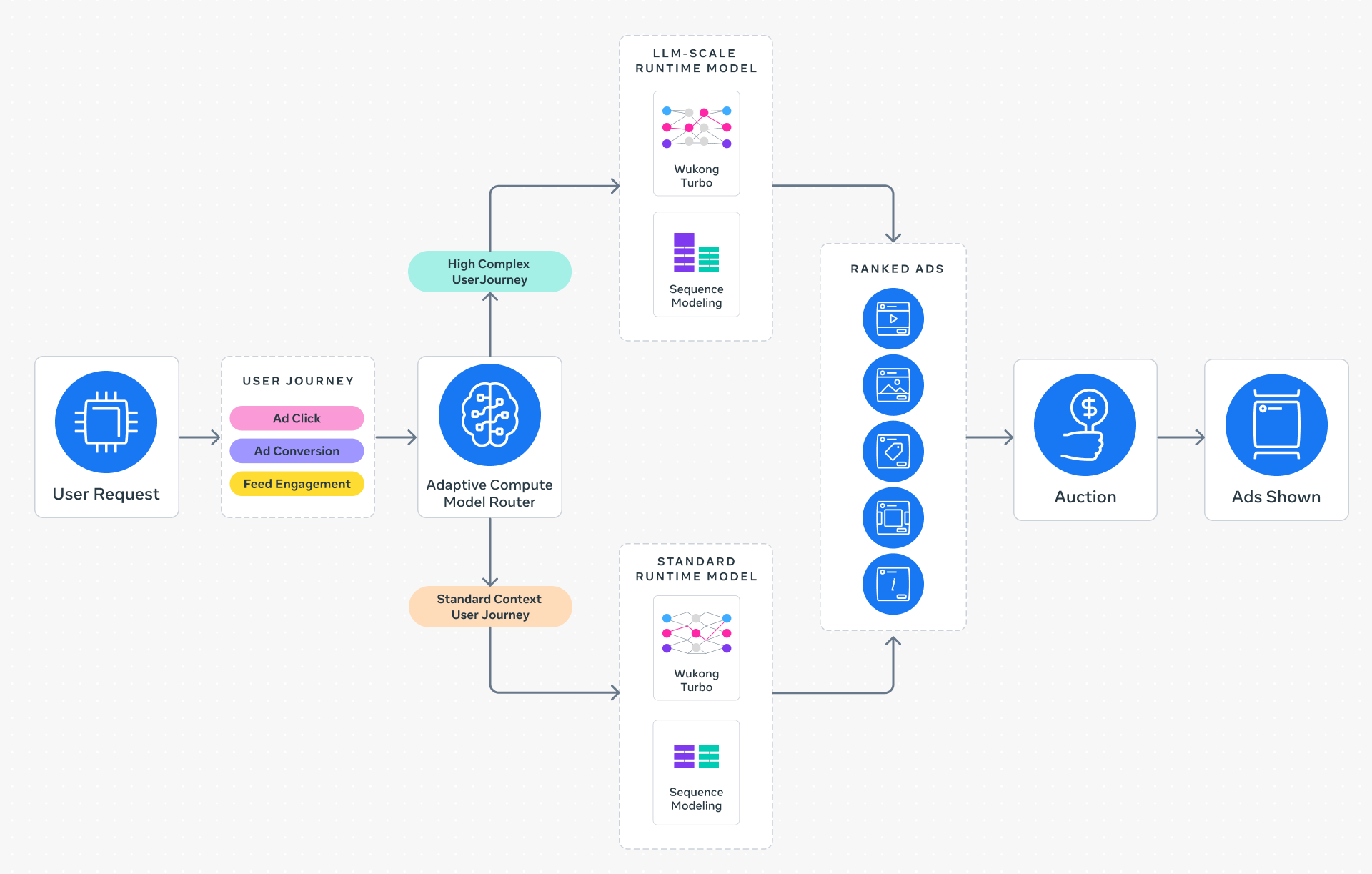
Reshaping the Serving Stack
Breaking the complexity/efficiency deadlock required a fundamental rethink of the inference pipeline, not just larger models. Three core innovations carry the load.
- Inference-efficient model scaling: A shift to a request-centric compute flow allows the serving of an LLM-scale model O(10 GFLOPs per token) at a fraction of standard LLM inference cost, holding latency to an O(100 ms)-bounded budget.
- Model-system co-design: Hardware-aware architectures tuned to underlying silicon constraints raise Model FLOPs Utilization (MFU) to 35% across heterogeneous hardware types.
- Multi-card serving infrastructure: Distributing embedding tables across an optimized multi-GPU cluster breaks single-device memory limits, enabling O(1T) parameter-scale models for a deeper understanding of user intent.
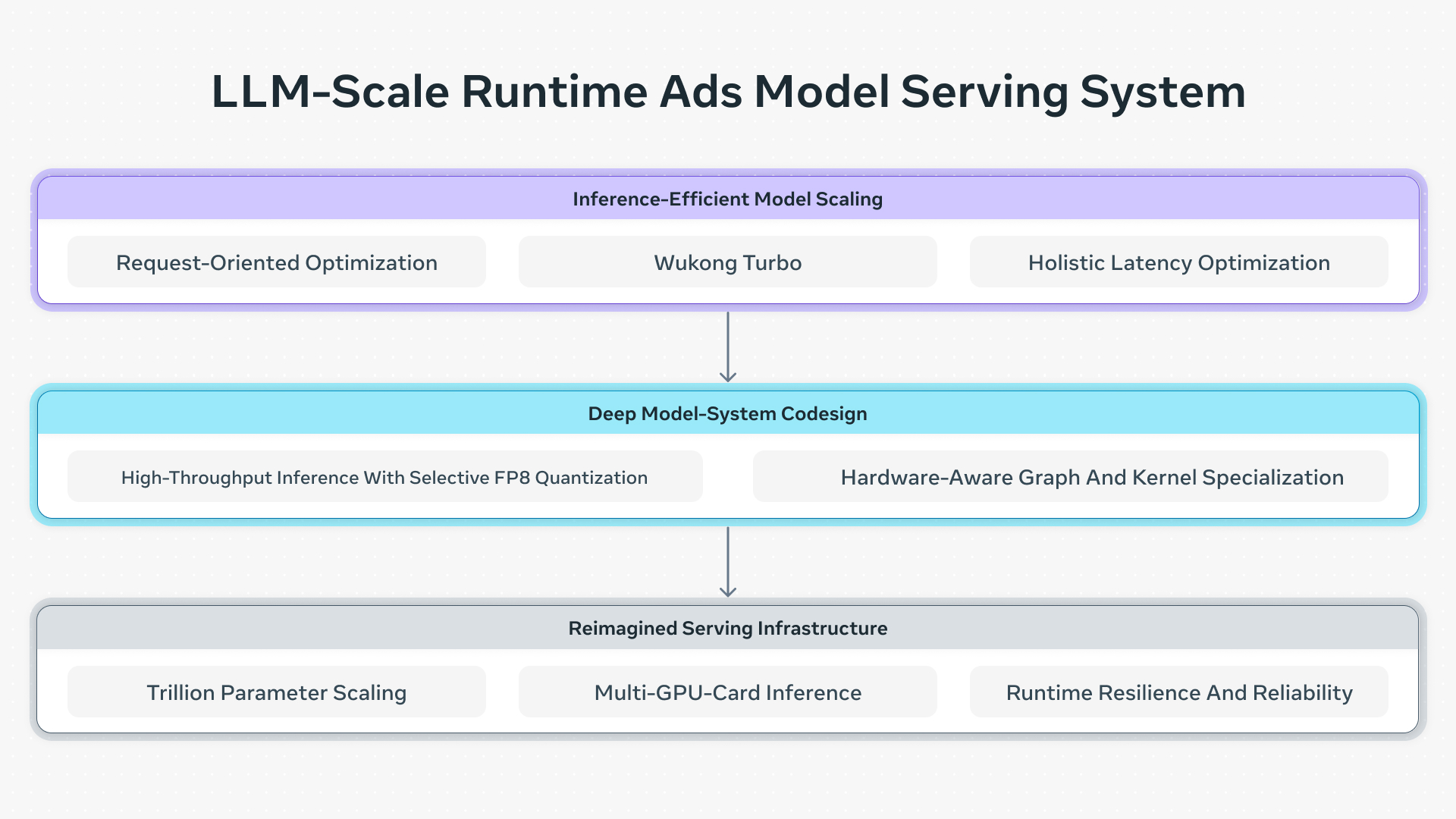
Cutting Compute and Memory Waste
The path to sub-linear scaling starts with the foundational compute pattern. Traditional ranking models score each user-ad pair independently, a highly parallel process that generates enormous redundancy at LLM scale. Adaptive Ranking instead adopts Request-Oriented Computation Sharing, computing dense user signals once per request and reusing them across all ad candidates directly inside the GPU kernel. This removes redundant embedding lookups and alleviates memory bandwidth pressure.
Request-Oriented Sequence Scaling applies the same logic to long-form user behavior sequences—previously off-limits due to compute and storage costs. The system processes heavy sequences once per request and shares results across all candidates. Storage is also optimized by replacing replicated data logs with a centralized key-value store that streams user history into training on demand.
Runtime Refinements in Wukong Turbo
Deep model stability is a separate bottleneck that emerges beyond a certain scale. The runtime evolution of Meta’s Wukong architecture—known for stackable factorization machines, sequence learning, and cross-layer attention—adds targeted fixes to keep the system numerically stable and efficient. A No-Bias layout removes unstable terms that can spike during training, boosting throughput without inflated FLOPs or parameter counts. Small Parameter Delegation shunts a subset of parameters from Fully Sharded Data Parallel (FSDP) to Distributed Data Parallel (DDP), reducing communication overhead, while sparsity-based simplification trims redundant linear-layer components. These refinements allow the model to grow in complexity without blowing up the sub-second inference budget.
Offloading Preprocessing to GPU Hosts
The last mile of inference speed comes from fixing the feature preprocessing pipeline. Execution had been constrained by client CPU work, which caused GPU data starvation. Adaptive Ranking moves preprocessing to remote GPU hosts, adopting compact tuple-based formats and GPU kernels that drop Top-K complexity from O(N log N) to O(N). Optimized data compression and a streamlined client flow also eliminate thread-pool contention. Together, they nullify the latency penalty typically associated with LLM-scale models.
Precision and Graph Alignment
Maximizing FLOPs utilization on modern accelerators requires co-designing the model and the execution layer. Meta takes two distinct steps to extract more from every GPU cycle.
First, the system deploys a selective FP8 quantization strategy. Blanket low-precision quantization risks degrading ranking precision, so the engineers built a micro-benchmark-guided selection mechanism that applies FP8 only to layers with high tolerance for precision loss. This reaps the throughput advantages of efficient data formats while leaving model quality essentially unchanged.
Second, Adaptive Ranking specializes the computation graph to the hardware. Operators that share inputs are fused to shrink round-trips between high-bandwidth memory and on-chip SRAM. Thousands of small operations are folded into denser compute kernels via Grouped General Matrix Multiply and horizontal fusion, reducing the memory footprint and raising effective utilization. Complex models then translate more directly into better ranking—not just longer pipelines.
Terabyte-Scale Reasoning
Recommendation models rely on sparse, categorical features mapped to high-dimensional embeddings. Sizing those tables is a delicate balance: too large causes overfitting, too small degrades model quality with hash collisions. Adaptive Ranking’s answer is memory-conscious allocation, pruning unused embeddings and sizing hashes to feature sparsity. Unified embeddings bundle multiple features into shared tables, cutting memory demand while preserving the capacity for intricate feature interactions.
When terabyte-level tables exceed the physical limits of even the largest GPU, a multi-card sharding mechanism breaks embeddings into segments spread across an optimized cluster. Hardware-specific communication optimizations keep cross-shard exchange fast enough to match single-card throughput, meaning model complexity is no longer capped by the capacity of one device.
Production reliability for trillion-parameter models also demanded attention to restart and healing times. Accelerated model loading with multi-stream downloading and remote caching now brings the system up in under 10 minutes, easing deployment pressure. Dynamic auto-scaling rules based on streaming multiprocessor utilization let the platform adapt to traffic spikes in real time, avoiding over-provisioned, costly capacity while maintaining stability.
By treating latency, memory, and hardware rhythm as first-class design constraints, Meta has shown that LLM-scale reasoning is attainable in near-real-time products. The approach hinges on reducing redundant operations and aligning every layer of the stack, from model precision to GPU scheduling, with the priorities of a global service.
Beyond the First Launch: Building a Self-Optimizing Ranking Infrastructure
With the Adaptive Ranking Model live on Instagram, the focus now shifts from a single deployment to a broader platform strategy. The goal is to change the fundamental relationship between inference performance and compute cost across Meta's recommendation systems. Rather than relying on a series of one-off engineering efforts, the roadmap calls for infrastructure that can automatically respond to changing user behavior and hardware conditions at global scale.
The initial phase of this work centers on making inference scaling more efficient so that models can grow deeper and incorporate longer user behavioral sequences. This requires a departure from traditional execution methods. To keep these increasingly complex models viable, Meta is developing new approaches to model compression and ultra-low precision quantization. The intent is to let state-of-the-art LLM-scale architectures run effectively across the heterogeneous hardware fleet Meta operates worldwide.
A significant portion of the future work involves removing the manual bottleneck of kernel optimization. Meta is investigating agentic optimization frameworks that can automatically tune performance for new model architectures and hardware as they are introduced. The aim is to automate the low-level engineering that currently slows down the deployment of new AI capabilities, ensuring that performance gains keep pace with model innovation without requiring constant human intervention.
The final piece of the roadmap targets model freshness. Traditional retraining cycles introduce latency between user activity and model updates. Meta is working toward near-instantaneous learning via incremental, in-place weight updates. This would enable the model to adapt in real time to shifts in user intent and demand patterns. Taken together, these initiatives are designed to keep the Adaptive Ranking Model relevant for both user experience and advertiser return on ad spend as Meta's ecosystem continues to evolve.
Acknowledgements
The authors thank the many contributors across Meta involved in the research, development, and production engineering of the LLM-scale runtime model for ads recommendation. This work reflects the collaboration of Jia Jiunn Ang, Ao Cai, Pan Chen, Wenlin Chen, Maomao Ding, Chengze Fan, Lu Fang, Birmingham Guan, Qin Huang, Daniel Molina Hurtado, Santanu Kolay, Ashwin Kumar, Boda Li, Huayu Li, Jiawei Li, Li Li (Ads Ranking), Liyuan Li, Mingda Li, Wenyuan Li, Rocky Liu, Jason Lu, Robert Luo, Yinbin Ma, Anna Mcburney, Sandeep Pandey, Uladzimir Pashkevich, Varna Puvvada, Pranav Sharma, Zijian Shen, Vibha Sinha, Matt Steiner, Chonglin Sun, Weiman Sun, Aaron (Li Bo) Tao, Bina Thakkar, Xiaohan Wei, Nathan Yan, Yantao Yao, Hongtao Yu, Li Yu, Sihan Zeng, Buyun Zhang, Bill Zhao, Alex Zhong, Zhehui Zhou, and the broader V-team.


