

One assistant, many tools: GitHub Copilot Extensions
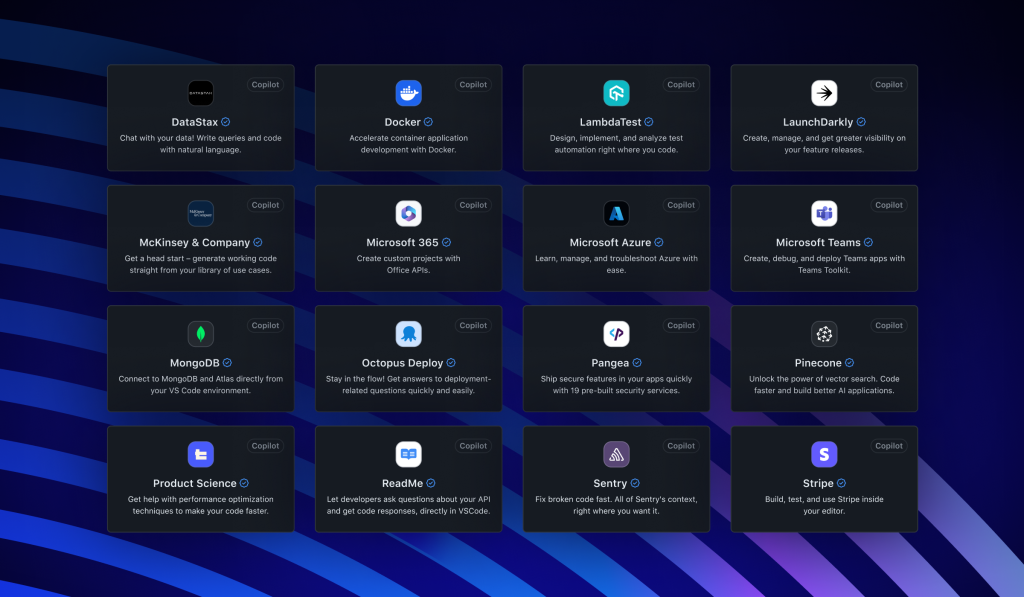
GitHub is opening Copilot Chat to third-party extensions, letting developers pull data, run actions, and drive deployments from their preferred services without leaving the editor. The initial partner lineup spans DataStax, Docker, LambdaTest, LaunchDarkly, McKinsey & Company, Microsoft Azure and Teams, MongoDB, Octopus Deploy, Pangea, Pinecone, Product Science, ReadMe, Sentry, and Stripe. Copilot Extensions are supported in Copilot Chat on GitHub.com, Visual Studio, and VS Code.
Public extensions will be listed on the GitHub Marketplace, but organizations can also build private Copilot Extensions for their own tooling—turning an internal API library or a custom monitoring system into a conversational interface.
From incident to deploy without switching windows
The intended use case is incident response. A developer paged for a database-related error typically moves between a GitHub issue, audit logs in DataStax, error monitoring in Sentry, and finally a deployment pipeline—each tool a separate context switch. With Copilot Extensions, that whole loop stays inside Copilot Chat: gather context, perform actions, generate files and pull requests, and deploy to Azure in natural language.
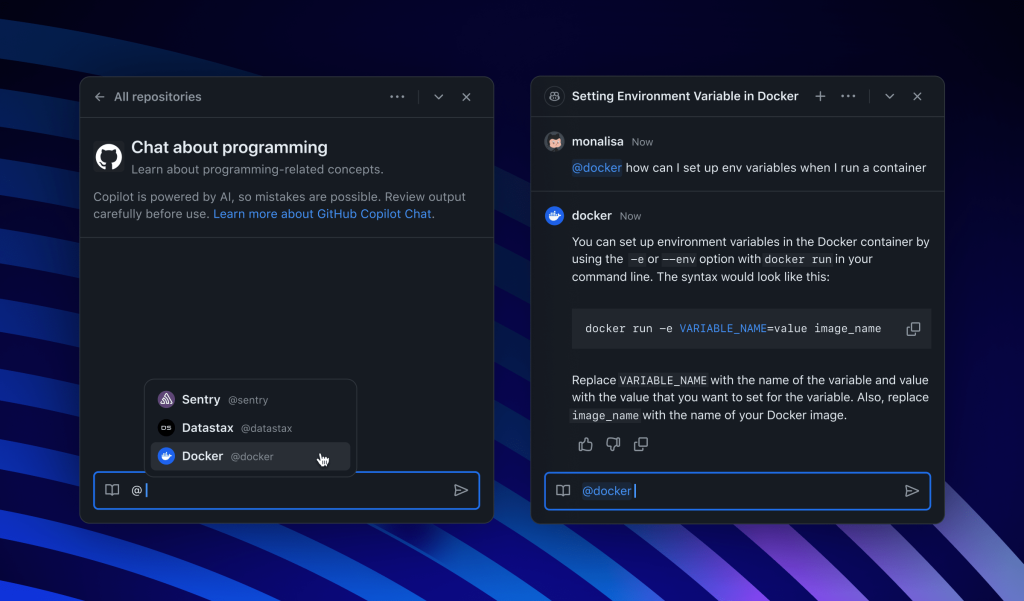
Partner extensions demonstrate the range. The DataStax extension lets developers interact with databases and build applications with AstraDB. Octopus Deploy's extension surfaces deployment status directly in chat. Sentry's extension accepts natural-language commands to resolve pipeline issues. LaunchDarkly's offering pulls documentation and best practices into the coding flow.
"This is the future of software development, where developers spend less time searching and more time building. Working in natural language, they can write code, retrieve data, and solve problems, all using a single intuitive workflow," said Tillman Elser, Engineering Manager at Sentry.
"The LaunchDarkly extension for GitHub Copilot integrates directly where teams are already building software. With it, developers can access documentation and best practices, right alongside their code. Minimize context switching, maintain flow state, and accelerate software delivery—all from one place," said Cody De Arkland, Product Incubation, LaunchDarkly.
Copilot for Azure previews at the edge of the ecosystem
Microsoft's own extension, GitHub Copilot for Azure, carries the deepest integration. Developers can ask architectural questions in chat—choosing an Azure service, running a React app, selecting a database for Django—and get guided deployment steps when ready to launch. Access to the preview is limited and managed through Microsoft directly; sign-up is available via the preview page.
Availability and rollout
The launch is staggered. Invited users initially get access to extensions from DataStax, Docker, LambdaTest, LaunchDarkly, McKinsey & Company, Octopus Deploy, Pangea, Pinecone, Product Science, ReadMe, Sentry, and Teams Toolkit on the GitHub Marketplace. Extensions from Stripe, MongoDB, and Microsoft—including Teams Toolkit and Microsoft 365—follow in the coming weeks on the Visual Studio Marketplace for VS Code.
Ecosystem strategy
The extension framework is part of a broader push to turn Copilot into a hub for the entire developer toolchain. Hundreds of partners have already registered for the Copilot Partner Program, and GitHub is positioning the platform as a way to lower the barrier to software creation—with natural language as the interface. For organizations, the option to build private extensions means internal knowledge and proprietary tools can live in the same chat surface as public ones. The stated endgame is an intelligent assistant that connects any tool in the stack, in natural language, from anywhere code is written.