Building Ebb: Headspace’s approach to an AI mental health companion
Headspace, the mental health app with over 105 million downloads, recently introduced Ebb, an AI companion designed to support reflective practice between therapy sessions. With many users turning to general-purpose AI chatbots for emotional support, the company identified a need for a tool that was clinically grounded and built specifically for mental health contexts. For the product and brand teams behind Ebb, that meant prioritizing safety, transparency, and a deliberate design process from the outset.
Navigating internal skepticism
The project faced significant internal hurdles before reaching users. Priyanka Marawar, Product Design Manager and UX Design Lead on Ebb, noted that people hold “polarized views on AI, especially in the context of mental health.” Even Lauren Allik, Headspace’s Lead Brand Designer, admitted to feeling “a little uncomfy” when she first received the brief.
To align the team around a shared vision, Marawar hosted early workshops in FigJam. This foundational phase was crucial, she says: “We could build those deeper connections between member and business objectives because we took that moment to clearly define what we were building in terms of the end-to-end experience, and why.” The team positioned Ebb not as a replacement for human care, but as supplementary support—an option for those who cannot afford therapy or are hesitant to seek it.
Naming and visual identity
After the workshops, cross-functional teams ran “playgrounds” in FigJam to explore what a Headspace AI companion might feel like. Illustrators, designers, copywriters, and animators each explored independently before converging.
Lead UX Copywriter Crystal Small and Senior Copywriter Sandy Sanchez deliberately avoided feminine names, which they felt would reinforce stereotypes about women as caretakers and dissuade men from engaging with mental health tools. “We ultimately decided that the name should be a friendly entity, not quite human but human-adjacent, and not of any specific gender,” says Crystal. When Sandy proposed “Ebb,” it was a “lightning-strike moment”—the name felt approachable and reflected the fluidity of emotions.
The brand team tested roughly six visual identities under Headspace’s “build-to-learn” philosophy. Creative Director Dani Balenson explains that her team used Figma to “quickly skin those screens with different identities,” with product and brand teams sharing screens back and forth. Ebb emerged as “a friendly blob,” personified to help members feel comfortable returning to the tool over time. The character deliberately avoids being too smiley, since members may arrive with heavy emotions. Gradients across the identity were chosen to “speak to a range of changing feelings and create a soothing environment,” says Balenson.
Transparency as a design principle
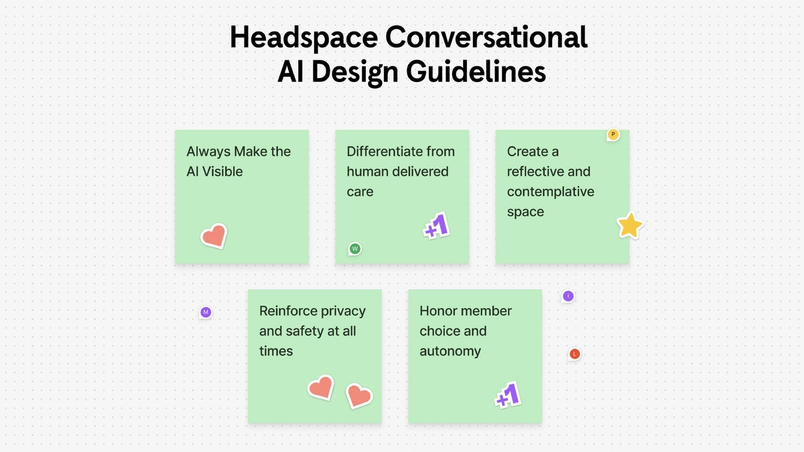
Ebb’s training included input from clinical psychologists, giving it robust scientific foundations. But design questions remained. Marawar saw challenges around helping members feel safe and understand what they were interacting with. Former Lead Product Designer Leah Braunstein designed the conversational interface to give users agency to exit or delete a conversation at any time.
A core principle was making the AI visible. “We didn’t want AI to be invisible,” says Marawar. “We wanted a member to know they were interacting with AI, not a human.” This transparency extended to the motion design, which drew inspiration from lava lamps to capture the “idea that your emotions can ebb and flow.”
Testing and iteration
The team used Figma prototyping from the earliest stages to gather feedback on positioning, naming, visual identity, discoverability, and conversational interface design. User testing confirmed that members understood they were interacting with AI and not a human, while also highlighting Headspace’s clinical expertise and privacy stance.
To evaluate how Ebb might fit into daily routines, users received access to the feature for a week. Feedback was collected through the research platform Dscout. “Figma and Dscout are the solid tools we keep going back to,” says Marawar. “That’s the pairing for us.”
During refinement, the team used the Mirror view in Figma’s mobile app to QA brand assets. “You can really take yourself into the mind of a member,” explains Allik. For Balenson, Figma was invaluable given the team’s remote distribution: “The best way for me to leave feedback, to play in the files, and ‘show not tell’ is to use Figma.”
Consistency at launch
As Ebb neared launch, consistency became the focus—particularly as this was Headspace’s first consumer-facing AI product. “We reviewed everything going out the door really closely, because that trust was so important and nuanced,” says Balenson. Copywriter Sandy Sanchez, responsible for copy across product screens, emails, and push notifications, relied on having “everything in one place” to stay consistent.
The brand team created a “story kit” in Figma—a toolkit containing all campaign assets, giving designers across the company “one source of truth” for content creation. When presenting to the wider company, the team used Figma Slides, which Balenson says allowed them to place prototypes directly into decks without losing motion elements.
Lessons from intentional design
For Marawar, “intentionality” is the project’s biggest takeaway. Despite the fast pace of AI development, she emphasizes that “there’s value in investing in research and user testing to help us build the right thing, and design with intention.” Ebb represents the culmination of that approach—extensive research, training, testing, and careful design resulting in a product that serves members while staying faithful to the Headspace brand.