
A Control Center for Parallel Agent Work
The agentic shift in software development has accelerated delivery but also introduced new friction: scattered context, heavy context switching, and opaque agent output that demands careful review. Developer tools were largely built for a single human driving a single task, not for directing multiple agents working in parallel. When agents run across different windows and workflows, it becomes difficult to track what is executing, what has been validated, and where your judgment is actually required.
At Microsoft Build, GitHub is unveiling the GitHub Copilot app, a desktop experience designed as a command center for this agent-native workflow. It is available in technical preview for Copilot Pro, Pro+, Business, and Enterprise users.
| Get started with the GitHub Copilot app today using your existing Copilot Pro, Pro+, Business, or Enterprise plan. Learn more > |
From a single My Work view, developers can monitor active sessions, issues, pull requests, and background automations across connected repositories. The system is designed to handle the scale of work that agentic workflows generate: commits on GitHub have nearly doubled year over year, crossing 1.4 billion per month, alongside over 2 billion GitHub Actions minutes per week.
Isolation Without the Branch Juggling
A core challenge of running multiple agents is preventing them from interfering with each other. The Copilot app addresses this by running every session in its own git worktree—a real, isolated copy of your branch. This setup happens automatically, eliminating manual configuration and cleanup. Whether you initiate work from a prompt or an issue in your inbox, Copilot pulls relevant context from existing issues, pull requests, and connected repositories.
Once an agent produces a pull request, the Agent Merge feature can carry it through the final stages. It monitors CI status, tracks required reviewers, and addresses failing checks, waiting until all conditions are satisfied before merging. You retain control over automation levels—choosing whether Copilot should drive CI back to green, incorporate feedback, or merge once your preconditions are met.
Canvases: From Chat to Inspectable Work
Chat interfaces excel at handling instruction and ambiguity, but they become unwieldy when an agent executes a complex task, producing a long stream of logs, decisions, and corrections. To bridge this gap, GitHub is introducing canvases in the Copilot app—bidirectional work surfaces that both humans and agents can interact with.
A canvas might display a plan, a pull request, a terminal session, or a deployment state. As agents work, they update the canvas; developers can edit, reorder, approve, or redirect that work in real time without sifting through a chat history. This represents the start of agent experience (AX) design in the Copilot app: chat for intention and discussion, canvas for visible, steerable execution.
This execution model benefits from cloud and local sandboxes, giving agents a bounded environment to run code, test, and iterate without touching production systems. Local sandboxing runs Copilot in an isolated environment on your own machine with restricted filesystem, network, and system access; policies for these sandboxes can be configured centrally. Cloud sandboxes provide a fully isolated, ephemeral Linux environment hosted by GitHub, which allows you to resume sessions from any device with remote control, subject to org-defined policies.
Code Review for the AI Era
As agentic workflows drive up pull request volume, review processes feel the strain. Copilot code review expands to handle this load with a new medium tier option, routing PRs to a higher-reasoning model for improved precision and recall. Repository admins can set guidelines per repo to either low or medium, reserving the more robust model for higher-impact code and using lighter, cost-efficient models for low-risk changes.
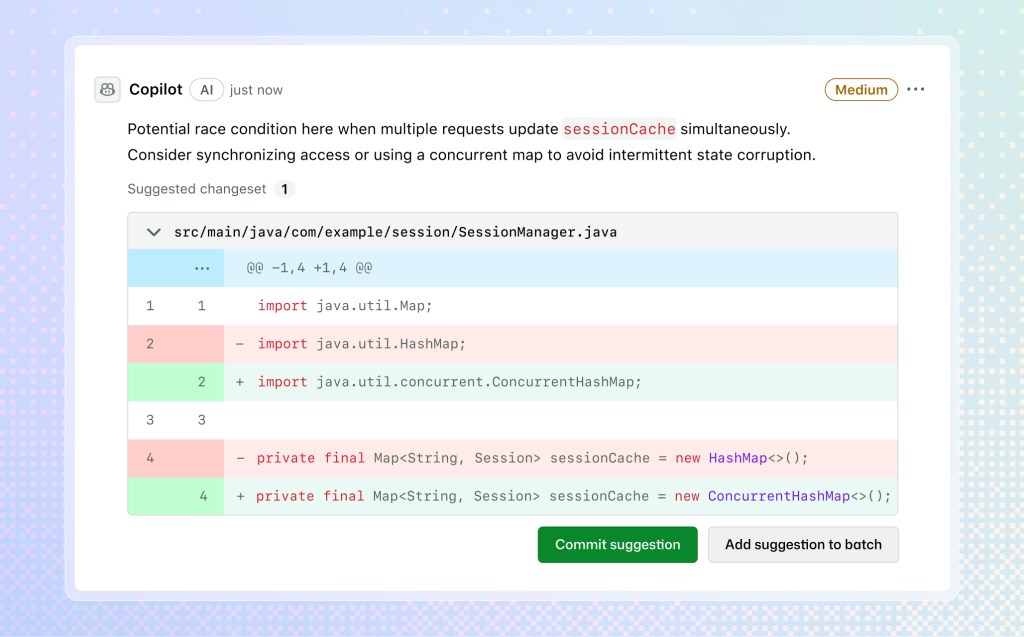
Beyond the base model, Copilot review is now extensible to fit your own standards and internal systems via custom agent skills, MCP server connections, and configurable actions workflows. A dedicated /security-review skill provides a focused path for security evaluation, while the /rubberduck skill is now generally available, using multiple model families to critique implementations and surface novel issues.
Code review is also expanding beyond GitHub.com; teams working in Azure DevOps can now use Copilot code review natively, with one-click review, inline comments, and committable fix suggestions.
One Runtime Across Surfaces
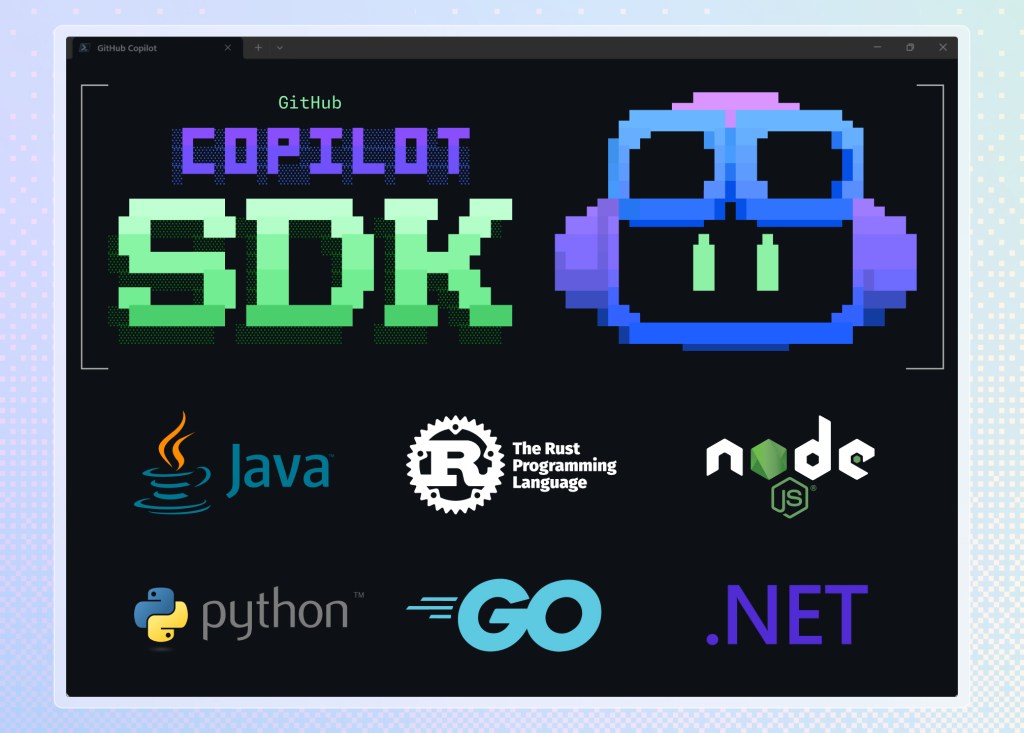
The agentic infrastructure that powers the Copilot app is available across multiple surfaces. The GitHub Copilot SDK is now generally available in Node.js/TypeScript, Python, Go, .NET, Rust, and Java, exposing the same agentic runtime to developers building custom tools—from internal code analyzers to release-note generators—so they don't have to wire together a bespoke agent stack.
For terminal-centric developers, Copilot CLI has been updated with a redesigned TUI in /experimental mode offering tabbed access to pull requests, issues, and gists. New voice mode uses on-device speech-to-text to keep audio local, and the /every command schedules recurring prompts. For cloud-based work, the Copilot cloud agent can now handle entire workflows—filing issues, starting discussions, and replying to reviewers—on a schedule or in response to GitHub events. By default, these agents ask permission before any write action, with an autopilot mode available once trust is established.
Continuity is enhanced with Memory++ and the /chronicle command, allowing Copilot to query context across sessions initiated in the app, CLI, VS Code, or on GitHub itself. Additionally, third-party agent apps from partners including LaunchDarkly, Amplitude, Sonar, PagerDuty, and Miro can be integrated directly into the workflow, assigning tasks to the agents that best fit each step.
## Building for a Durable Agentic Future
GitHub is positioning these launches as a unified system where agents do more of the work while human developers maintain authority over quality, policy, and delivery. The emphasis is on availability and reliability; with faster agentic adoption, the company states its focus remains on hardening the underlying systems to ensure a dependable experience.