A Social Layer for Video Discovery
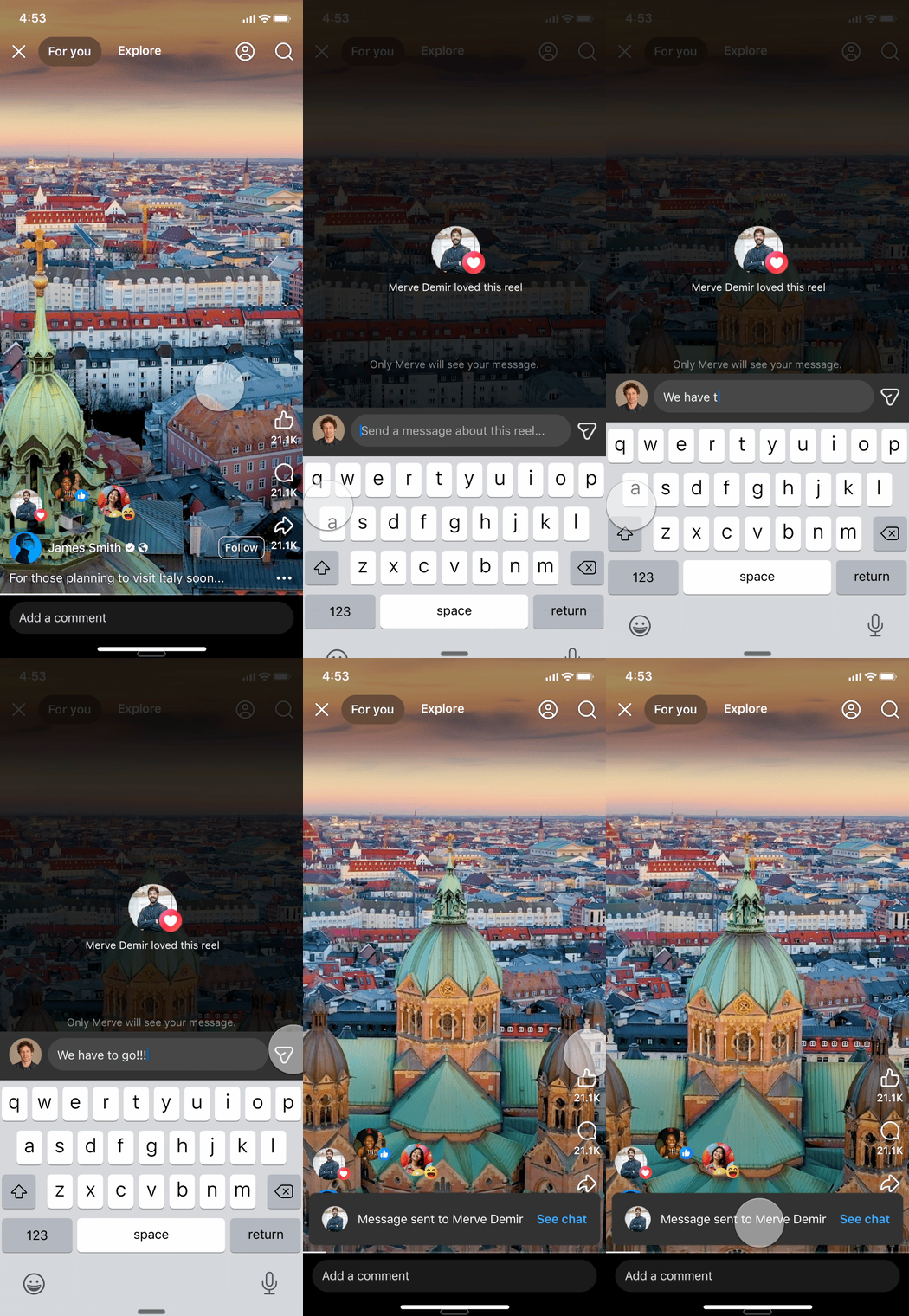
Facebook Reels' friend bubbles put a social veneer over video discovery: a bubble attached to a Reel signals that someone in your network has liked or reacted to it, and tapping it opens a direct conversation with that person. The feature pairs video recommendations with relationship signals so that content discovery becomes a shared experience rather than a solitary scroll.
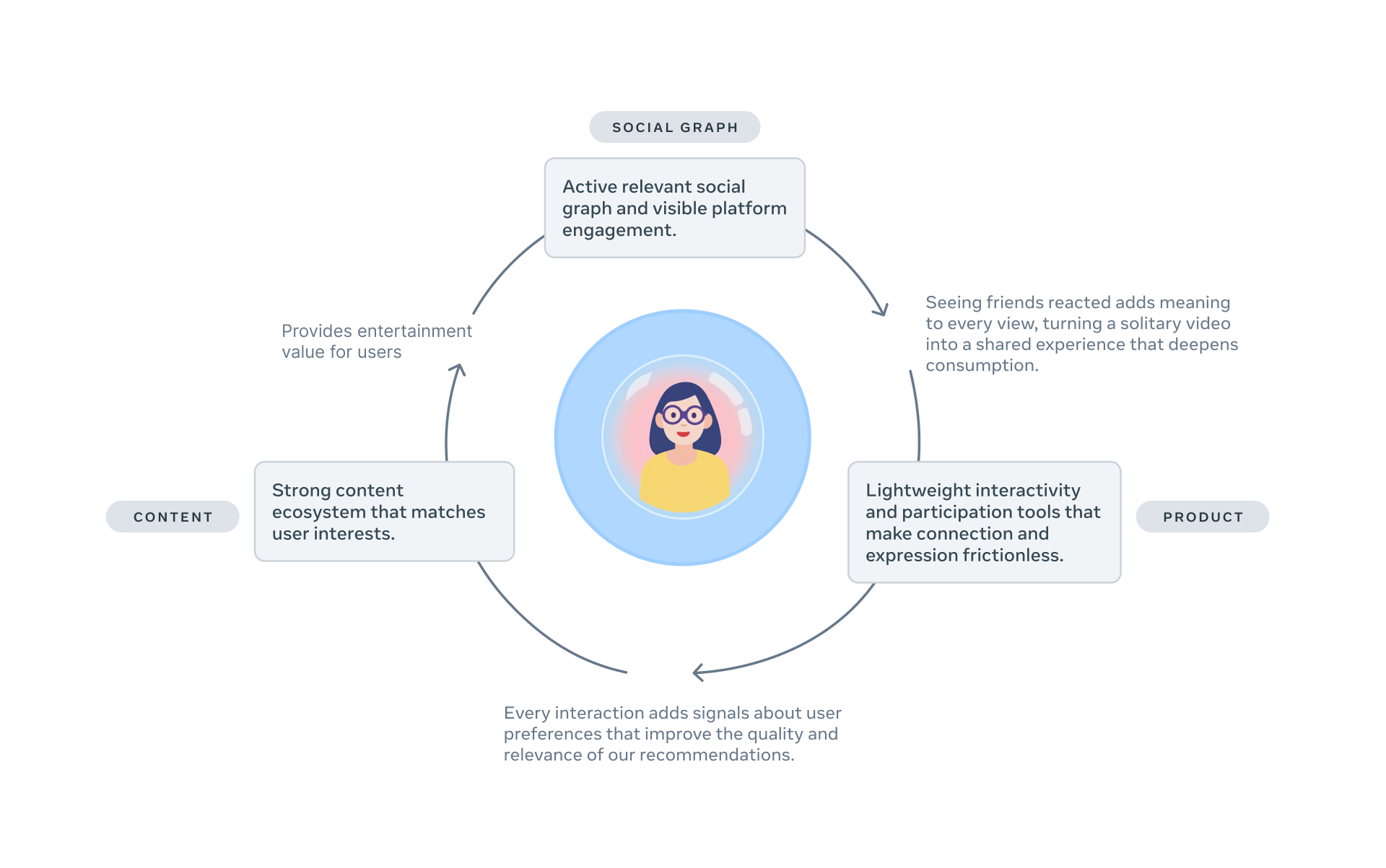
The underlying system brings together two strands of machine learning. One model estimates how close two people are on Facebook; another determines which videos are relevant to a viewer. Together, they determine which friend-interacted videos should surface, based on both the strength of the friendship and the quality of the content itself. Videos that sit at the intersection of personal interest and friend interest tend to perform well, creating a loop in which social discovery drives engagement, which in turn reinforces the social graph.
System Architecture at a Glance
Two core components make up the friend bubbles recommendation pipeline:
- Viewer-Friend Closeness: A model that weighs which friends' interactions are most relevant to a given viewer.
- Video Relevance: A ranking component that scores which friend-interacted videos are contextually appropriate.
Measuring Relationship Strength
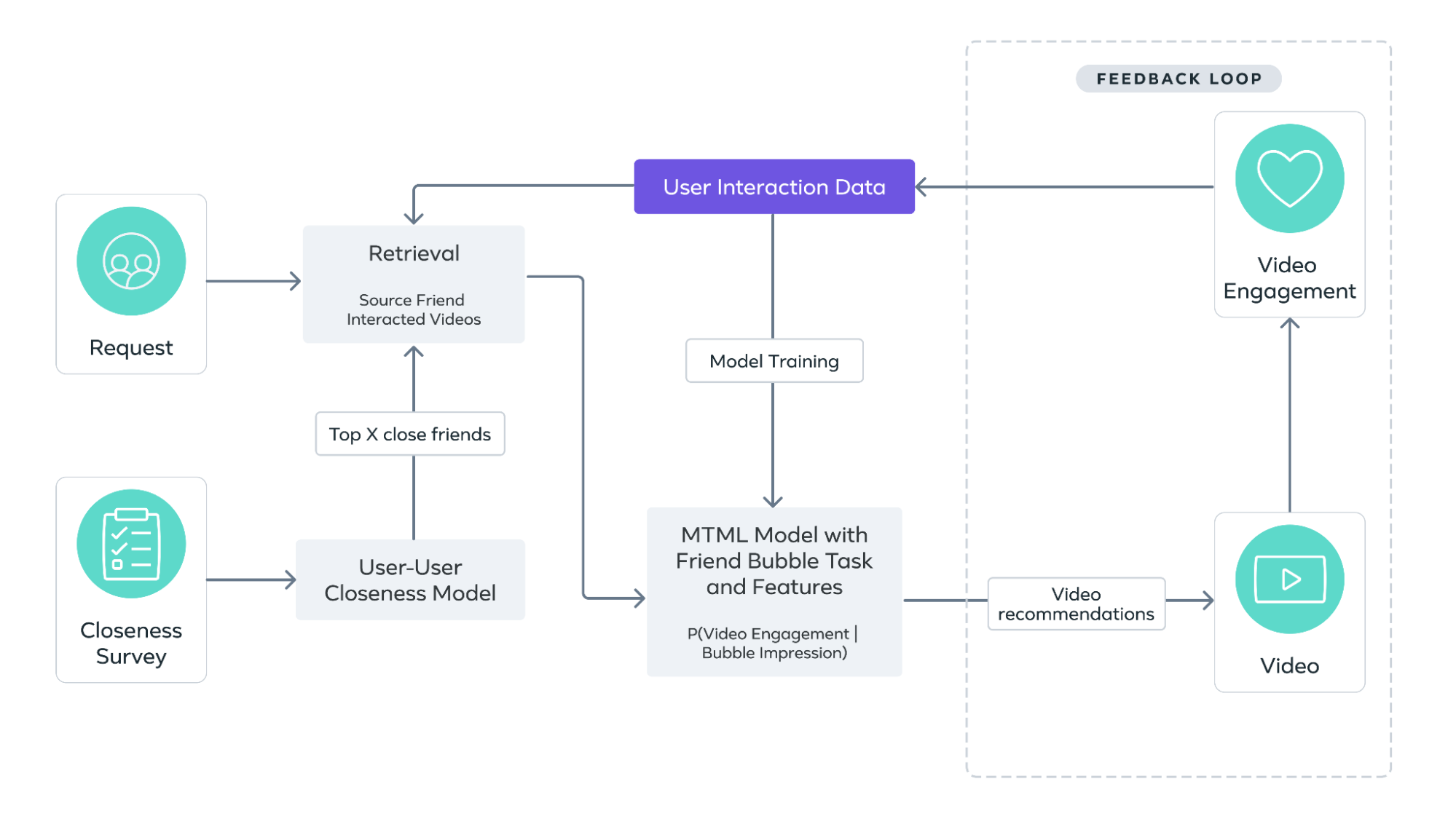
Friend bubbles draw on two complementary closeness models. One is trained on survey feedback; the other learns from in-app behavior.
The survey-based model uses a lightweight binary question — whether a user feels close to a specific connection in real life — asked of a random sample of Facebook users. Training signals include social-graph features such as mutual friends and interaction patterns, plus user attributes like location, friend count, and posting frequency. This model is refreshed on a regular cadence and runs weekly inference over trillions of person-to-person connections.
The second model is surface-specific. It is trained on real interactions that occur when bubbles are displayed, including likes, comments, and reshares. This gives it a more contextual view of closeness: how likely a viewer is to value content recommended by someone based on their actual engagement patterns on the platform.
The system favors connection quality over quantity. A larger friend graph naturally yields more bubble content, but the model shows that abundance does not guarantee better engagement. The goal is to surface only the relationships most likely to create meaningful social context.
Friend-Aware Video Ranking
Ranking friend-interacted content required two changes to the recommendation pipeline: sourcing enough of that content in the first place, and teaching existing ranking models to appreciate its value.
Expanding Candidate Retrieval
The retrieval stage explicitly sources videos that friends, as identified by the closeness model, have interacted with. This expansion of the top of the funnel is necessary because, without it, high-quality friend content never reaches downstream ranking stages — it is simply filtered out before it has a chance.
Adding Friend Context to Ranking Models
Early development revealed a key obstacle: friend-interacted videos were not ranking poorly because they were low quality, but because the ranking models lacked user-user closeness context. Without visibility into relationship strength, a model cannot learn that a video's relevance sometimes derives from social meaning rather than generic interest signals.
To correct this, friend-bubble interaction signals were added as features, and new tasks were introduced into both early-stage and late-stage multi-task, multi-label (MTML) ranking models. These additions let the models incorporate viewer-friend relationship strength and learn downstream engagement patterns for videos with social bubbles. Interaction data from friend-bubble displays flows back into model training, creating a continuous feedback loop that refines what the system learns about which friend-content pairings resonate.
The video-ranking formula, which already tuned for multiple optimization goals, was augmented with a friend-bubble ranking objective. This objective aims to maximize overall video engagement using interaction metrics like watch time, comments, and likes, alongside a conditional probability term, P(video engagement | bubble impression), that estimates the likelihood of engagement after a bubble impression. Tunable weights balance the trade-off between driving social interaction and delivering compelling standalone content.
Client-Side Performance Constraints
Reels is latency-sensitive, so adding per-video metadata was not a straightforward change. Three constraints governed the integration:
- Smooth scrolling
- No load latency regressions
- Minimal CPU overhead for metadata fetch and processing
Facebook's video delivery system prefetches metadata, thumbnails, and buffered content ahead of playback. Friend-bubble metadata retrieval was pinned to this existing prefetch window, enabling reuse of cached results, avoiding redundant CPU work, and eliminating wasted network requests. Because bubble data arrived with the video content, the UI could render both simultaneously, avoiding mid-playback updates and redraws.
Animation is strictly conditional: it is disabled during active scrolling to preserve responsiveness, and turned off entirely on low-end devices where even idle animation hurts performance. Bubbles only appear when the closeness model confirms a strong relationship signal, keeping the interface clean and the experience fast.
Impact and Results
User feedback surveys show that bubble-annotated videos receive higher interest scores and more positive sentiment ratings than videos without bubbles. The feature also improves session quality: users who see bubbles spend more time actively watching and engaging, with growth concentrated in longer sessions. Bubble-related signals show a delayed effect on longer-term engagement, suggesting that repeated exposure to friend-endorsed content builds sustained interest.
Friend bubbles also introduce users to a wider range of topics and creators than they would find on their own. This content drives active engagement — likes, comments, shares, and follows — even when it falls outside a user's typical interests.
Not all friend signals carry equal weight. Expressive reactions like love or laughter drive stronger downstream engagement than simple likes, especially for comments and private shares. Videos with multiple friend interactions also perform better, with engagement scaling consistently with the number of bubbles shown.
Next steps for the system include expanding friend-driven recommendations to additional surfaces, improving cold-start handling for users with limited friend graphs, and refining ranking signals for more precise personalization.